This question can be taken two ways:
a) Does the rigidity of spiral tubing impede one's ability to easily focus anywhere in a 3D range of motion?
or
b) Does the intrinsic flexibility of the spiral tubing cause problems or movements when attempting to focus precisely?
A hybrid answer to both rephrased questions:
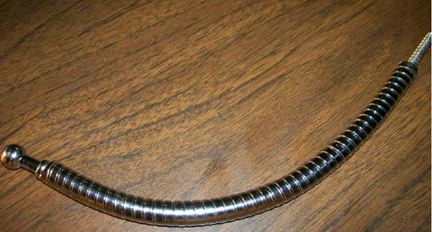
The primary reason for attaching a semi-rigid spiral tubing is to allow for larger (up to 3 inches) but more likely very small and incremental manual adjustments when required.
These inevitable last minute microscopic modifications, performed by simply tapping the tubing in any desired x, y, or z direction, for example, can actually be performed much quicker compared to raising and lowering the tripod arm.
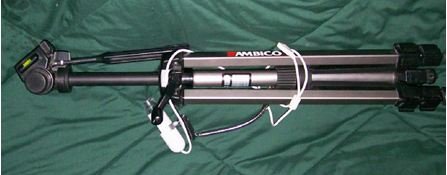
Mounting the USB microscope 'directly' and 'rigidly' to the shaft of the tripod, on the other hand, severely restricts or even eliminates the possibility of implementing this jury rigged procedure consisting of only a quick finger tap.
One could conversely argue against the addition of this seven (7") tubing since the already-included ball joint connected to a mounting stand does allow for these small movements.
However, not including this seven (7") tubing extension prevents the user from making longer (up to approx. 3") manual adjustments which may come in handy some day if the measurement location needs to be located further away from the center of gravity of the tripod stand.
I personally would rather be prepared for any unanticipated measurement situation by designing a device that is more accommodating...
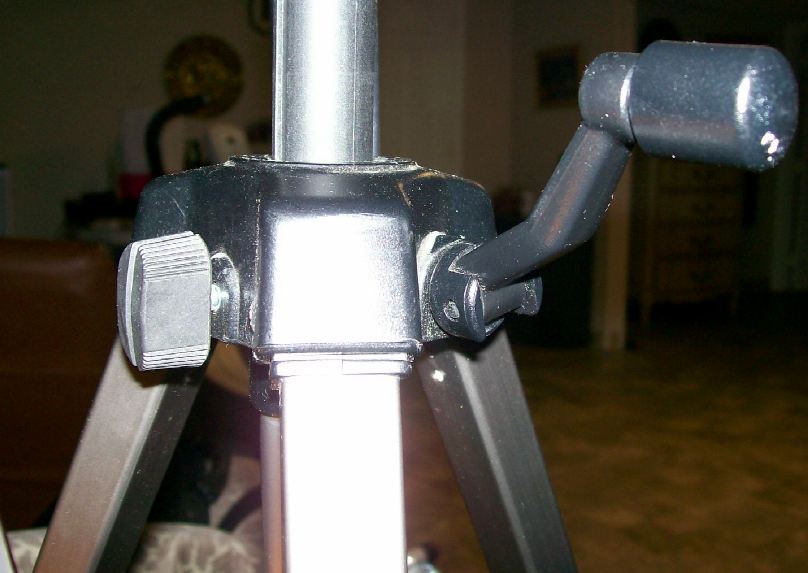
By the time one has reached this optional and final tapping stage the need to utilize the focus wheel or crank shaft should be extremely diminished assuming the same object is being photographed in the same area.
Also w/r/t the flexibility of spiral tubing causing problems such as unwanted movement when focusing, the degree of rigidity of the spiral tubing is great enough to prevent further movements once it has been set to a certain position.
I personally feel that designing the length of the tubing to be no more than seven (7) inches is paramount to avoid an inevitable 'drooping of the tubing'

situation. The perceived innuendos of this phrase need not be elaborated upon.
A longer section of tubing inevitably results in an overall greater tubing weight and an increased moment arm producing more torque which naturally facilitates easier bending of the tubing from the natural and ever-present effects of gravity:
http://moon.ouhsc.edu/dthompso/namics/torque.htmIn layman's terms it is much easier to open a shut cellar door, for example, if one pushes upwards on the side farthest away from the door's hinges.
But just imagine being on a ladder looking upwards and trying to open this same cellar door by pushing upwards on this door at a point located just a few inches from the hinges: a daunting and almost impossible feat since the moment arm at this location is less.
I am sure these answers may have deviated to an extent from the original nature of the question but hopefully they have added some needed clarification to better understand the method to my madness.












 that a traditional microscope stand would not really provide me with enough flexibility to attain the ultimate goals I had in mind: ‘quickly' and ‘accurately' focusing on large and small coins with desirable and repeatable results.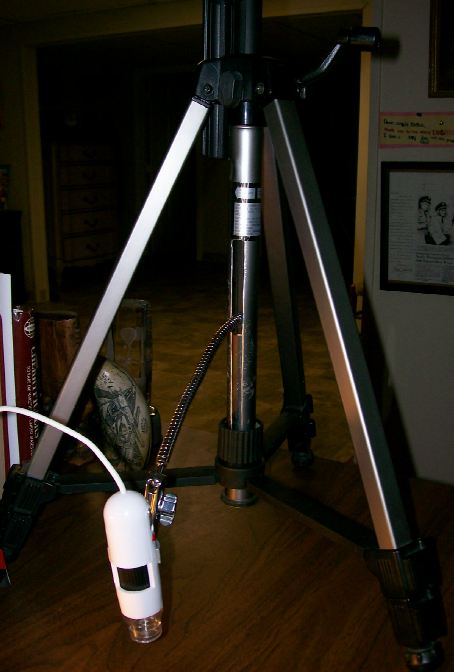


 Posted 01/29/2012 06:19 am