| Author |
 Replies: 11 / Views: 14,245 Replies: 11 / Views: 14,245 |
|
|
New Member
United States
11 Posts |
I have been going through my Dad's collection. He has quite a few silver coins in 2x2" cardboard holders that were then placed inside clear sleeves. Many of these coins are now green at the places where they came into contact with the sleeve. (See photos) It was suggested to me by a dealer at a show this weekend that I could and should clean this off. His suggestion was to use either mild soap and water and gently rub with a old T-shirt. Or use a little oil of the bridge of my nose. Any reason I couldn't just gently rub with an old T-shirt without using soap or nose oil? I was able to clean off all the green of this coin by just gently rubbing with a dry T-shirt. What's best?  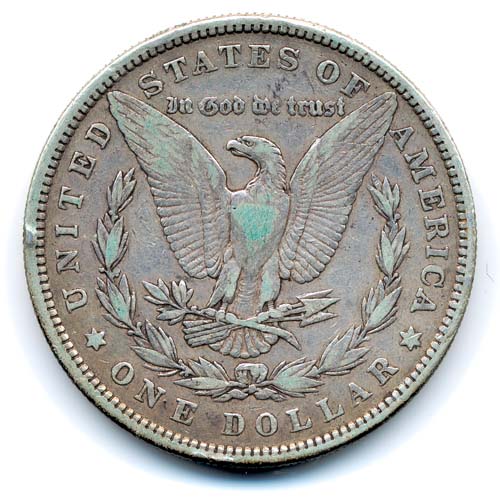 |
|
|
|
Moderator
 United States
23731 Posts |
Any rubbing on a coin is going to leave marks and effect the grade and value. You can try an acetone bath which should remove the discoloration.
|
|
Pillar of the Community
United States
2150 Posts |
From what you describe, it sounds like PVC residue. I would not suggest any type of rubbing across the coin. Even light rubbing will leave microscopic marks that will leave the coin pretty much worthless. As echizento suggested I would first try an acetone dip. If you have never worked with acetone I would read up on it first. Do a search for acetone in the search box on this site and read through some previous posts to get an idea what to do. For certain make sure you are in a well ventilated area and put your acetone in a glass container as it will melt plastic.
|
|
Valued Member
United States
487 Posts |
Maybe they are just envious of your other coins.
|
|
Moderator
Australia
16986 Posts |
Green forming on silver coins, especially on the high points like this, is classic PVC damage. The dealer is correct in suggesting the green goo should come off, as it's sticky, and still potentially acidic. Soap and water should do a reasonably good job, but acetone or some similar solvent is recommended to remove it all with minimal harm to the coin itself. Just "rubbing it off" will tend to smear the goo around and push it into the cracks and crevices of the coin, where damage might continue. Besides, "rubbing" a coin causes friction and wear and even on a fairly worn coin like this one is something to be avoided in principle.
Do a forum search for PVC and acetone for advice and tips on using it. Acetone is flammable and not entirely healthy, so use it in the home with caution.
Don't say "infinitely" when you mean "very"; otherwise, you'll have no word left when you want to talk about something really infinite. - C. S. Lewis
|
|
Pillar of the Community
United States
2049 Posts |
I had some Morgans like this with the classic green PVC residue. Acetone worked well. The advice here is sound about not rubbing the coin, but in this case the coin pictured is already in a lower grade and has a noticeable rim nick on the reverse at about 9:00. On lower graded Morgans like this that are found in the common silver dollar trays, a little rubbing to help get all of the residue off isn't going to do much to lower the value. On nicer grades you want to be extra careful of course. You can find acetone at your local hardware store, but make sure you do it in a well ventilated area...the fumes are nasty!
|
|
Pillar of the Community
United States
4846 Posts |
|
|
Pillar of the Community
United States
596 Posts |
It is saint paddy's day after all.
|
|
Bedrock of the Community
United States
20753 Posts |
Of course that green showed up for St. Patrick's Day.  Should just go away now that that day is over.  I really liked that NOSE OIL thing. Sure he didn't say off the inside of your nose? As to the soap, consider LAVA soap. Great for getting rid of almost anything.  Not sure but possibly that dealer was joking or at least I hope so. Just stick to some Acetone. As already noted, do a search on this forum for coin cleaning, cleaning coins, Acetone, etc. Should find many, many interesting, but logical and realistic information. |
|
Moderator
United States
23522 Posts |
While you research acetone, pay particular attention to just carl's inputs. Not only is he professionally-qualified to address the subject, he's also a voice of reason in a sea of babble, mine included.
|
|
Bedrock of the Community
United States
14454 Posts |
Quote:
use a little oil of the bridge of my nose. I think what he is trying to describe here is what is called by coin people as "thumbing" the coin where you use your body oils to wipe the coin to kind of cover up imperfections on coins. I do not think it would do much for PVC |
|
Pillar of the Community
United States
677 Posts |
Quote:
pay particular attention to just carl's inputs. Not only is he professionally-qualified to address the subject, he's also a voice of reason in a sea of babble,  I'll second that! |
| |
Replies: 11 / Views: 14,245 |
|










 Posted 03/15/2010 10:52 pm


