| Author |
 Replies: 28 / Views: 4,157 Replies: 28 / Views: 4,157 |
|
Valued Member
Australia
155 Posts |
I have a few ancients that I have just carded,some I haven't I.D'd yet,my scanning skills arent so great at the moment with a new scanner and all,but I'll do my best,heres the first 2, 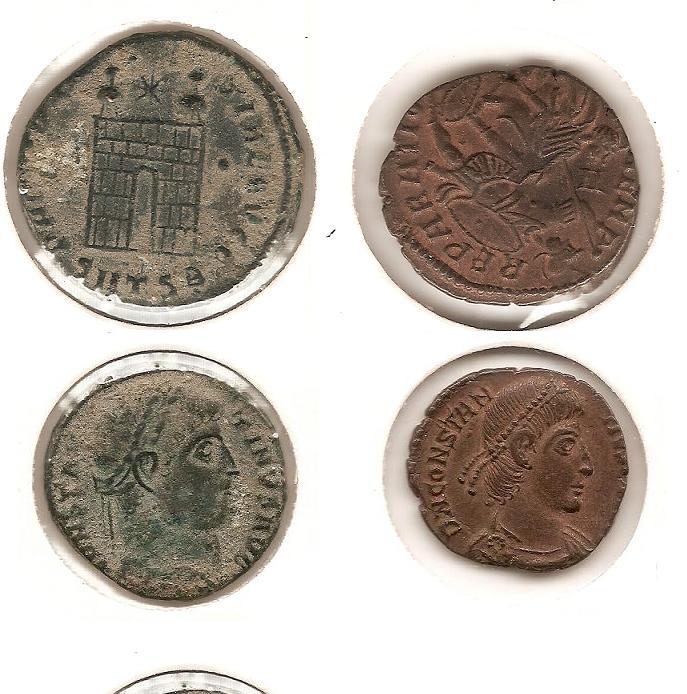 The coin on the left measures 18mm,the other 16 mm. Cheers  |
|
|
|
Moderator
 United States
23731 Posts |
#1 is a Campgate of Constantine I 307-337 AD minted at Thessalonica.
#2 is the Emperor Constantius II 337-361 AD.
|
|
Valued Member
 Australia
155 Posts |
Awesome thanks mate,I have a few more but I won't post them all in a day,heres another 2 though.their detail isn't the greatest,but here goes, 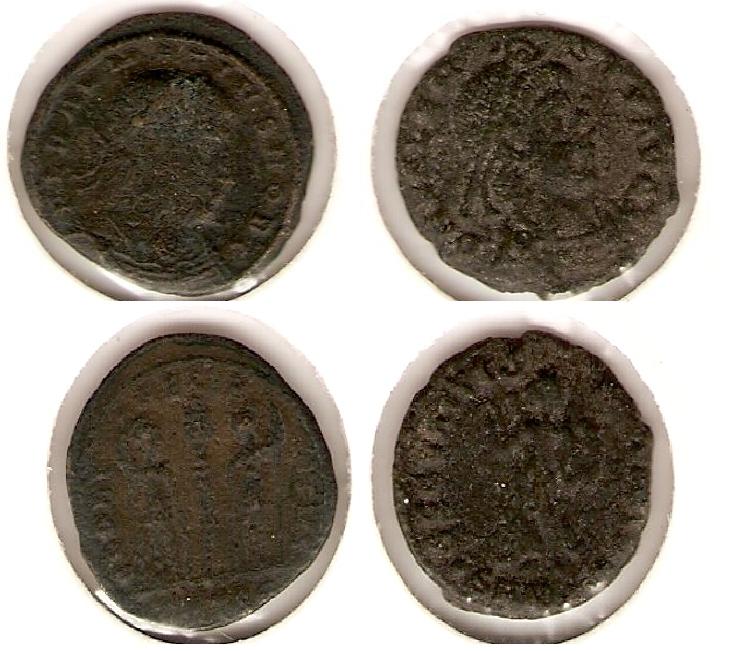 Both coins measure 16mm,enjoy! |
|
Pillar of the Community
United States
3098 Posts |
I've always wondered how ancients were made. Were the cast or struck? And if they were struck, how were the planchets made? They all seem very... jagged.
|
|
Moderator
Australia
16920 Posts |
Agosos: the pics of this second batch aren't as clear as the first, but my best guesses for their identity are: Left: Caesar Delmatius, nephew of Constantine the Great who was briefly (335-337 AD) in charge of the territories of what are now Greece and Bulgaria. Reverse type: GLORIA EXERCITVS, two soldiers standing and holding a military standard. I can't make out the mintmark, but it'll be similar to example on Wildwinds. Right: Emperor Valens (364-378 AD) with reverse Victory walking; SECURITAS REIPVBLICAE. Again, the mintmark is unclear. Several examples on Wildwinds. wd1040: Ancient coins were, for the most part, struck. They were, however, struck by the ancient method of "hammering" - placing the blank between two dies and whacking the whole assembly with a hammer. There is no collar or anything else to control or contain the rim of a hammered coin, so they usually look rougher and more "jagged" than a machine-struck coin. Methods of blank preparation changed over time and changed from place to place and our knowledge is at best incomplete, but in most cases, a blob of metal of more or less the correct weight was cast by pouring into an open mould. The weight of precious metal coin blanks would have been controlled more accurately. For larger bronze coins, further preparation of the blank prior to striking might involve smoothing it on a lathe, or heating. This website has a good summary of our current knowledge of ancient blank preparation and die cutting.
Don't say "infinitely" when you mean "very"; otherwise, you'll have no word left when you want to talk about something really infinite. - C. S. Lewis
|
|
Valued Member
Australia
155 Posts |
Cheers for that Sap.I'll post some more later,the quality should be better,they are 2 of the worst I have from memory. Edit:Oh I put a pic of the reverse of that weird Thai coin I found.Its in the same post in world varietys Edited by Agosos
04/02/2010 11:36 am
|
|
Valued Member
Australia
155 Posts |
Heres a couple more,it seems my scanner doesn't pick up the detail to well on the coins with a darker patina. 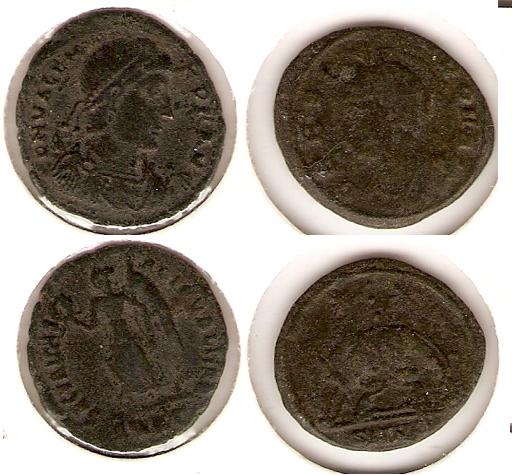 I found if I invert the colors it brings the detail out a bit more, 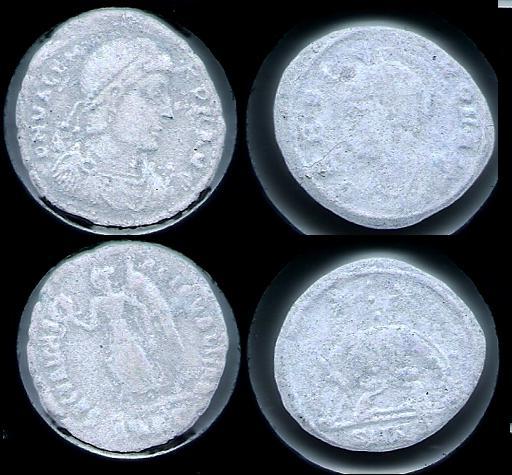 The detail is better on the next bunch, 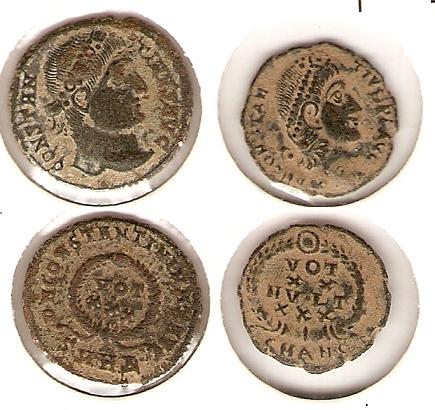 Cheers and enjoy. |
|
Moderator
Australia
16920 Posts |
If you scanned them before you put them in 2x2's, that might make the pics clearer.  #5: appears to be more or less the same as what I guessed #4 was: Valens, Victory, SECVRITAS. Again, the mintmark isn't quite readable on the scan, except for the last letter, Greek gamma, meaning whichever city it was struck in, it was from the fourth officina (branch minting-house) within that city. #6: It would be hard to read, except this particular type is unmistakeable even when worn or corroded: an "anonymous city commemorative" type, issued during or shortly after the reign of Constantine I. Obverse has the portrait of Roma, reverse the mythological scene of Romulus and Remus being suckled by the she-wolf. I think the mintmark is SMN, which would be Nicomedia mint. Here's a good example on Wildwinds. #7: Constantine the Great, reverse VOT XXX in wreath, mintmark SMH(delta)(dot) - Heraclea mint, third officina. Very much like this example. Constantine's thirty-year-service vow occurred in 326 AD, dating this coin nicely. A nice example with fine "desert patina" contrast. #8: Constantius II, reverse VOT XX MVLT XXX in wreath, mintmark SMANQ I believe - Antioch mint, ninth officina. Unfortunately, the Antioch mint used this design over a broad period, from 347-355 AD. Scroll through the Antioch section of the Wildwinds Constantius II page for examples from other officinas. Don't say "infinitely" when you mean "very"; otherwise, you'll have no word left when you want to talk about something really infinite. - C. S. Lewis
|
|
Valued Member
Australia
155 Posts |
Thanks again mate!I dont know if its just me but your links seem to be broken in the last post.
I have 7 more romans I have yet to I.D.I know I could get of my butt and research them ,but its more fun sharing them with you guys.
You are right about number sixes mintmark.
Looking at the rest, they all have desert patinas,which hopefully means I wont have to rip them out of their 2x2s when I scan them.
More tomorrow,cheers.
|
|
Moderator
Australia
16920 Posts |
Quote:
I dont know if its just me but your links seem to be broken in the last post. I forgot to insert the URL for the bottom link. Sorry - I'll fix it now.  Don't say "infinitely" when you mean "very"; otherwise, you'll have no word left when you want to talk about something really infinite. - C. S. Lewis
|
|
Valued Member
Australia
155 Posts |
Heres two more,left ones a tad worn,hopefully theres enough there. 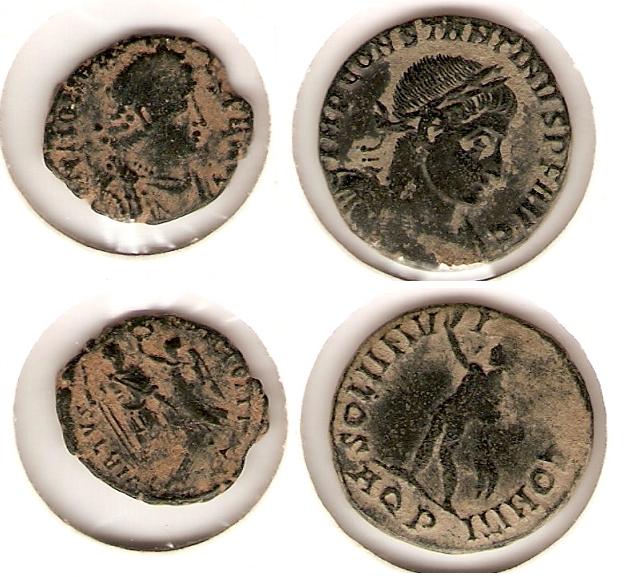 |
|
Moderator
Australia
16920 Posts |
#9: the obverse legend is a bit mangled, but I think it begins with DNHO - making Honorius the most likely candidate. THe reverse type, VIRTVS EXERCITI, triumphant emperor being crowned by Victory, was struck under Honorius. Can;t see any trace of the mintmark. Wildwinds example. #10: Constantine the Great, reverse type SOLI INVICTO COMITI, the sun-god Sol standing, mintmark a nice clear AQP - Aquileia mint, first officina. WIldwinds example. Don't say "infinitely" when you mean "very"; otherwise, you'll have no word left when you want to talk about something really infinite. - C. S. Lewis
|
|
Valued Member
Australia
155 Posts |
Thanks again mate.I am having hassels with whirlwinds site,it worked a couple of times for me but now I'm have cookie problems,ill work it out I'm sure.
Would I be right in dating Honorius 393-395?Thats when he reigned so I'm guessing it would be somewhere around then.Reading up on constantine the great seems to make dating his a bit trickier,did he mint coins from the start of his reign or after he defeated the other emperors?
Cheers.
|
|
Moderator
Australia
16920 Posts |
One of the first things a new emperor did once they declared themselves emperor was start churning out coins proclaiming that fact. They didn't waste any time about it. Some emperors only reigned for a few weeks or even a few days, yet still found the time to make coins. Honorius held the rank of augustus (emperor) from 393 until his death in 423. From 393 to 395 he was co-ruler of the entire empire under his father; when his father died, he and his brother Arcadius divided the empire between them: Arcadius took the eastern half, and Honorius the Western half. The coins make no distinction between these two periods of his reign. Constantine I first appeared on coinage with the rank of caesar (junior emperor) in 306 AD. In 307 AD, he was given the high-sounding but meaningless title of "filius augustorum" (imperial son), which Constantine found unsatisfactory. He declared himself augustus in 309 and coins with the title of augustus (senior emperor) appear from that date, although coins minted in territories controlled by his rivals continued to call him "caesar" for some years afterwards. He did not finally secure control over the entire empire until 324. Coins of Constantine can therefore be found with all three titles after his name: NOB C (caesar), FIL AVG (imperial son) and AVG (augustus). AVG coins are the most common. Don't say "infinitely" when you mean "very"; otherwise, you'll have no word left when you want to talk about something really infinite. - C. S. Lewis
|
|
Pillar of the Community
United States
4846 Posts |
does anyone have any ancient africa coins?
|
|
Moderator
Australia
16920 Posts |
Quote:
does anyone have any ancient africa coins? Yes. Egypt is in Africa (though it was not thought of as part of Africa in ancient times). Egypt under the ancient Pharaohs issued very few coins (and these are very scarce and valuable) but Egyptian coinage issued after the conquest of Alexander the Great, and into Roman and Byzantine times, is relatively cheap and plentiful. I have numerous examples. The ancient superpower of Carthage is also in Africa; it was situated in what is now Tunisia. I have a couple of Carthaginian bronzes. There's one African city I don't have, but it's on my wantlist: Cyrene, in what is now Libya. This Greek colony was the source of the now-extinct silphium plant: a species of celery which not only tasted delicious but had powerful medicinal qualities, it was harvested to extinction in Roman times. The silphium plant features on many of the coins from this city. All of the places mentioned so far are from the northern Mediterannean fringe of Africa. The only truly "native African" ancient coinage comes from the Axumite Empire, located in what is now Ethiopia. The coinage of most Axumite kings is quite scarce, but a couple of the kings are common. Hoards of Axumite coins often turn up in southern India, demonstrating that ancient seafarers maintained a thriving trade route across the Indian Ocean. I have a silver quinarius of King Ousanas, circa 320 AD. Don't say "infinitely" when you mean "very"; otherwise, you'll have no word left when you want to talk about something really infinite. - C. S. Lewis
|
| |
Replies: 28 / Views: 4,157 |







 Posted 04/02/2010 04:41 am





