| Author |
 Replies: 21 / Views: 4,041 Replies: 21 / Views: 4,041 |
|
Pillar of the Community
Canada
576 Posts |
It's a well circulated 1907 large cent. Feels light as a feather. It has the identical diameter of a regular large cent but its planchet width/depth is a little less than half of a regular cent. The weight difference is immediately noticeable. Any 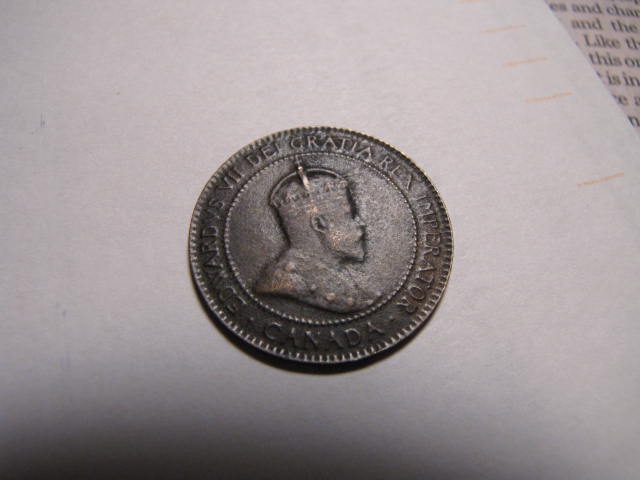 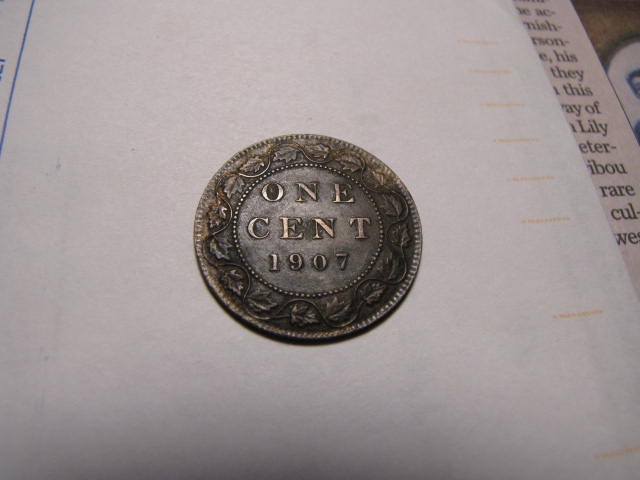 ideas on how it came about? Are there others reported? |
|
|
|
Pillar of the Community
Canada
1248 Posts |
this is something for ZONAD...
he is the expert...
|
|
Valued Member
Canada
153 Posts |
It's from acid .. either a garage or science experiment, mythbusting concerning coca-cola, or something similar. From time to time, you see these with just about any date ... post-mint.
|
|
Pillar of the Community
 Canada
576 Posts |
Hmmm, worth pondering but I don't think it's an acid thing. There's too much of a thickness difference. Too much weight difference without the accompanying and obvious exaggerated corrosion or surface defacement that you'd expect with acid. The reverse shows no diminishment of basic detail appropriate to the wear. The obverse shows more wear and detail decline but it's insignificant. The original planchet was definitely a thin one, something comparable to many of the 1859 issues that were more thin than their already underweight peers of the year.
|
|
Bedrock of the Community
Australia
21789 Posts |
I have an uncirculated 1965 British penny that is only 60% of the correct weight. It is what is known as a 'Mint Sport'. This coin was struck at The Royal Mint in London, before it was re located to Llanstrisant, Wales. A lot of Mint employees did not want to have their jobs moved to Wales. As a form of protest, all sorts of oddball coins were made. These were thrown over the perimeter wall of the Mint to be picked up free by passers by. My penny is one of those recovered by the public. |
|
Pillar of the Community
Canada
576 Posts |
Sel, that's a fascinating tidbit. I know mint employees everywhere, especially in the past before the age of msss surveillance, likely got into some mischief but to hear of such activity as a form of protest is new to me. I wish this coin was mint. I really don't know the story behind this one but as far as the acid theory put forward in the previous post, my thinking is this: if I were to take a Canadian large cent and cut it carefully in half, to do the work of acid without the acid itself, to remove the obverse, wouldn't the fresh cut coin be void of an obverse completely? Virtually no detail left at all? This coin is so thin it almost floats when you toss it into the air. That's an exaggeration, of course, but it gets to the nature of what it is.
|
|
Pillar of the Community
Canada
1483 Posts |
I agree with the acid theory. It's amazing that the details dissolve equally and the coin retains the almost normal appearance. I think the obverse was the side most affected in this case.
|
|
Pillar of the Community
Canada
576 Posts |
Thanks, Zonad. You agree with R2C. You both could be right. But as I've mentioned I don't understand how the obverse is still intact at all if the thickness of the coin has been reduced so substantially. As the metal is eaten away by the acid wouldn't the entire obverse disappear as the metal reduction exceeds 50% of the thickness of the coin? I don't understand that aspect. I assume if I cut an Edward large cent in half across the breadth of the coin, separating the reverse from the obverse entirely that the obverse will not be visible at all on the half containing the reverse's details.
|
|
Bedrock of the Community
United States
10045 Posts |
 with acid too--I've seen a few, although not this particular series. The wiry rims and skinny, sharp-edged legends strongly suggest the work of acid--imo. I don't think a planchet half the normal weight would strike up so equally  Edited by DVCollector
01/20/2011 3:00 pm
|
|
Bedrock of the Community
United States
12437 Posts |
Quote:
As the metal is eaten away by the acid wouldn't the entire obverse disappear as the metal reduction exceeds 50% of the thickness of the coin? The acid acts equally on the fields and devices, you will not get a smooth planchet with no detail. The surfaces are porous(most obvious on the obv) and the rims have been thinned, the denticles are about to fall off. A coin struck on an extremely thin planchet would have serious strike quality deficiencies. |
|
Valued Member
Canada
153 Posts |
If you want to try something that many of us did as kids, just put a large cent (or small one) in a small glass of regular Coaca-Cola (if it still has the same formulation). Seal the top so that it can't evaporate and watch the coin disolve like this one has partially. The side that stays touching the bottom of the glass will either have much more or much less "burn-off" (I can't remember which had the most/least). The coin will still have esentially the same amount of relief that it started with over most of the coin, because the high points and flat fields will eat away at the same rate. The rate will be a thinner, lighter coin with almost as much detail until the end of the experiment .. then it will dissolve altogether. I even did it with a spoon one month .. it takes a while so it's not instantaneous. I think that the 1907 had the acid or solution actually brushed or applied to each side intermitantly .. you normally will get a fully submerged one to get the edges eaten away as well.
|
|
Pillar of the Community
Canada
576 Posts |
Interesting comments here! Thanks! R2B, I think I'll try the coke thing. It is a strange large cent. The edge of the coin does make you wonder as the rim is smooth and the thickness consistent. Thanks again for the ideas on this one to all who commented!
|
|
New Member
United States
1 Posts |
I also have found a Canadian thin planchet, Edwardian large cent. Mine is dated 1910 and is the same exact diameter as a regular issue but about 1/2 the weight and thickness. It also seems to be rim-less with the denticles reaching the coin's edge. The fields behind the bust do seem to have some miniscule pitting that would give credence to the acid theory, but I would like to think it's a thin planchet that got mixed in with the others at strike-up time. Wm
|
|
Pillar of the Community
Canada
576 Posts |
We can all hope but I tend to go with general opinion here and defer to the acid theory. If the surface of my coin was more convincing - smooth and coin-like like a regular issue - I might change my mind. But it is a curiosity and one more to prompt conversation when shown.
|
|
Pillar of the Community
Canada
2784 Posts |
before I even read the other's comments I thought acid etched (more so on the bust side)
|
|
Rest in Peace
United States
9104 Posts |
definitely acid, look how the legends are thinned
|
| |
Replies: 21 / Views: 4,041 |







 Posted 01/20/2011 06:20 am





