| Author |
 Replies: 17 / Views: 5,508 Replies: 17 / Views: 5,508 |
|
New Member
United States
30 Posts |
I have heard that this coin (1, singular) exists... Yet I have a hard time finding ANY information on it. I was wondering if any of the coin collectors and enthusiasts that frequent these forums may be able to shed some light on this curious coin.
Who owns it?
Are there any pictures of the coin?
The DIE used and any characteristics.
The reason it was made...
|
|
|
|
Moderator
 United States
23522 Posts |
I'm aware of its' existence, but very little else.
Just for audience clarity, a "Class III" coin is one believed to be a proof, as it demonstrates the sharp, square rims, frosted surfaces and mirror finish of a true Proof. A "Class II" is a known Proof of unauthorized mintage, and a "Class I" Proof is authorized.
|
|
Pillar of the Community
3660 Posts |
The existence of such a coin or coins would depend entirely on your own personal definition of "proof"........... If to you it means characteristics that owe similarity to square edges, strong strike, and fully brought up design, then there are probably a lot more than just one coin in existence...... If you feel a proof is a product of creation as are the Philadelphia proofs, then the coin that you speak of does not exist.
Proofs created in Philadelphia were struck on a Medal Press (because of the high striking pressure) from highly polished dies and planchets. Branch mints did not possess medal presses, and therefore did not strike medals or proofs.
Branch mints did have the capability however to effectively simulate such a strike...... Polishing plates were included in each shipment of dies and collars to the branch mints for the purpose of rejuvenating those dies as they wore, but the polishing plate could sharpen the design drop offs of an unused die to the point of superiority over that of a new die..... planchets were the responsible creation of the mint that struck them, and could be polished to a high state of luster, as well as being annealed to softness that would bring up the design in a sharp die..... coin presses were adjustable in various ways, and pressure was one of them, and could be adjusted to high pressure beyond normal strike level.
Can anyone today tell the difference? The only way that I know of is by the mint mark.... Philadelphia struck proofs on a medal press.... branch mints did not.
|
|
Pillar of the Community
United States
5685 Posts |
Zee, Thank you for the concise, informative, educational comments.......To keep things clear, the planchets were the responsibility of the branch mints, however the dies were only made, then, in Philly, correct? This would also leave the re-polishing of the dies to the branch mints also. Not Philly.
|
|
New Member
 United States
30 Posts |
Let me know if any of these things I state are incorrect or off base... 1881-O's come in only one strike (other than said BMP)... Business Strike. There are DMPL's, which are the most sought after, for this year and Mint. ALL 1881-O DMPL's were struck once. USUALLY, the Business Strike DMPL's were struck from fresh dies, meaning no gouges or pitting. A DMPL struck with a defective die would be considered rare. SO IF an 1881-O (way beyond)DMPL exhibiting characteristics such as... what could be cautiously considered either Die Deterioration or slippage, affecting a group of denticles on BOTH sides (denticles look like they are triple struck), ear doubling (although not a known VAM), a double profile, highly polished fields (to the edge between the denticles), and to top it off there is die rust between neck and and wing of the eagle as well as a couple other spots, unslabbed from Montana and graded out ms 64/65 by a local dealer's quick eye test... How would you proceed if that coin fell in your lap? |
|
Pillar of the Community
3660 Posts |
Quote:
1881-O's come in only one strike (other than said BMP)... Business Strike. My answer would be (as I stated earlier) that this would depend upon your definition of BMP. Quote:
There are DMPL's, which are the most sought after, for this year and Mint. Correct, and DMPL is what I feel many folks misidentify as BMP.... they are one and the same animal. Quote:
ALL 1881-O DMPL's were struck once. Correct. Quote:
USUALLY, the Business Strike DMPL's were struck from fresh dies, meaning no gouges or pitting. The term "fresh dies" (to me) has nothing to do with gouges or pitting, but rather a recent state of polishing or basining..... Many dies, but not all, were highly polished prior to initial use. Quote:
A DMPL struck with a defective die would be considered rare. Again, your definition of "defective" would come into play..... many dies exhibit features that are less than the optimal level of mint desirability...... The degree of these defects constitute collector desirability. Quote:what could be cautiously considered either Die Deterioration or slippage, affecting a group of denticles on BOTH sides (denticles look like they are triple struck), Many times, certain features on a coin are not die specific, but rather press oriented..... I really don't see anything 'cautious' about considering that a "fresh" die might be in any state of "deterioration". Quote:ear doubling (although not a known VAM), a double profile, highly polished fields (to the edge between the denticles), Very common stuff..... There are many dies of this common year that are so similar as to be indistinguishable from the next die. Quote:
unslabbed from Montana and graded out ms 64/65 by a local dealer's quick eye test... I'm not impressed with the opinions and claims of dealers. Quote:
How would you proceed if that coin fell in your lap? Sounds as if you have already bought it.... You might proceed by posting pictures to get comments of those who might give you honest answers and opinions. Let me say this one thing in closing...... The terms PL and DMPL are degrees of sensationalism attached to specific coins due to their level of clean shiny fields and frosty devices, and I consider both terms to be misnomers.... 'Strike' is an integral factor in a proof coin, eclipsing the mere degree of reflectivity a coin might display. Objectivity quickly blends into subjectivity in determination of Proof, DMPL, PL, and non PL..... experience will be your best guide.... short of that, get the unbiased opinions of the Morgan folks here (rather than the claims of a dealer whose interest lies in selling you the coin). |
|
Pillar of the Community
3660 Posts |
Quote:
To keep things clear, the planchets were the responsibility of the branch mints, however the dies were only made, then, in Philly, correct? This would also leave the re-polishing of the dies to the branch mints also. Not Philly. Correct you are Mike...... Thanks for the clarification. |
|
New Member
United States
30 Posts |
The guy that gave it the eye test is a very well respected dealer in Irvine CA and was referred to me by a pcgs rep in Newport beach, CA. I didnt buy it... my Grandmother gave it to me... here's a few pics I took a while ago in my back yard with my LG Env Touch, no tricks... Not too revealing and it's meant to be that way... This coin IMO needs someone skilled in the ways of conservation so it may take its rightful place among the 81-O's. It needs a light "non proof field altering" dip that will remove what I think is PVC or oxidation from the album it was in.. Nt sure. Anyone serious about taking a look at it can stop by any time in Corona Del Mar. Tell me what we could do and if it sounds good ill cut you in or maybe I'll just keep it.    |
|
Pillar of the Community
3660 Posts |
Yes, I remember the coin, and like I said back then: "Personally, I think that it a very beautiful coin with an exceptional strike and fantastic detail." http://www.vamworld.com/message/view/home/14517631http://www.vamworld.com/message/view/home/15575064Let me say one thing about the tripled denticles..... 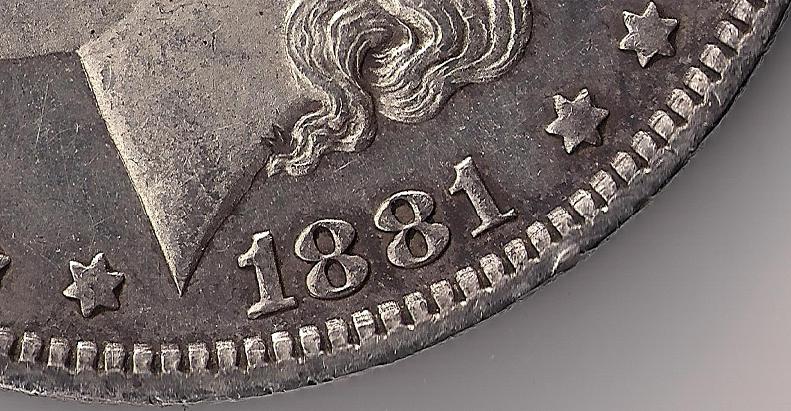 This is not the result of the coin being struck three times..... New Orleans had no medal press, and the Morgan & Orr coin press was incapable of repeated striking of the same planchet. Sometimes doubling or tripling is inherent in the die as a result of hubbing, but sometimes this doubling or tripling is caused by the strike and is called Machine Doubling or Strike Doubling..... The die faces are slightly convex so when they initially contact the planchet (which is of a slightly smaller diameter than the collar), the planchet is pinched in the center by the opposing dies and displaced outward toward the collar as the dies further compress the planchet, which sometimes results in slight movement of the planchet during strike. Edited by zeewool
03/19/2011 02:13 am
|
|
New Member
United States
30 Posts |
Thank You for the remarks and your good memory... a few more pics for you guys... ear doubling, and rust patches between eagles right facing talons and feathers and shoulder neck. The rust might not be too evident due to scan but in person it is evident. Not sure if its a good or bad thing but it's there...  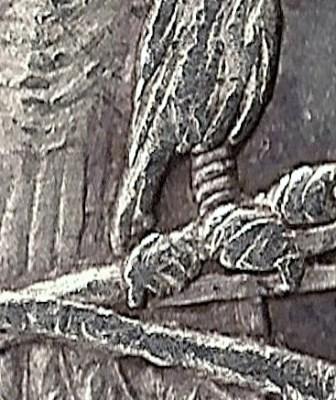 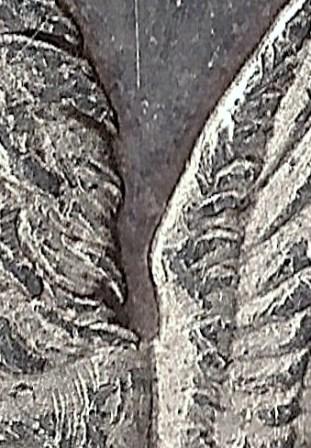 |
|
Pillar of the Community
United States
3076 Posts |
an interesting thought is......this old post, was supposed to go the the BIG SHOW in Feb....?YET ITS MARCH...My guess is it did'nt pan out for you... ...As far as the trippling of the denticles, its a common and unwarrented NON VAM related occurance of the die making process as it takes up to 10 strikes once per day to get the the hub ready for making the die reproductions, this is very very common knowledge...some coins have up to 9 or 10 layering or your so called doubling effects....its due to the fact that the dies while they have to be kept warm do not expand back to there original place and the next strike to produce the hub..gets another layering feature... and as far as a grade of MS65 I would have dumped it a moments notice... It may be PL or DMPL but far from MS65 grab your money while you can...with all the dings and wear AU looks about right.... as far as your comment ALL DMPL's are struck once all coins are only struck once with the exception of proofs...under strick circumstances which you are tying to imply.. for a non proof mint...year... \ As Zee noted polishing during the die's life polishing happens resulting in DMPL ONCE AGAIN, despite the coins dies been used....AFTER that polishing sharpens details, and those coins can be DMPL....does not mean they are proof... You dance around why its obvious its not a BMP but you still procreate the existance that it could be.... even after the BIG SHOW..that would make this all clear....now to resurect the idea of when it was shot down....in the big show...I don't blame you for questioning, but sooner or later the negatives out weight the obvious.... |
|
New Member
United States
30 Posts |
Wow... Alladin. I'm not sure which is worse. Your spelling or your disposition.
Your reply, which was so eloquently put together, procreates how very, very intelligent you are. For some reason you seem threatened by what I am trying to accomplish, for if you truly believed in what you say, you would not need to waste your time telling me what you think. Right? Or are you trying to look cool in front of your friends?
Have you EVER seen THE 1884-O Class III BMP? (yes there is an 1884-O as well)
Can you tell me how many times a class III BMP is struck?
As for the Big Show... and the people I was introduced to, they had far less knowledge about BMP's than I had hoped. Before some people even look at the coin they have decided it couldn't be...
When I presented them with the coin, referred it's BMP characteristics, they passed me off to some guy who was supposedly THE foremeost expert on BMP's who then pointed me towards the 1879-O's (which are a class I and were authorized as proofs with plenty of documentation) and told me that my coin should look like them. Then the real kicker, he asked me if I had any paperwork or documentation supporting my claim and if I didn't I should do some research and find some.
There were some actual open minded people there, who did find the coin especially unique... unfortunately they didn't know the secret hand-jerk to get he go-ahead from the powers that be.
|
|
New Member
United States
30 Posts |
Also I want you guys to take a good HARD LOOK at something for me...Because I want you to tell me I'm wrong so I will stop. Go look at ANY NON - Branch Mint Proof Morgan dollar... LOOK AT THE SPACE BETWEEN THE DENTICLES. 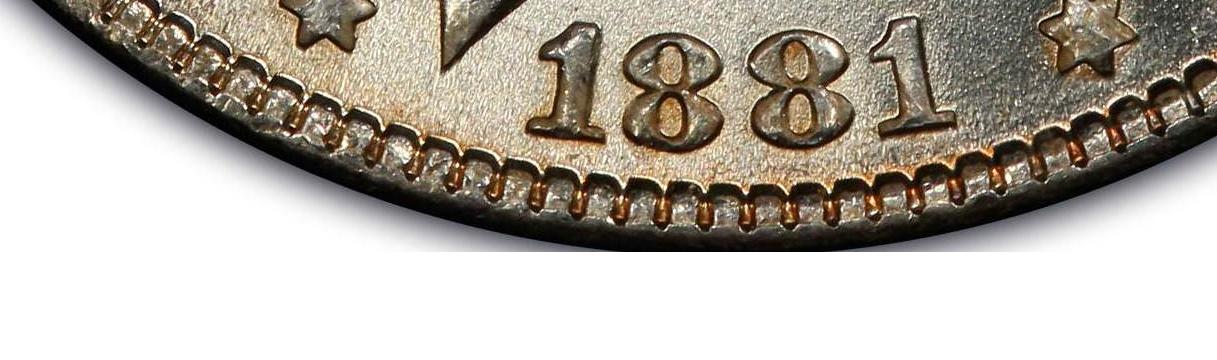 FILLER MY COIN's FIELDS are polished fields to the edge between the denticles... there is no "filler"... as pictured above. NOW LOOK AT A PROOF COIN... Branch Mint Proofs are not as good but if you look at you'll the spaces between the denticles don't have that "FILLER" MY COIN DOES NOT EITHER |
|
New Member
United States
30 Posts |
HOW BOUT THEM APPLES?
Is there a BETTER WAY TO TELL THE DIFFERENCE?
|
|
New Member
United States
30 Posts |
READ THIS TOO... "The branch mints did not have hydraulic presses as the Philadelphia Mint did; therefore, strength of strike such as seen on this coin could only have been achieved by MULTIPLE STRIKINGS." LINK: http://coins.ha.com/common/view_ite...&Lot_No=9099 |
|
Pillar of the Community
3660 Posts |
Sometimes some of us blend beer or wine with our online activities JD.... please don't take these instances personally.
As for the filler between the denticles.....
The space between the denticles actually is the die face..... it actually is the field...... when the die impacts the planchet, a the die field receives a certain amount of wear....... this wear is often more pronounced where the die field is at its narrowest (weakest), and at the device drop offs..... this is why the very small devices such as the lettering of 'In God We Trust' are sometimes broken on the die and appear on the coin as a fill.... this is also why the wear to the field between the denticles appears as though there is metal dust or metal overflow between the denticles.
A newly polished die will not only transfer as a cleaner, brighter coin field, but will square the die's device drop offs of the field to give the die a sharper imprint in the planchet.
The 'filler' between the denticles is not really a build up of anything, but actually a breakdown or wear down of the die field.... the die field is the relief (or highest portion of the die), while the devices (denticles, stars, lettering, eagle, wreath, Liberty head, etc), are depressions in the die field.
Beautiful DMPL reflectivity (such as your coin exhibits), is the product of highly polished dies and planchets, and I have little doubt that this was no accident..... Routine coin production would not warrant such a high degree of beauty, but die polishing was the responsibility of individuals, and some folks surely went overboard while others only did the job halfway.
I think that I mentioned before that dies were basined prior to initial use with polishing plates, and the main reason for this was to achieve the the proper radius (convex curvature) to the die, but side effects were smoothing and polishing of the die field, and sharpening of its device drop offs.
Proof coins are created using highly polished dies, properly annealed and highly polished planchets.....The New Orleans mint had neither the medal press to strike proofs, or the annealing capabilities to soften complete planchet production thereby resulting in hard planchets appearing as weak strikes.... Polishing planchets to a higher state required extra time in the riddler, annealing the planchets required extra time in the oven, and time is one thing that the N.O. mint didn't have to spare.... the mint was not created to match production levels dictated by the Philadelphia mint.
I believe that yours may have been a coin that was struck with the intent of being as proof like as possible... possibly a presentation piece..... It was struck only once though, despite the illusion caused by what I believe to be metal displacement in the dentilces.
|
| |
Replies: 17 / Views: 5,508 |










 Posted 03/18/2011 3:20 pm


