|
This page may contain links that result in small commissions to keep this free site up and running.

Welcome Guest! Registering and/or logging in will remove the anchor (bottom) ads. It's Free!
To participate in the forum you must log in or register. | Author |
 Replies: 26 / Views: 5,383 Replies: 26 / Views: 5,383 |
|
New Member
Australia
34 Posts |
Hi everyone, so much on this site its is unbeleivable, well done. So I have a question, my grandmother left me a heap of coins and notes. After a lot of research I've found out that a lot of them are worth a fair bit of money. One not in particular I cant find a lot of info, all the info I do find is always the same. Can someone please help me. The note in particular is dated 1st dec 1910, it is a 1 pound note dating back to pre federation. I have seen a lot of pictures of it on sites but I have read that it is worth anywhere between 8,000 up to close to 250,000. The note I have is in bloody good condition for its age. Can some one please help me and give me proper advise rather then me trying to read between the lines. 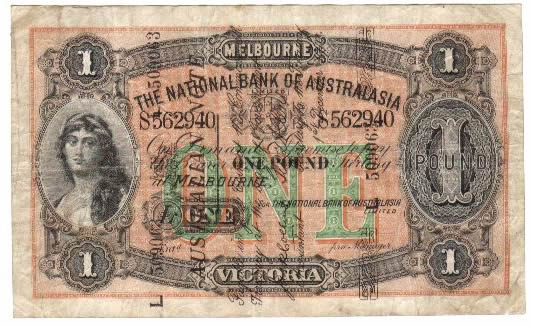 Edited by bigdamoc
11/04/2009 04:42 am
|
|
|
|
Moderator
 Australia
16916 Posts |
Hello and welcome. Your note certainly appears to be very interesting indeed, and quite scarce.
This particular note is what is known as a "Superscribed Australian Note". It was originally printed for the National Bank of Australasia, one of the pre-Federation note-issuing banks, but some unissued notes were purchased by the Commonwealth in December 1910 and overprinted for use as an Australian note. That's what the sideways black overprint visible across the face means.
The superscribed National Bank of Australasia £1 note is listed in the Renniks coin and banknote catalogue as number S50, with a catalogue value of about $30,000 in this condition (I'd grade your note at "good Fine" from what I can see of it on the pic); this isn't one of the scarcest types, but none of the superscribed notes are "common". According to government records, over 50 of these notes were never redeemed; this is one of those notes.
The final question that must be asked is, "Is it real?". There were some reproduction notes issued back in the '60s and '70s that fool some people, but they were usually printed in black ink on coloured paper; this looks a lot more like the authentic colour scheme. I'd assume it was genuine, until told otherwise by an expert seeing it in hand. A genuine note should be 179 x 103 mm in size; a reproduction is likely to be smaller than this.
I should hasten to add: do NOT clean it, wash it, press it or in any way try to "improve" it. Any such attempt will likely damage it and reduce it's value.
Don't say "infinitely" when you mean "very"; otherwise, you'll have no word left when you want to talk about something really infinite. - C. S. Lewis
|
|
Pillar of the Community
Canada
1082 Posts |
|
|
Bedrock of the Community
United States
10045 Posts |
 Wow...that's very cool! |
|
Pillar of the Community
United States
1116 Posts |
wow beautiful note thanks for posting it's probably the only time I will ever see one
|
|
Pillar of the Community
Australia
1040 Posts |
Wow..That is amazing. Assuming you are in Australia, I would recommend getting in touch with someone like John Pettit Rare Banknotes, especially if you want to sell it. If nothing else, he will be able to tell you if it is real. From the pictures, it sure looks like it.
Follow Sap's advice, do not do anything that could potentially damage this note. Well meaning attempts to 'clean' notes and coins ALWAYS ends up in reducing their value substantially.
Also, go to a newsagent and get this months copy of The Australian Coin and Banknote magazine. There is an article on care and storage of banknotes, as well as information on who else you may be able to take it to. Since you have more, you need to decide if you are going to keep them or sell them, and storage will be very important if you are going to keep them.
Also, please, please, please post some more pictures of the rest of your Grandmothers collection.
Edited by latman100
11/04/2009 8:41 pm
|
|
Bedrock of the Community
United States
10045 Posts |
Quote:
Follow Sap's advice, do not do anything that could potentially damage this note. Well meaning attempts to 'clean' notes and coins ALWAYS ends up in reducing their value substantially.
 If anything bears repeating, it is that. Don't even try to iron this note flat, steam it to reduce wrinkles, or anything that seems harmless. |
|
New Member
 Australia
34 Posts |
Thank you for all the info, I'm defenitly being careful with the collection, havent touched any of the notes with my fingers.
The note is not one of the 60's or 70's ones, its defenitly real.
Sap - If records show that there are about 50 of these that were never redeemed, does that mean that the ones that were redeemed would be worth less then the catologue price of 30,000 you say. By this I mean that I found 2 notes with consecutive numbers that got sold for 395,000, now even if I take 1/3 of that price, even 1/4 there is a big difference from 30,000 to say 100,000. These 2 notes that got sold were almost identical to the note that I have, I'm sort of a little worried if I was to sell it that I dont sell it for half of its real value.
As you all can tell that I'm soooo shocked to have virtually in my hands my house that I just bought paid off and want to get the most I can for it.
|
|
Moderator
Australia
16916 Posts |
Quote:
does that mean that the ones that were redeemed would be worth less then the catalogue price of 30,000 you say. I'm not an expert in the series, but as far as I know, all redeemed notes were destroyed, except for a few which were cashed in long after the rest; these were donated to museums. I think the government also kept one of each note, unissued, as an example, and other unissued "specimens" may also have been sent to England. Quote:
I found 2 notes with consecutive numbers that got sold for 395,000, now even if I take 1/3 of that price, even 1/4 there is a big difference from 30,000 to say 100,000. Two things I can think of would increase the value of these notes. First, the consecutive numbering. Nobody back in the 1910s collected banknotes, and nobody would have kept consecutive examples of these notes as such; any consecutive numbers would be "natural" in that the person who originally acquired them likely never even noticed or cared that they were consecutive. So few of these notes survived that the odds of consecutive numbers surviving are quite low; the two items together make a single artefact, much rarer than the individual notes. Consecutive numbers don't raise the price of modern notes by much (if at all) because a lot more pairs have been deliberately kept together by collectors. Secondly, to have remained together "accidentally" in this fashion, they must not have been in circulation for very long, so they're probably in much better condition than yours is. Even a small change in grade can make a big difference in price. Your note catalogues at $50,000 in VF and $100,000 in EF; that's why getting it properly graded by an expert who can see it in hand is most important. Don't say "infinitely" when you mean "very"; otherwise, you'll have no word left when you want to talk about something really infinite. - C. S. Lewis
|
|
Moderator
Australia
16916 Posts |
To add: if you're wanting to maximize your chances of getting "fair value" for it and not get ripped off by a dealer, put it up for auction. I wouldn't recommend ebay; really valuable stuff like this shouldn't go on ebay unless a reputable dealer is offering it. I'd suggest one of the big Australian coin auction houses like Downies (Melbourne), Nobles (Sydney), Colonial (Brisbane) or IAG (Gold Coast) - I believe they'll all happily auction it for you. Don't say "infinitely" when you mean "very"; otherwise, you'll have no word left when you want to talk about something really infinite. - C. S. Lewis
|
|
Moderator
Australia
16916 Posts |
To add to my addition: if you're anywhere near the Gold Coast this weekend, bring your note to the ANDA Show being held there. See here for details. It'll cost you ten bucks to get in, but many of the big dealers (including four of the five named so far in this thread) will be there and would happily value your note for you. Don't say "infinitely" when you mean "very"; otherwise, you'll have no word left when you want to talk about something really infinite. - C. S. Lewis
|
|
Pillar of the Community
United States
2669 Posts |
Wow! How exciting! Congratulations  Quote:
Also, please, please, please post some more pictures of the rest of your Grandmothers collection. |
|
New Member
Australia
34 Posts |
ok here are a few that I quickly scanned up, thanks for the previous posts, very helpful! 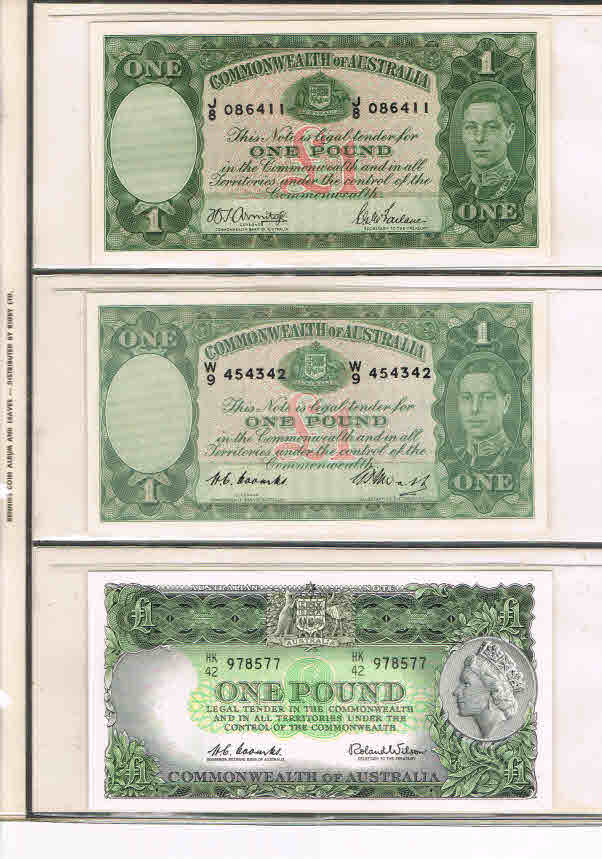 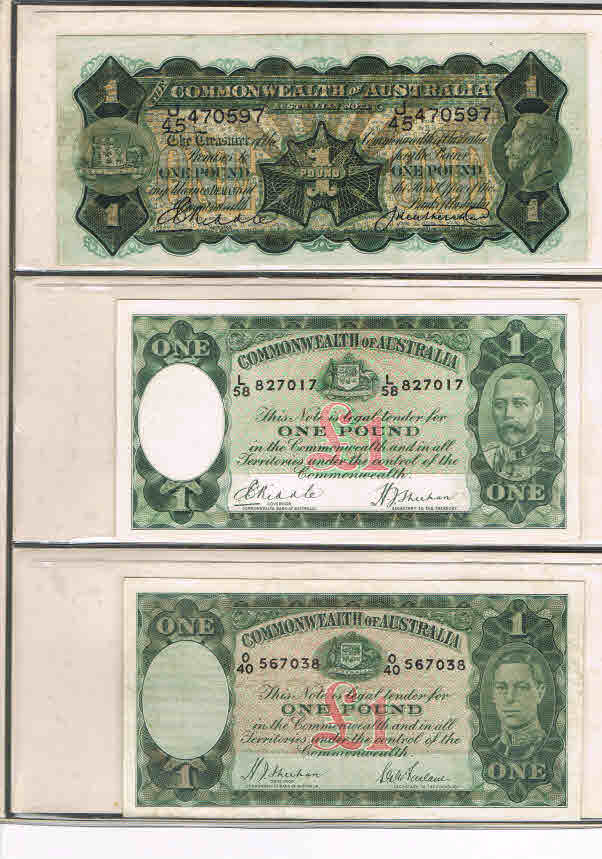 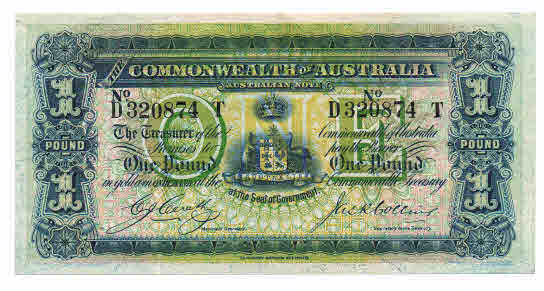 If anyone can let me know any info or approx valuations of these it would be much appreciated. Sorry of the quality of scans, first few times I've ever done it haha Edited by bigdamoc
11/06/2009 03:22 am
|
|
Pillar of the Community
Canada
1082 Posts |
Beautiful quality, nice notes...high end, but I'll defer to some of our other Aussie members, because they could answer your questions better regarding what these would bring there -- where the values would likely be the highest.
|
|
Pillar of the Community
Australia
1040 Posts |
The first one is Armitage/McFarlane, difficult to tell grades from scans, but I would say it is Ef or better. Ef is valued at $325, aUnc at $575 and Unc at $975. Yours may be Unc, but like I said, it is hard to tell from the pics.
The second one is Coombs/Watt, Ef $425, aUnc $700, Unc $1300
The third one is Coombs/Wilson, it looks to be uncirculated, value $375
The fourth one is another 'WOW' one. Riddle/Heathershaw, again, difficult to tell the grade from the scan. Vf $875, EF $2500, aUnc$5000, unc $9750
The fifth one is Riddle/Sheehan, looks to be in great condition, Ef $2100, aUnc $3850, unc $7000
The sixth one is Sheehan/McFarlane, Vf$325, Ef $825, aUnc $1450, Unc $2500
The last one is another 'WOW' Cerutty/Collins. Fine $2100, Vf $6250, Ef $21,000 aUnc $36,500 Unc $57,500
You really need to get these assessed. You have an important and valuable collection that would be incredibly difficult to replace in the event of loss or damage. The 'wow' notes here don't turn up all that often and a collection like yours will generate a lot of interest if you decide to sell them all at once. Australian banknotes have been an incredibly good investment over the last couple of decades. They have out striped virtually all other forms of investment. If you don't need to sell, this collection will only increase in value. If you do need, or want to sell, take your time and learn all you can to make the best decision. Like Sap said, auction will probably be the best way to go.
Please understand this next bit carefully. I have given you a few prices for each note based upon grade, VF being Very Fine, EF being Extra Fine and so on. Value of ALL notes and coins is based upon a few things, condition, as denoted by VF, EF etc, scarcity, which your "wow" notes definitely have, and demand, again, your 'wow' notes. Grading is subjective, you may want them all to be uncirculated because they are the most valuable, but if three dealers say it is EF, then that is what it is.
Placing your notes at auction will be the best way to determine value, people will pay what they think they are worth, with no other factors influencing.
Selling to a dealer might, and I say 'might', result in a slight down grading in the dealers favour. For what you have, you need to be dealing with the experts in this field.
If you approach a few dealers with the intent of obtaining valuations for insurance purposes, which will most likely cost a small fee, you will get a good idea of grade.
Edited by latman100
11/06/2009 11:04 pm
|
|
Pillar of the Community
Australia
1040 Posts |
Oh, and thanks for the pictures. It is great to see collections like this that have been hidden away for ages suddenly come to light.
|
| |
Replies: 26 / Views: 5,383 |
To participate in the forum you must log in or register.
Disclaimer: While a tremendous amount of effort goes into ensuring the accuracy of the information contained in this site, Coin Community assumes no liability for errors. Copyright 2005 - 2026 Coin Community Family- all rights reserved worldwide. Use of any images or content on this website without prior written permission of Coin Community or the original lender is strictly prohibited.
Contact Us | Advertise Here | Privacy Policy / Terms of Use
|
| Coin Community Forum |
© 2005 - 2026 Coin Community Forums |
| It took 0.43 seconds to rattle this change. |
 |
|
| |
| |







 Posted 11/04/2009 10:28 am


