| Author |
 Replies: 18 / Views: 8,915 Replies: 18 / Views: 8,915 |
|
New Member
United States
4 Posts |
Hello, I have a large coin collection my brother and I gathered over many years. 170 bi-centennial quarters for example, and lots of other stuff. The bag weighs 7 pounds and contains a lot of silver. I'm trying to send it to my brother who lives in Canada now, for his kids to continue the collection. I already tried to ship my "rock, stamp, and shell collection" in one 67 lb. box as a trial run and it was returned due to customs issues. UPS doesn't know how much the taxes will be until it arrives at the location, and I don't want to stick anyone else with a large bill. Is there a clean way to ship such things without getting charged an arm and a leg in taxes for items which have always already belonged to us? Thank you. Edited by fixmdude
11/05/2009 5:03 pm
|
|
|
|
Pillar of the Community
Canada
1082 Posts |
First of all, I don't understand why you are "getting charged an arm and a leg in taxes". If you're talking about duties, you must have declared the package wrongly, or didn't fill out the right Customs form, or something. Typically, "collections" are duty-free as long as there is some educational application to it. As well, I know for certain that stamps are duty-free worldwide under Universal Postal Union rules. It would seem to me that coins could easily be valued at face and be called a "Gift" if nothing else, which indeed they are at this point.
Second, I don't know why you would want to ship anything UPS when the USPS provides much better service and traceability. I know for certain that if your coins are lost by UPS, you're going to have fun trying to get them to settle your claim. Yet, sending them by Registered Mail through the Post Office gives you much better traceability to the point where it is highly unlikely they would disappear in the mailstream.
|
|
New Member
 United States
4 Posts |
I don't know why either. I shipped the collection and insured it for $2,000. The Staples UPS center filled out the forms for me when I shipped it. UPS called me to say that the forms were filled out wrong because I have to list prices separately for the individual items such as stamps, shells, and rocks, not one price for the whole collection, and, I can't claim anything worth over $60 as a gift when shipping to Canada, so the receiver will be charged duties. They wouldn't tell me how much for me to pay it up front so it's getting shipped back to me rather than stick the receiver with a large bill. (16% plus fees would be ~$350)
I tried UPS because it has a tracking number, is insurable if it's lost, and I've had equally ridiculous experiences with USPS in the past on non-related issues.
Sounded ridiculous to me too, that's why I'm on here asking!
Edited by fixmdude
11/05/2009 5:32 pm
|
|
Valued Member
Canada
124 Posts |
Shipping to Canada is a pain sometimes. The simplest things will raise a red flag and will stop your packages at customs.
You might have more luck sending several smaller packages and tagging them as a gift than 1 large package but I'm not sure what that means cost wise. I gave up trying to get people to send me things and just get my wife to deliver in person now since she's back and forth every other week.
|
|
Pillar of the Community
Canada
1082 Posts |
Ah, see, that's what you get when you ship by UPS. They're totally full of something, and it's not good intentions. Let's look this over point-by-point: Quote:
UPS called me to say that the forms were filled out wrong because I have to list prices separately for the individual items such as stamps, shells, and rocks, not one price for the whole collection... Okay, it makes sense to summarize the value for each type of thing in a breakdown fashion, for example: Stamps For Collector US$ 1,200.00 Mineralogical Collection US$ 300.00 Zoological Collection (Shells) US$ 200.00 ------------ TOTAL US$ 2,000.00 You would do this because this is how you would declare it at any Customs checkpoint anywhere in the world, wouldn't you? Of course you would! Quote:
I can't claim anything worth over $60 as a gift when shipping to Canada, so the receiver will be charged duties. Right in most cases, but wrong in this one, because Collectibles are non-dutiable and therefore, non-taxable. Quote:
They wouldn't tell me how much for me to pay it up front so it's getting shipped back to me rather than stick the receiver with a large bill. (16% plus fees would be ~$350) You would pay nothing, and neither would the receiver. One thing is for certain: UPS doesn't know what the (in the hot place) they're talking about. Quote:
I tried UPS because it has a tracking number, is insurable if it's lost, and I've had equally ridiculous experiences with USPS in the past on non-related issues. USPS also has a tracking number, but remember: faster isn't always better. Insurable? Read your fine print. They may say it's insurable, but they'll change their tune quickly if you have to make a claim. Equally rediculous experiences with USPS notwithstanding, if the item is something of value, send it by Registered Mail, which is kept separate from the regular mailstream and has to be checked in and out of every office where it's handled. It may be a little slower, but is definitely more secure. Here is an extract from the Canada Border Service Agency's (formerly Canada Customs) Tariff Ratebook which has a searchable database that can be found here: http://betterdollar.com/duty-tax/duty/You will note that all of the items you mentioned are free of duty. 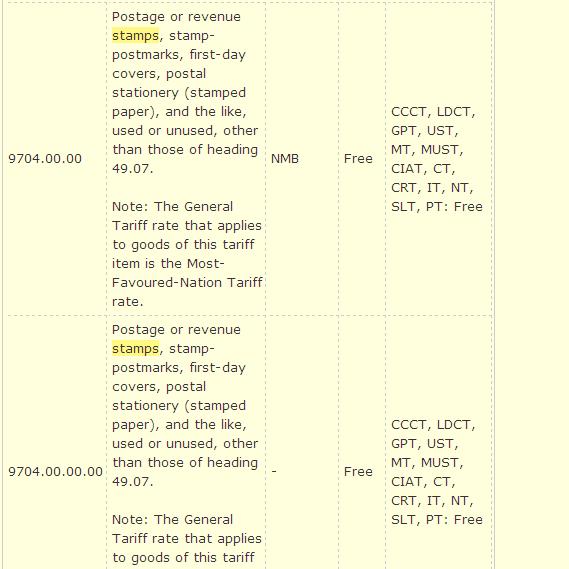 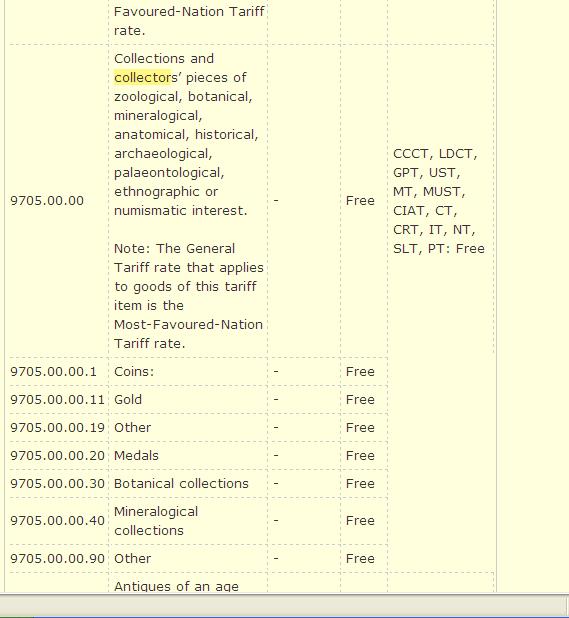 For information about USPS Registered mail, see here and note the rates of insurance coverage: http://www.usps.com/send/waystosend...lservice.htmAlso note that if you want to make your shipment go faster, you can bundle Registered Mail with Priority. As well, here is the Customs Form you would use on your package at: http://webapps.usps.com/customsform...ecipient.jspMy suggestion would be that when you get to the point where you're listing the items, you list them as such to make life easier for everyone: Stamps For Collector US$ 1,200.00 NOTE: NON-DUTIABLE UNDER
CBSA TARIFF NUMBER
9704.00.00Mineralogical Collection US$ 300.00 NOTE: NON-DUTIABLE UNDER
CBSA TARIFF NUMBER
9705.00.0040Zoological Collection (Shells) US$ 200.00 NOTE: NON-DUTIABLE UNDER
CBSA TARIFF NUMBER
9705.00.00 ------------ TOTAL US$ 2,000.00 ***NOTE: ITEM IS GIFT TO BROTHER AND IS A FAMILY POSSESSION***For your Coins it would be Coins US$xxx.xx NOTE: NON-DUTIABLE UNDER
CBSA TARIFF NUMBER
9705.00.00.1That should solve your problems and clear up UPS's misinformation. |
|
Pillar of the Community
Canada
1082 Posts |
Addition:
USPS may still use a single-sheet Customs form for parcels. If they do, your chore would be easier still.
As to sending a combined parcel, I personally would rather send items in their own parcel.
|
|
New Member
United States
4 Posts |
Thank you, that's what I was looking for!
|
|
Pillar of the Community
Canada
1082 Posts |
BTW, unofficial rule of thumb for Canada Customs Officers:
"If you can't get more than $5 in duty out of it, it's not worth doing paperwork for; let it through."
|
|
Pillar of the Community
Canada
598 Posts |
>>> edit >>> your list that has "Free" down that one column may lead one astray. That is the MFN column (MFN being cropped off the heading)... see below. I really must comment here. The MFN schedule does not preclude the application of GST/PST or Harmonized Taxes. The applied MFN tariff is on top of these taxes. Having an item fall within the MFN tariff schedule of exemptions means it will only have the appropriate provincial taxes applied. Schedule D provides exemptions for Ontario and B.C. only and only to very specific items. Here is the CBSA link to the very newest CBSA HARMONIZED CUSTOMS TARIFF - SCHEDULE (t2009-06-01-99-eng). http://cbsa-asfc.gc.ca/trade-commer...1-99-eng.pdfI will post Schedule D shortly (and the MFN list)... but in Ontario (and BC) PST is exempt on fine gold and silver whereas GST is applied when imported. When buying within the said provinces these tax applications are reversed. There is also a five dollar fee for Customs(CBSA) handling if the package is diverted for inspection. The word fine is also important... for instance sterling(.925 silver) and higher is exempt (as per Schedule D)... this is outlined as well in the Schedule, but anything lower would have GST, PST,(or Harmonized Tax) and a $5 handling fee applied in all provinces... if the item were not from a Most Favoured Nation, then that listed taxation percentage would apply as well. This is all for Postal Imports... private couriers use the same harmonization codes but charge a fee for their services to properly perform the documents necessary for cross border services(CBSA). Their fees are listed on their contracts and outrageous as they seem, an Ontario court recently deemed them to be fully disclosed in their contracts, and fully legitimate business expenses... not gouging as the litigant had set out to prove originally. >>> I'm gonna keep on editing >>> This magical US import gift exemption... if an item is a gift, the first $60 of value are not taxable... if the gift is worth $200, then the appropriate taxes will be applied to the remaining $140. For gosh sakes, collection is a collective term... like group, lot, pile o', etc... taxes apply, and if your stuff is coming from some nasty, evil country other taxes apply. It is not some arbitrary amount charged to an importer... using the proper codes and lists you can calculate the costs to the penny before your stuff is even sent. >>> edit >>> Memorandum D2-3-6... top of page 16. Ontario and BC exemptions... note "All others taxable". Taxes are GST, PST, Harmonization... duties are when MFN does not apply, and service fees(Canada Post or courier). http://cbsa-asfc.gc.ca/publications...-3-6-eng.pdf>>> more edits... let me ramble... ... as for the tracking number and collecting on a lost package. It has been 18 months now, all documents have been filed with the USPS as per their listed procedures... and I really do know what I'm doing. I don't get all huffy and send nasty words or such... just file the appropriate documentation as per protocol(and have the facts verified by a Customs Broker). The claim was decided in my favour... 5 months and... processing? I 'spose it would be the same with any lost parcel because most couriers seem to have very similar procedures... now how far would I have gotten as Mr. Attitude?... just the facts do nicely. >>> edit >>>... and another thing. If you use the actual CBSA list I've link to, you can find shells and mineral samples and umbrellas and... it all rite there. Sometimes I get upset when I see someone wanting a simple answer that really isn't... and then... oh, things got so terribly wrong. I hoped I corrected such. Your collections are not to be freely imported into Canada... unless they are not selected for inspection! >>> ok; last edit so as I can stop perusing government documents. This is a list of Most Favoured Nations(MFN Preferrential) Tariff countries/situations. The letters to the rite of that "Free" column posted up above... this is what they stand for. So, if this preferrential tariff is applicable, regular tax/duty applies.... if the MFN is not applicable, the listed percentage will be applied to the value above the regular tax/duty as per the schedule. http://cbsa-asfc.gc.ca/trade-commer...006CTA-e.pdfSo, the country of origin of a coin is where the coin itself was struck/hammered/molded/etc... not where it currently resides. Then the purity of such coin is also a factor(in certain provinces). Then the current value of the coin... in bullion or face, which ever is higher(seems like a bit of a grab here, but if the item is lost this works in your favour). If numismatic value exceeds both/either, then list fairly and retain itellectual property as such(KM# and value from recognized source/catalogue). Then where the coin is actually being sent from. Then where the coin is going; the different provinces as outlined in Schedule D. So, you can list the full code for your item(s) times the number of that item. The year on a coin makes no matter to the CBSA. The CBSA makes an honest effort, but, well... here's a bit of a recent letter I sent to re-coup some erroneous charges... I have since received full restitution. "This American (U.S.A.) numismatic coin was imported from the United States into Canada as part of my personal collection. The United States has Applicable Preferential Most Favoured Nation(MFN) Tariff(NAFTA/UST) status. Enclosed documents verify country of origin. I believe the PST amount to be exempt according to Memorandum D2-3-6 Appendix C regarding PST Exempt articles in Ontario. Customs Tariff-Schedule 71.08 is listed in the exemptions. This coin would fall into category 7108.20.00 00 Monetary. Being issued as a one dollar circulation legal tender coin in 1852 America." So, I remember one guy that said he was gonna stomp into the post office and demand this and that... bonne chance... bonne chance Edited by IBGolden
11/05/2009 10:03 pm
|
|
Pillar of the Community
Canada
1082 Posts |
You know, I see what you're saying, but in my experience, what they should be doing in theory and what they actually do in practice are usually two different things. I think it would be helpful if we knew where the sender and the receiver both lived. I would value the coins at face. The stamps I would lowball the value on, keeping in mind that 30% of Scott's is usually the normal "real" value. I have had collections come into Canada from the US from ebay sellers valued at up to $100 on the customs form admitted free of any charge with the words " ebay Auction Lot" written on the form. As to shells, they're likely worth whatever anyone would want to put on for a value, say even $20, and ditto the rocks. I would also send each type of item separate from the others. As to the $5 handling charge, this actually goes to Canada Post, but they are only supposed to divert items that they feel for sure would actually be charged for duty and taxes. Keep in mind that most of these clerks are overworked, and if a customs slip has a notation that the item is duty-free under Tariff number whatever, they will usually not bother diverting the package. If the item isn't charged, the fee can be easily appealed, as can any duty and taxes if you feel they aren't applicable, or were applied wrong. And of course, the Customs rule of thumb I mentioned also comes into play a lot more often than you might think. My sources? Experience with dozens of mail shipments, 20 years of living on the border, and eight years working inside the Post Office there. |
|
Pillar of the Community
Canada
598 Posts |
It is not what I'm saying. It is what has been legislated in Canada. I have not experienced any variation of these facts other than updates and minor errors that a simple letter sent back along with the CBSA adjustment form (that comes with your package) can correct.
... my experience, eight years of importing PMs. Go by the book. If something goes astray, you'll be better off. A one ounce Gold American Eagle has a face value of $50. If it gets lost do you want $50 in restitution?
Of course I hope my shipments are not diverted for inspection. Then I pay nothing extra. I'd say it's about 50/50 at this point... and it's all part of doing business. But, I sure as heck ain't gonna lie about contents. I pay for coverage and expect coverage. It is due diligence to be accurate. In the event of a claim... my "t"s are crossed and "i"s dotted.
A one time shipment... sure you can do what you like and hope for the best. But, what I was trying to help out with was the "why" part of cross border shipping costs. All costs are clearly defined on the appropriate sites... well, sure there's digging. I had to dig to find the new links posted above. I usually just use the same list I've printed for my most common codes.
My real peeve was with the list you posted as "Free" next to the items in question... you listed this fact in red, and claim these items as "NON-DUTIABLE UNDER CBSA TARIFF NUMBER..." Previous postal employee or not, that information is absolutely erroneous... the MFN may be free... but all other taxes/duties/tariffs apply as per the Schedule. You can actually look up the specific numbers you posted and find the provincial taxable rates on them. If the CBSA received such a claim, it would tax as per the schedule and offer no explanation... they are not interested in training anyone. It is little wonder that people are frustrated by such a system. I don't bother with articles that do not pertain to myself... but I learn the snot out of the articles that do.
|
|
Pillar of the Community
Canada
1082 Posts |
Except in this case the MFN is the one that is applicable, in this case the US.
The other thing is that Registered Mail never, or very seldom, goes astray because of the check in/check out/extra paperwork/extra special red bag/first to be handled and documented nature of it. To lose a Registered item at Canada Post causes all sorts of unpleasant things to happen, including investigations by their S&I unit, so it receives extra care. I doubt Registered items are treated any different by the USPS.
|
|
Pillar of the Community
Canada
598 Posts |
Quote:
Except in this case the MFN is the one that is applicable, in this case the US.
WpgLwr Again... incorrect. There would be no MFN tariff if the items were produced in one of Most Favoured Nations as listed (in this case the US is indeed MFN Tariff free), but these items would still be subject to the appropriate provincial taxes. All goods crossing the border whether by post, courier, vehicle, etc are subject to provincial taxes... to say all items produced in the US are not subject to taxation (as it appears you have gathered by looking at the one document you have posted) is absurd. You live near a border and I'm sure you are aware of the declaration when returning to Canada with items purchased in the US. The single document you have posted deals with the MFN Tariff only... check the GST/PST, Harmonized Taxation Schedules for your particular province to see what I mean.... eg.: 40% silver US coins imported to Canada; They would be subject to GST and PST but exempt from the MFN tariff. If they were .999 silver rounds coming into Ontario from the US (and the rounds were produced in the US or other MFN country), they would be subject to GST only... if they came by registered mail(to Ontario) and were inspected by Customs, add the $5 handling fee. Please understand that the CBSA documents deal with Canada... provicial taxes are applied for the particular destination and determined by your provincial authority not the CBSA. The information you appear to have gathered is compounding confusion on the matter. ALL items entering Canada are subject to GST, PST, Harmonized Taxes and MFN Tariffs. By using the schedules you can determine which (if any) taxes/tariffs(collectively called duties) are not applicable to your item. I can not find any other words to make this any clearer... and if you still believe that the items listed are "tax free", I give up... and it is no wonder you are frustrated by the apparent random nature of import taxation... I routinely deal with this matter with other people as well... and sometimes it's an epiphany and sometimes it's  |
|
Pillar of the Community
Canada
1082 Posts |
Yes, sales taxes can apply to items that are free of duty.
Customs in Canada are primarily duty collectors but usually if there's no duty to be collected, the simple reality is that they usually don't even bother to calculate any taxes on it. The paperwork they fill out when you declare something is primarily to assess a duty rate, on which they will then compute whatever GST and Provincial are applicable, but no duty, no bother.
Sorry, but I have never had a Customs officer assess me for sales tax only, neither in person, nor through the mail.
Like I said, I see what you're saying, but the theory is different from the practice. Of course, there is always room for a keener to throw a monkey wrench into things, but I haven't had it happen yet.
|
|
Pillar of the Community
Canada
598 Posts |
Okay. I agree with that. And that's why about half my stuff is simply sent on, bypassing Customs. And the other half has a great enough value to be worth the Customs assessment... over hundreds.
In the cases of assessment, I verify the harmonization code(s) et al, and if in error, I send a letter similar to the one I posted above... to Winnipeg!... as outlined on the back of the adjustment form on the package. Typically I'm just sending to re-coup the PST as outlined in Schedule D for Ontario. A cheque usually arrives in about 2 weeks.
In the cases of higher value shipments, I prepare the documentation and send it to the shipper... remember, I have no problem correctly identifying and valuing the contents for insurance purposes. And you are rite that the higher value item(s) are most likely to be inspected by Customs. I am not trying to put anything over on anyone... having made successful claims in the past, the cost is all figured into it and the peace of mind is, for myself, worth it.
I have had nothing but positive relations with the CBSA by communicating with them in an informed manner... sometimes they can be downrite pleasant. I guess I just go by the book, and doing so has yielded the most satisfactory results... your a stand up person WpgLwr and I just wanted to state the legal facts... and the actual positive fact of a package just being scurried rite past Customs inspection is always a pleasant one indeed, but I can not always count on this fact and ain't afraid to get my feet wet in a pile of, ah... it can be like a crossword or some kind of brain teaser... I'm usually up for the challenge of a little legalise and hoop jumping... keeps me in shape.
And did you hear the one about a California company that paid it's employee bonus in Gold Eagles(2)... a hundred dollars claimed the company... two thousand dollars claimed the courts.
>>> edit >>>... in the past six months all CBSA assessed items I've received were for Ontario GST and PST only. Only one adjustment claim form was required and satisfactorily successful.
Edited by IBGolden
11/06/2009 9:14 pm
|
|
New Member
United States
4 Posts |
Results are in, customs charged $335 in taxes on the package regardless of what I wrote on the form (as specified here "NON-DUTIABLE UNDER CBSA TARIFF NUMBER...". So, even though the box was full of nothing but rocks I picked up off the groud, shells off the beach, and cancelled used stamps ripped off of thousands of envelopes over the years, trash to most people, I still had to pay $335 in taxes to UPS & Canada for shipping it to my brother who took part in the collecting, all just because I happened to insure it for $2,000 due to it's personal sentimental value of being a lifetime of efforts. Now I'm afraid to ship the coins, those are actually worth something.
|
| |
Replies: 18 / Views: 8,915 |
To participate in the forum you must log in or register.
Disclaimer: While a tremendous amount of effort goes into ensuring the accuracy of the information contained in this site, Coin Community assumes no liability for errors. Copyright 2005 - 2026 Coin Community Family- all rights reserved worldwide. Use of any images or content on this website without prior written permission of Coin Community or the original lender is strictly prohibited.
Contact Us | Advertise Here | Privacy Policy / Terms of Use
|
| Coin Community Forum |
© 2005 - 2026 Coin Community Forums |
| It took 0.55 seconds to rattle this change. |
 |
|










 Posted 11/05/2009 5:15 pm


