| Author |
 Replies: 140 / Views: 50,439 Replies: 140 / Views: 50,439 |
|
Pillar of the Community

United States
4051 Posts |
I'm putting together some coin photo setups and am looking for feedback. At this point I'm wondering if any folks on the group would have interest in them. They'll be built from a microscope base, with a bellows mounted, a lens, and appropriate adapters. Here is a picture of the first one I built, followed by a photo taken with it. If there is enough interest here I will keep the forum up to date on my progress. Each setup is different! Pricing will be in the $300-$400 range depending on bellows and lens type. Thanks...Ray 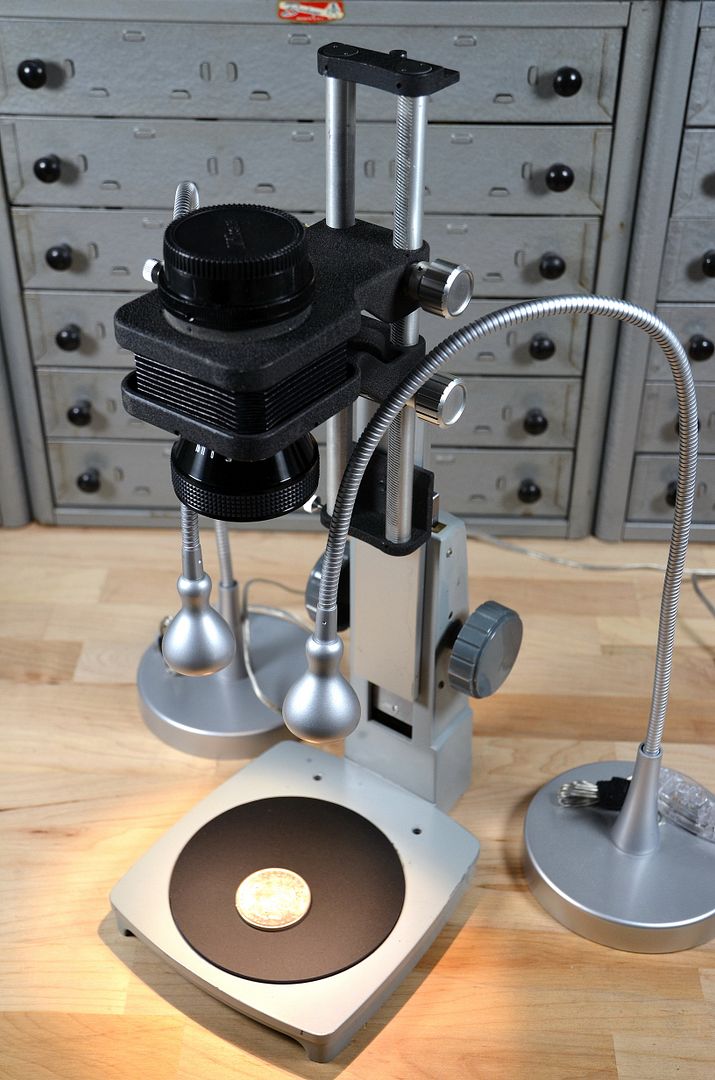  Edited by rmpsrpms
04/30/2011 10:38 am
|
|
|
|
Moderator
United States
14463 Posts |
that's a nice setup. What is the name of the stand that has your lenses? I have been looking for a mount for my digital microscope so I can fin e tune the adjustments
|
|
Pillar of the Community
United States
737 Posts |
Very nice and clean set up. Something to think about. Keep us posted.
|
|
Pillar of the Community
 United States
4051 Posts |
The stand is a Bausch & Lomb Stereozoom "A" stand. I removed the bracket that mounts the microscope pod and replaced it with a bar to mount the bellows onto.
|
|
Pillar of the Community
United States
1064 Posts |
Wow, your setup looks to be worth more than my entire collection! I'm going to have to re-think my little hand-held... Nice photos!
|
|
Pillar of the Community
United States
4051 Posts |
Thanks for the positive responses! The tough thing about putting these together is getting a wide enough view to frame larger coins. Most bellows setups are used for higher magnification. Here's a 1:1 crop of a pic with this setup at max magnification: 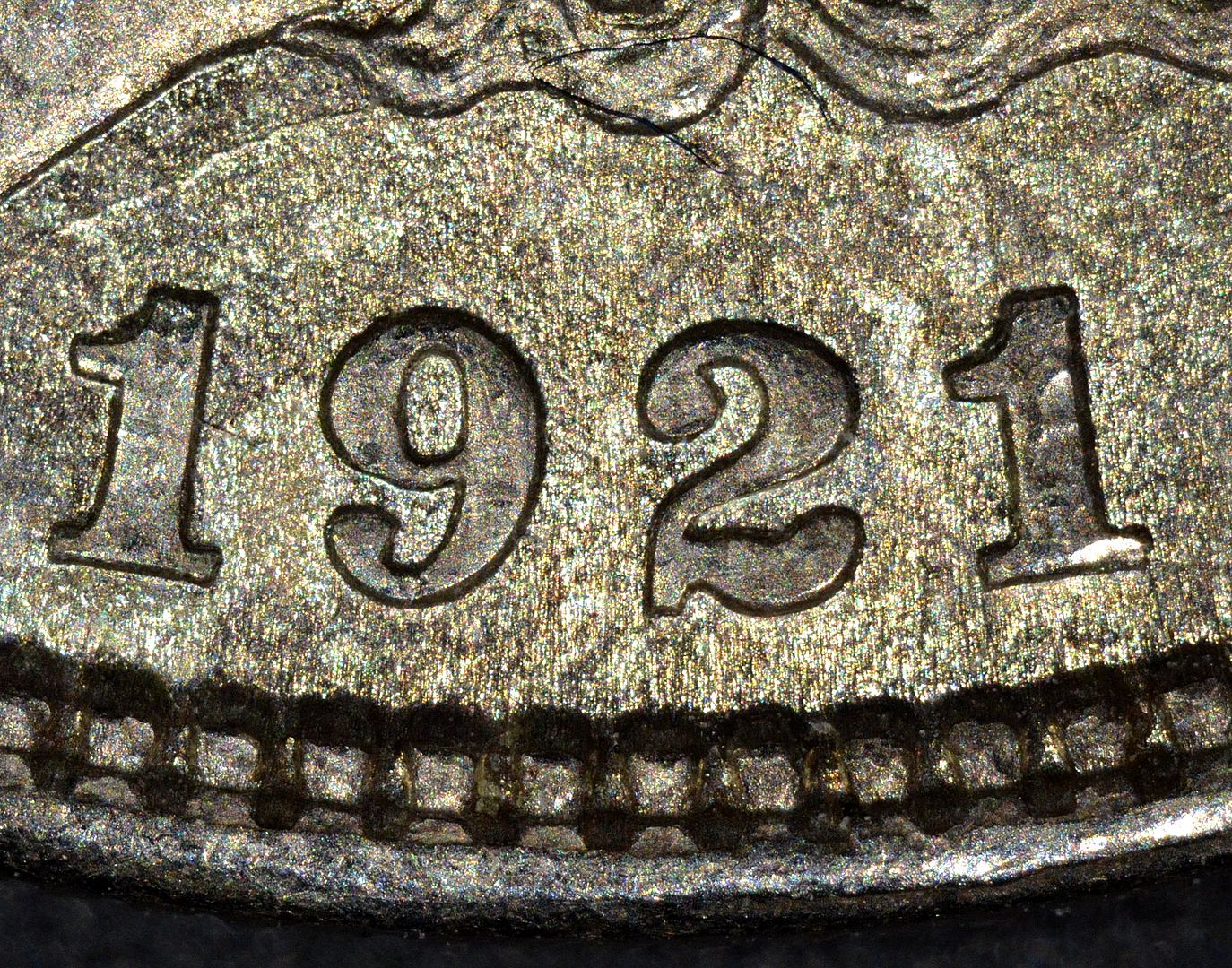 Edited by rmpsrpms
04/30/2011 10:39 am
|
|
New Member
United States
6 Posts |
I'm very interested in your setup. I dont really understand it. But I've been looking for something like this for a while.
How does it work? Where is the camera ?
|
|
Pillar of the Community
United States
4051 Posts |
You can see the Nikon lens cap on top of the setup where the camera attaches, so it should make sense that
the setup acts like a stationary camera lens. I can adapt the setup to any camera, but since I shoot Nikon
that's my default.
Now to explain the setup a bit...
For bigger coins, the distance from coin to lens is bigger, but distance from lens to camera is smaller,
so you simply adjust these two parameters until you get the magnification you want. For small coins,
or for detail shots, distance from coin to lens is smaller, and distance from lens to camera is bigger.
Note that this setup has no "communication" with the camera, ie camera has no idea what you've attached to
it. This forces you to use the full manual mode in the camera. If you can tether the camera to a PC then this
helps with setting it all up, but only a few cameras can do this effectively and it takes software to work
effectively. So most folks will work through the viewfinder.
Here is the overall procedure for taking a coin photo with this setup:
1) Open lens aperture to maximum
2) Adjust bellows length to approx magnification desired
3) Adjust lens height for best focus
4) Iterate 2 and 3 above while framing coin in viewfinder or on PC screen
5) Set aperture for desired resolution and depth of field (usually 5.6 or 8 for coins...)
6) Adjust Lighting for desired composition and effect
7) Adjust ISO and shutter speed
8) Shoot picture and check result
9) Iterate 7 and 8 above until correct exposure is achieved
Simple procedure, right? Some people will look at the above and freak out at how complicated it is, while
others will think that I've WAY over-simplified it. In reality, just getting the lighting where you like
it is a huge task on its own until you develop a feel for it, which may take hundreds of trial and error
photos. Nice thing about the dedicated bellows system is that once you have it set up for a given coin
size, only small adjustments are required for fine focus and such. You can remove your camera and go on
a trip, come back and the setup is still just right!
Edited by rmpsrpms
04/30/2011 10:43 am
|
|
New Member
United States
6 Posts |
I'm a collector, not a camera guy.
I have no idea what you just explained.
I'm not even sure if you can "dumb" it down for me to understand it.
I'm the guy who keeps the digital camera on "auto"
Thanks, Bruce
|
|
Pillar of the Community
United States
4051 Posts |
Bruce...I hear you. This is a pretty advanced setup, and a pre-requisite is a DSLR that can mount to it.
Nice thing about it is the body can be removed without messing up the setup, allowing you to easily use the body
for other photographic purposes.
Now, I just realized it is also possible to mount a dedicated USB camera to this setup as well. Maybe I should
hook one up and see how well it could work.
Edited by rmpsrpms
05/01/2011 1:05 pm
|
|
Locked
822 Posts |
Why would I need this instead of my $140 copy stand that works like a champ? |
|
Moderator
United States
23522 Posts |
Quote:
Now, I just realized it is also possible to mount a dedicated USB camera to this setup as well. Maybe I should hook one up and see how well it could work.
After a dSLR, you'll get nothing from a USB camera that will satisfy you. What lens are you using? Looks like you're getting about 2:1 to the sensor, which is darn good with that clarity. |
|
Pillar of the Community
United States
4051 Posts |
SuperDave,
There are some USB cameras that are pretty decent. I use a Tucsen 3MP on my micro setup and it gives a pretty
good image. They have 5MP and 9MP that I might upgrade to eventually.
These photos were taken with a Spiratone 75mm Flat Field Macro lens at f/7.1. Not an expensive lens, but does
a pretty good job. Nice thing is the Spiratone Macros are T-mount, so fit both the Spiratone as well as the
Vivitar bellows (as shown in the photo).
Ray
Contact me for photographic equipment or visit my home page at: http://macrocoins.com |
|
Pillar of the Community
United States
4051 Posts |
""Why would I need this instead of my $140 copy stand that works like a champ?""
A copy stand is not directly comparable to the full macro setup since the copy stand
doesn't include a lens, but in general there are pros and cons to both types of setups:
Copy Stand Pros
- Can get very far from the subject for plenty of lighting flexibility
- Corollary to the above is you can use longer focal length lenses
- Corollary to above is longer lenses often come with tripod mounts
- Tripod mount allows you to remove camera and not disturb setup
- Can mount a similar bellows and lens combination as the dedicated setup
Copy Stand Cons
- Focus adjustment is fairly coarse/imprecise, not good for high mag
- Few stands are rigid enough for high mag
- Large footprint on table top
- Longer lenses are generally lower resolution
- Camera must be semi-dedicated unless lens is permanently mounted to stand
- Still need to buy the lens
Dedicated Macro Setup Pros
- Fine and precise focus adjustment
- Rigid connection good for high mag/ better for low mag
- Wide magnification range
- Small footprint 6" x 8"
- Less expensive to upgrade lenses
- Better lenses available
- Fixed setup, can remove camera without disturbing settings
- Overall much cheaper than copy stand + macro lens
Dedicated Macro Setup Cons
- Slow to adjust bellows settings
- Manual operation, no autofocus, few cameras can auto expose
- Limited range of focal lengths for lenses due to compact configuration
- Closer camera to coin distance also means less lighting flexibility
- Takes more expertise to operate
Edited by rmpsrpms
05/01/2011 1:53 pm
|
|
New Member
United States
6 Posts |
Ray,
Thanks for all the advice!
I like the idea of the dedicated USB camera. I've used them and seem easy enough.
I've been looking around for a dslr but I feel that I won't be able to use it properly and therefore be wasting my money.
Let me know how you make out with the USB camera.
Thanks!
Bruce
|
|
Pillar of the Community
United States
509 Posts |
Thanks for your feedback on my own thread, Ray but actually, I've been following this one with interest from the beginning. Was hoping for more feedback to help explain your hardware since I'm at the "Camera for Dummies 101" level. Didn't want to ask any dumb questions but since no one else has, guess I'll jump in. Firstly, just what the heck is a bellows? I can see it in your set-up foto but is it part of the camera? What exactly does it do/accomplish? Secondly, where's the camera? I can see a lens (what looks like one) sticking out the bottom there and something that looks like a lens cover on top. I really like the look of that Bausch & Lomb Stereozoom "A" stand. Reading through your posts, I "think" it can be used to mount any DSLR camera without modifications? Just looking at the photo, it appears to be tabletop. (I'm thinking of available space I have). What are the maximum/minimum extension heights on it? It looks like precision personified. Lastly, those goosenecks look very versatile/adjustable. I use goosenecks myself but they don't look nearly that exotic. What sort of light do they provide?
|
| |
Replies: 140 / Views: 50,439 |







 Posted 04/30/2011 05:02 am





