Coin Community Family of Web Sites Join Thousands of Coin, Bullion, & Money Collectors
Vancouvers #1 Coin and Paper Money Dealer 300,000 items to help build your collection! Coin, Banknote and Medal Collectors's Online Mall Royal Canadian Mint products, Canadian, Polish, American, and world coins and banknotes. Join Thousands of Coin, Bullion, & Money Collectors Specializing in Modern Numismatics Royal Estate Auctions - $1 Coin Auctions


Username:
Password:
Save Password
Forgot your Password?


This page may contain links that result in small commissions to keep this free site up and running.

Welcome Guest! Registering and/or logging in will remove the anchor (bottom) ads. It's Free!

8 Reales Edge Question

To participate in the forum you must log in or register.
First Page Previous Page  Showing last 15 replies.
Author Previous TopicReplies: 51 / Views: 15,774Next Topic
Page: of 4
Pillar of the Community
Australia
653 Posts
 Posted 02/03/2018  8:28 pm  Show Profile   Bookmark this reply Add Squire Wilson to your friends list
Yes swamperbob, I do not mind the odd "historical counterfeit" in my collection. I have just posted such an example on the address at http://goccf.com/t/293348

However, I have no time for the flavourless creations of modern counterfeiters. These totally lack the vital ingredient of "historical depth".

Squire
Pillar of the Community
Australia
653 Posts
 Posted 02/05/2018  12:36 am  Show Profile   Bookmark this reply Add Squire Wilson to your friends list
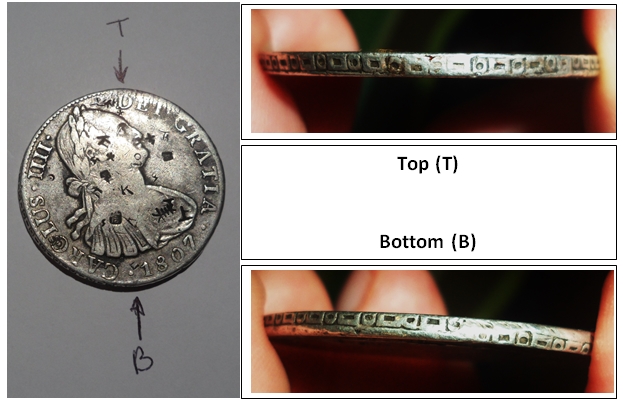
Following up from the comments of swamperbob and colonial john I have exmined the rim of the 8 Real piece that I bought recently for the "rim overlap" areas. I have attached a photo collage showing the most likely areas. I hope this helps in classifying the coins pedigree.
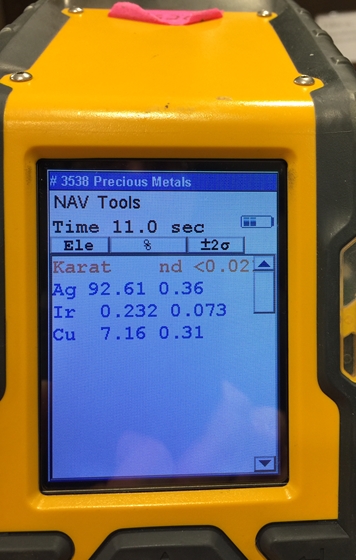
More excitingly, I have visited a friendly coin shop and have obtained an XRF reading on the coin. The output is presented as follows:
Element: Percent : 2 times standard deviation
Silver (Ag) : 92.61% : 0.36%
Copper (Cu) : 7.16% : 0.31%
Iridium (Ir): 0.232% : 0.073%
I think the Silver content is very satisfying . This affirms the chop marks as authentic classifications of the correct silver purity by the Chinese traders.
Also the Iridium content is interesting. From reading the literature Iridium is often associated with Platinum and this may have a South American connection.

Any comments that can help me on my "8-Real Heritage Quest" would be much appreciated

Squire

8-Reales-Edge-Question
Pillar of the Community
United States
5362 Posts
 Posted 02/05/2018  05:44 am  Show Profile   Bookmark this reply Add swamperbob to your friends list
Larryh86GT Now we have some real scientific evidence to evaluate.

The XRF Test indicates:


Quote:

Silver (Ag) : 92.61% : 0.36%
Copper (Cu) : 7.16% : 0.31%
Iridium (Ir): 0.232% : 0.073%


There is no detectable gold in the coin. Therefore the coin was not made at any date prior to 1850 in the UK. Since the UK ceased their manufacture in 1850 and Iridium is unknown in English silver deposits. This places your coin in the most likely made in the US category. This also moves the likely date of manufacture to some point AFTER 1880. The reason for this dating is the lack of gold - period.

As you indicate, the chop marks do mean the coin was certified by the Chinese Schroffs as genuine silver. This is a physical confirmation that the coin was in China. The Schroffs certified the coin using Specific Gravity testing after 1835. However, they did not certify the coin was made in Mexico nor that it was made in 1807 the date on the coin.

Iridium is actually not a trace element I would expect to see in such a large amount (1/4 percent) in any coin. It is a bit of a surprise. It however does nothing to effect the status of the coin as a Class 2 Silver Circulating Counterfeit.

The Ag to Cu ratio shows, with Ag 2 1/2 percent high and Cu 2 1/2 percent low, is what I would call appropriate surface silver enrichment due to the final acid bath before it left the "factory" for China. To clean off dirt grease and other crud most metal works producing silver bathe their finished products in warm diluted acid. Mexico City did it and so did the US silver industry in the 1880s.

You have pictured the edge overlaps correctly. I have circled where I believe the lap occurs in yellow.
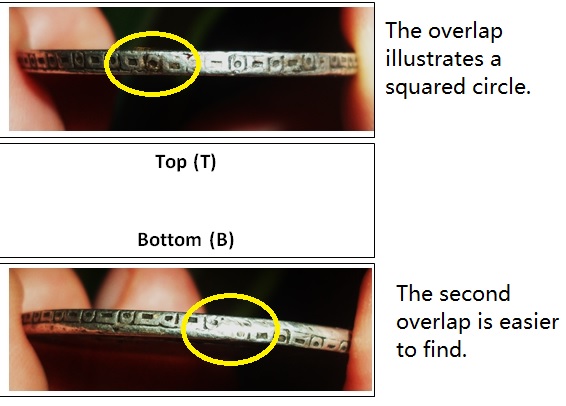
8-Reales-Edge-Question

They are 180 degrees apart. They are also the same length. That indicates the counterfeiters were using a correct 2 die mill (a so called Castang machine). The Spanish called it a mill and the coin was called a milled dollar. Here is a similar edge mill from 1763.
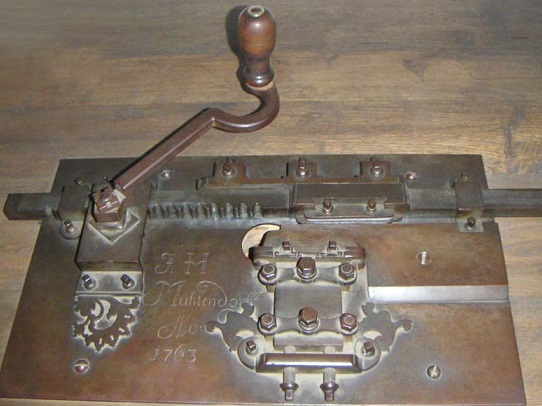
8-Reales-Edge-Question

The critical take away from the edge pictures are the incorrect shapes used on the edge dies. Note in particular the circles that are not circles. Look at the circle nearest to the left side of the yellow elipse at the bottom of the picture. The circle has a FLAT side. They should not. Note also the varying wall thicknesses of the circles and rectangles and the fact that the three segments are not grouped as such.

The Matrix block used to make punches for working dies in Mexico consisted of a Rectangle, a Circle and another Rectangle. You can see a picture of the actual 1772 Mexico City Matrix Block in Gilboy's book on Columnario's. The three element punch was repeated in the groove in the die block about 6 or 7 times to make a full edge die. The rectangles are the only overlapped element. That was intentional to keep the alignment and spacing proper. The circle was never doubled and should never be clipped. Here is how I visualize the overlap of the individual punches as they are applied 1-2-3.
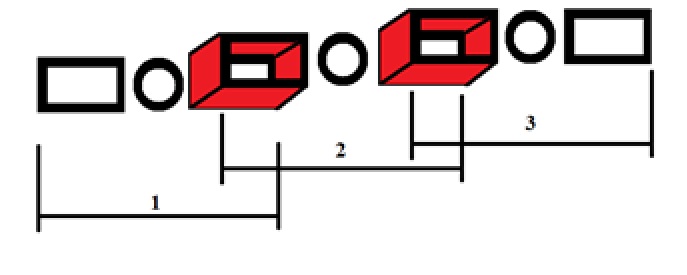
8-Reales-Edge-Question

The actual edger die did not have to be very long to do half of the edge of an 8R. Less than 3. Here is a blow up of the same 1763 edger to show the grooved edger die. The coin could not wobble in the groove and there should be no side to side drift.
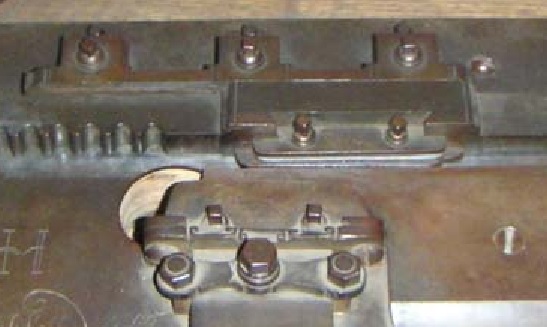
8-Reales-Edge-Question

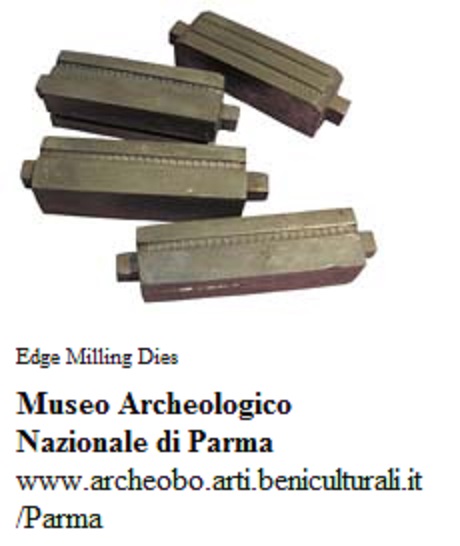
Here is a picture of a few dies that were used in an edging mill. In each case the die details would be found at the base of a groove machined into the edge die.
8-Reales-Edge-Question

Regarding your comment about the Platimum - Iridium connection being South American. You are correct. That happened in Columbia where Platinum was found in placer deposits along with gold.

Geology tells us that heavy metals like gold and silver come from miles below the earth's surface and that deposits near the surface are primarily associated with active volcanic zones where plates were colliding millions of years ago. The rocks of the crust cracked under the pressure of plate movements and superheated liquid quartz carrying metals rose into the cracks and filled them. The filled cracks are referred to veins they spread in vein like patterns.

Eons later after the mountains cooled and eroded the veins were exposed at the surface. The upper parts of the veins that had already eroded away are now found in the gravel and sands of streams that cut through them. These are placer deposits and can be recovered by panning. They occur down slope from the veins.

The rock still containing the veins are referred to as hard rock deposits. Miners tunnel through the rock along the veins to remove the metal bearing rock.

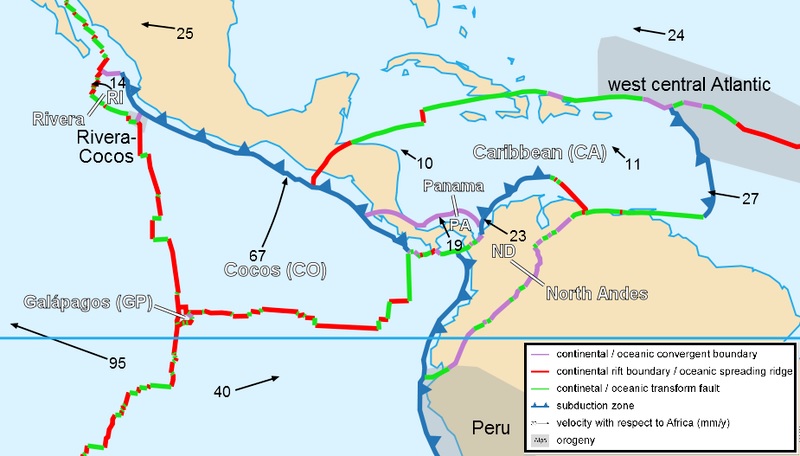
So where are these veins. They tend to occur near and along plate boundaries. In Central America 5 different tectonic plates come together. All of Mexico north of Belize is located on the North American Plate and so is the US. The old active fault system where metal is found runs along the Mountain range that extends from south of Mexico City to California and Nevada. All of the Mexican mines are located on this plate. From Belize to Panama the land formation is due to the collision of the Caribbean Plate on the east and the Cocos Plate on the west and the Nazca Plate from the southwest. These are Oceanic plates and the Caribbean Plate is sliding over the Cocos and Nazca Plates. Colombia is located on the North Andes Plate a continental plate. Bolivia, Peru and Chile are on the South American Plate. See picture below:
8-Reales-Edge-Question

The tectonic plate that includes the Mexican uplift (North American Plate) is not the same plate as the one in Columbia (North Andes Plate). The uplifts and the infiltration of heavy metal into the rock formations occurred at different times millions of years apart. The elemental compositions are not the same hence the trace contaminants are different.

I hope this helps. You can see how several areas of science and history come together to help identify these coins.

colonialjohn I read the article yu pointed out. The subjects discussed involved coins found in archaeological deposits which have become brittle due to electrochemical corrosion and chemical trasformation of the crystaline structure of the metal over many years. The coins we are reviewing in Class 2 discussed here were not subjected to the same forces and prolonged exposure that the silver in the study were. Some Class 1 coins like the thin plate Sheffield counterfeits, some cold welded silver foil over copper coins and electro-types may be applicable if they were recovered in digs. The corrosion and breaking of bonds here is straight forward. Corrosion follows the silver to copper boundary seam and over time breaks the bond causing the silver layer to become detached. The surface cracks referred to here are solidly affixed to struck coins, show no delamination and often date to the pre-strike planchet as demonstrated by differential compaction by the force of the strike.



Pillar of the Community
United States
1757 Posts
 Posted 02/05/2018  3:10 pm  Show Profile   Bookmark this reply Add colonialjohn to your friends list
IMO unfortunately this analysis does not make any sense due to the HIGH iridium value by ITSELF. I suspect this is a hand held XRF gun and it may not have been properly calibrated or sensitive enough to pick up all the trace elements. Usually with platinum we see a osmium-ruthenium-iridium group and also with gold we see platinum possibly if South American in origin.

I agree it is a Class 2.

I have a Class 2 coming up for sale in a week or two on ebay, Its an 1808 with 90% Ag. Crude Edge. Its assay: Silver (90.12%), Copper (9.36%), Lead (0.13%), Platinum (0.09%): False reading?, Indium (0.02%), Mercury (0.01%), Zinc (0.02%), Gold (0.2%), Bismuth (0.01%) and Iron (0.003%). This was done with a $250,000 XRF Edax Orbis in a vacuum chamber.

My point there should be more metals listed here in this assay. IMO at this point more fingerprint analysis and SEM/EDS microstructure analyses are really need in GNL Class 2's. We got the silver level correct of course and everything is correct in GNL but in some ways the Class 2's are the most difficult to understand and IMO more research is needed in their alloy make-up and microstructure and trace element signatures.

As David Scott so ably indicates in his classic work "Gold and Platinum Metallurgy of Ancient Columbia and Ecuador" = Most gold contains silver and copper while native platinum may contain varying quantities of iron, copper, rhodium, palladium and iridium.

Iridium by itself? Unfortunately as I have been told XRF guns can only shoot generally one area per coin based on their wide aperture size and as alluded to before I question the calibration of this XRF gun prior to its analysis of this piece.

In terms of surface embrittlement I will bend on this one Bob.

LOL.

JPL
Edited by colonialjohn
02/05/2018 3:12 pm
Moderator
Learn More...
Canada
10463 Posts
 Posted 02/05/2018  4:39 pm  Show Profile   Check SPP-Ottawa's eBay Listings Bookmark this reply Add SPP-Ottawa to your friends list

Quote:
Silver (Ag) : 92.61% : 0.36%
Copper (Cu) : 7.16% : 0.31%
Iridium (Ir): 0.232% : 0.073%


Iridium is from the XRF primary beam source itself. That means that you are getting either attenuation of the X-Rays because they did not strike the target, or direct bounce-back from the surface of the coin to the detector.

Most hand-held XRF instruments will do this, and even bench-top XRF machines can give Iridium readings in "alloy" mode.... trust me, there is no Iridium in that coin. The key to using an xrf gun or xrf analysis well is to understand its limitations and plenty of practice on known materials which the xrf can and does get wrong, having said this they are a fantastic tool if used correctly.

It is even better if you understand how the electrons are being displaced from their orbital shells, and how to decipher false signals generated by secondary peaks (lead-rich coins are nasty for doing this... the secondary peak for lead is pretty hard to most detectors to discern from hafnium (Hf)... I routinely refer to this custom version of the Periodic Table:

https://chem.libretexts.org/Core/An..._XRF_Spectra
"Discovery follows discovery, each both raising and answering questions, each ending a long search, and each providing the new instruments for a new search." -- J. Robert Oppenheimer

Content of this post is licensed under a Creative Commons Attribution-NonCommercial 3.0 Unported License. See: http://creativecommons.org/licenses...0/deed.en_US

My eBay store
Moderator
Learn More...
Canada
10463 Posts
 Posted 02/05/2018  4:56 pm  Show Profile   Check SPP-Ottawa's eBay Listings Bookmark this reply Add SPP-Ottawa to your friends list

Quote:
Geology tells us that heavy metals like gold and silver come from miles below the earth's surface and that deposits near the surface are primarily associated with active volcanic zones where plates were colliding millions of years ago.


swamperbob, it is just a little bit more complicated than that.... you get all kinds of mineral deposits from tectonics if you are approaching it at that scale. Vein deposits (or lode deposits) are actually a product of intrusive plutonic suites, which of course, drive the hydrothermal engines that transport hit fluids upwards into veins, which ultimately, result from come plate tectonics (on the grandest scale). Those hot fluids can also deposits these precious metals at high temperatures within the upwelling instrusive magma itself (Porphyry deposits) or in low temperatures (skarn deposits) - both of which can produce nuggets, and both of which do not deposit their metals in veins...

But, it is when continents pull apart, that you get the volcanogenic massive sulphide deposits with precious metals. Back-arc basins are the ideal target for these.

Structural features such as cratonic or basement shear zones also can dictate where metals will be emplaced... the tectonic image you show is the present day, most of the metal deposits in the area in question were emplaced well before North and South America joined together about 4.5 million years ago...

I suspect the majority of the precious metal deposits mined from the 1300s to the 1700s were placer deposits. In areas close to the equator, the chemical weathering of lithic minerals is pretty acute, so in one simple sedimentary cycle, you can go from a lithic rock containing low grade precious metals to a quartz-rich placer deposit with heavy minerals (like precious metals) concentrated by depositional processes...

(CCF Staff Geologist)
"Discovery follows discovery, each both raising and answering questions, each ending a long search, and each providing the new instruments for a new search." -- J. Robert Oppenheimer

Content of this post is licensed under a Creative Commons Attribution-NonCommercial 3.0 Unported License. See: http://creativecommons.org/licenses...0/deed.en_US

My eBay store
Pillar of the Community
Australia
653 Posts
 Posted 02/06/2018  12:44 am  Show Profile   Bookmark this reply Add Squire Wilson to your friends list
Wow, what an amazing response from swamperbob, colonialjohn, SPP-Ottawa.
I think this is numistmatics at its finest

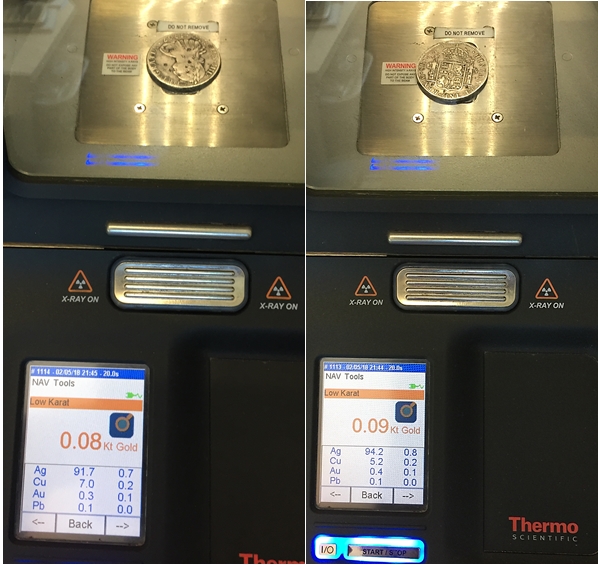
Following on from comments regarding the accuracy of the XRF scan, particularly regarding the Iridium result I visited a Bullion dealier and he kindly scanned both sides of my coin with his "Thermo Scientific XRF scanner. I wanted a second opinion regarding the metal content.
The result has really "thrown the cat amongst the pidgeons" !
Results are as follows:
Obverse of coin:
91.7 percent Ag, 7.0 percent Cu, 0.3 percent Au, 0.1 percent Pb
Reverse of coin:
94.2 percent Ag, 5.2 percent Cu, 0.4 percent Au, 0.1 percent Pb.
The dealer also kindly examined the coin by magnifying glass and also tested the thickness using calipers. He pronounced it a genuine old coin and not a "recast". In particular he mentioned the silver and trace gold combination is a result of very old silver refining processes.

To show that I am "fair dinkum" (serious), I have attached pictures of the scanning results. The first one is yesterdays result from one side of the coin, the second is todays result.

Comments would be very welcome indeed. I am particularly intrigued by the variations in the trace metals.

Squire

8-Reales-Edge-Question
Pillar of the Community
United States
5362 Posts
 Posted 02/06/2018  02:29 am  Show Profile   Bookmark this reply Add swamperbob to your friends list
SPP-Ottawa Very good information which I do understand. My comments above have been tailored to the audience because even SG testing seems to trouble many members of the forum. I am not saying anyone here is "stupid" by any means. I am merely trying to use the KISS principle which I learned as an instructor in first year Chemistry at UMass.

Simplicity or even "over-simplicity" from a technical perspective is less harmful than a fear based ignorance of the scientific basis for the examination of coins in general. Left in the hands of professional authenticators the limitations of the handheld XRF can be overcome.

When I introduced plate tectonics it was not to complicate the situation but point out a simple reason for why not all of the mineral deposits could be presumed to be identical i.e. South American (Colombian) deposits containing Platinum can not be presumed to match the Mexican deposits which on a macro level are platinum deficient. I understand that the plates continue to move to this day but I could not locate appropriate diagrams within the time frames I was faced with, plus it would also be confusing to people who do not understand tectonic activities in general.

Squire Wilson The new results show lead and gold as trace contaminants. This new information combined with the absolutely incorrect application of the edge - most likely points in the direction of Birmingham between 1830 and 1850 as the origin of your coin.

The coin remains a Class 2 type only an earlier one than the other test would indicate. In the Birmingham vicinity there are lead mines which are a primary source of silver in the English midlands. These were operated from antiquity in the area of Derbyshire just south of Sheffield (the one of Sheffield Plate fame) which is just north of Birmingham. These mines produce silver as a by-product of lead refining and their location roughly midway between Sheffield and Birmingham points to them as a likely source of silver for Birmingham itself. Galena was the most plentiful ore in the area the presence of lead gold and silver in one deposit is the clue.

Matthew Boulton of Birmingham (associated as we know with many coining developments and always a suspect in the British production of "authorized" counterfeits) partnered with James Watt of steam engine fame to manufacture engines so that the depth of mines in the area could reach below the water table. Steam engines made to pump water was the initiating force behind much of the industrialization in England.

So I find the confluence of history and science in this coin to be particularly interesting to speculate upon. I also see it as a potential solution to an issue that has bothered me for some time. Why do some 8Rs with small chops appear to be late Class 2 issues and others do not?

Small sized Chinese Chops are typically thought of as the earliest of the chop forms. Larger more damaging chops are typically thought of as arising later typically after 1850.

I was a bit concerned that diagnosing your coin as post-1880 Class 2 might be a conflict of sorts. It was another of the "late class 2 coins" to appear with small chops. I have seen similar results in the past and I now intend to re-examine several coins in my collection for this reason.

It may be that I also need to retest my coins to see if recalibration of early hand held XRF results will reclassify all of the small chop coins to England as opposed to the US.

coloneljohn I agree with your assessment of the Iridium level. Higher than any I recall but I did not check all of my results to be sure. Given the revised results of the tests the level was incorrect. I would like to know specifically what was changed. It could help me in preforming retests on the small chop coins in my collection.
Pillar of the Community
United States
1757 Posts
 Posted 02/06/2018  10:04 am  Show Profile   Bookmark this reply Add colonialjohn to your friends list
Still Class 2 due to diagnostics. XRF assay is correct now IMO for an instrument with a detection limit accuracy of say 0.1%. Note the lead as an ore contaminant, trace gold from the high silver presence and copper added for hardness in my opinion in the alloy. These Class 2's are tough based on their diagnostics to differentiate from regals without really delving into GNL. They will continue to be slabbed, fool collectors and always be considered as legitimate pieces for ALL time. Who has the knowledge, time and patience to differentiate OUT these China trade pieces. Its a good lesson here ... when in doubt VIEW THE EDGE.

GREAT THREAD!

Not a self promotion but just my opinion the silver electrodeposited Cap and Rays I introduce in my new book (FORGOTTEN) IMO are unquestionably JUST AS TOUGH. Sometimes all we can do is report and hope for the best.

JPL
Pillar of the Community
Australia
653 Posts
 Posted 02/06/2018  11:51 pm  Show Profile   Bookmark this reply Add Squire Wilson to your friends list
I was intrigued about the difference between the XRF scans from the Coin Dealer and the Bullion Dealer, results shown in my previous post.
Therefore I decided one more XRF scan from a Jeweller.
This result is 92.5% Ag and 7.69% Cu. No other trace metals registered on the XRF scanner.

The way I interpret this is that the Bullion Dealer had the best XRF scanner as this showed up the widest range of trace metals.
The Coin Dealer showed Iridium and I think that this is derived from the primary beam sources, as per the explanation given by SPP-Ottawa.
The Jeweller's XRF machine is simply not sensitive enough to pick the trace metals.
Comments from Coin Community Forum members would be very welcome.

On another point, is there a reference about the Chinese Chop Marks on the coin? This would futher assist in assigning a history to this coin.
I have a Chinese colleague at work and I will show her enlargements of the Chop Marks on my coin soon. She may be able to help me interpret these. I will certainly let CCF members know of my findings.

Squire
Pillar of the Community
United States
1757 Posts
 Posted 02/07/2018  08:45 am  Show Profile   Bookmark this reply Add colonialjohn to your friends list
Hand held XRF's vary but some have instrument detection limits (IDL's) only to 0.1% so accuracy is normally "A POWER OF TEN" upward from this IDL or 0.1% X 10 = 1% to be clear here. That much iridium was clearly an error in the detector for whatever reason. In terms of Chinese chop marks I doubt they will show origin to a specific area in China ... most are translated into common every day sayings but not talking here about the authenticity of chop marks. You saw how well made this piece was and the level of silver so it was authenticated in Canton or wherever many times. That is why GNL Type 2's are so tough ... the Ag reading can at times be near 90% or even 85% with a little more lead and so many are slabbed. Without XRF and IMO the edge and the denticles around the edge are valuable tools as described in GNL to determine whether regal or Class 2. The only problem is if in a slab its difficult to check 180* overlaps. In the end and sad to say - what you don't know ... can't hurt you as a GNL Class 2 in a TPG.
Pillar of the Community
Australia
653 Posts
 Posted 02/10/2018  7:49 pm  Show Profile   Bookmark this reply Add Squire Wilson to your friends list
Thank you for the information colonialjohn

Squire
Edited by Squire Wilson
02/10/2018 7:49 pm
Pillar of the Community
Australia
653 Posts
 Posted 02/14/2018  12:40 am  Show Profile   Bookmark this reply Add Squire Wilson to your friends list
During my recent web browsing I found an interesting article regarding British (Birmingham) restrikes of the Spanish 8 Reale piece as posted by the San Jose Coin Club on page 3 at http://www.sanjosecoinclub.org/NL/2...News%201.pdf

I hope this is of interest to CCF members

Squire
Pillar of the Community
United States
5362 Posts
 Posted 02/14/2018  01:28 am  Show Profile   Bookmark this reply Add swamperbob to your friends list
Squire Wilson Very interesting article. Must have been written by a genius.

Actually that is a copy of one of my first articles on counterfeit coins written for this forum. Can't remember how far back it goes but probably it was written in 2005 or 2006 a couple years before I started writing my book.

I re-read it and the only "fact" that I now consider to be incorrect is the list of Birmingham related counterfeits found in Coronado's book. I include a refutation of the list and classifications provided in Coronado's book in the Notes and Comments section of Appendix 2 of my book "Counterfeit Portrait Eight-Reales, The Un-real Reales." The Coronado book gives no citation for any list of Birmingham coins by date but several that were actually illustrated are simply incorrect for the category of coin types. In general Coronado's book is not worth buying.

The rest of the article is still a good general summary.
Pillar of the Community
Australia
653 Posts
 Posted 05/19/2018  04:14 am  Show Profile   Bookmark this reply Add Squire Wilson to your friends list
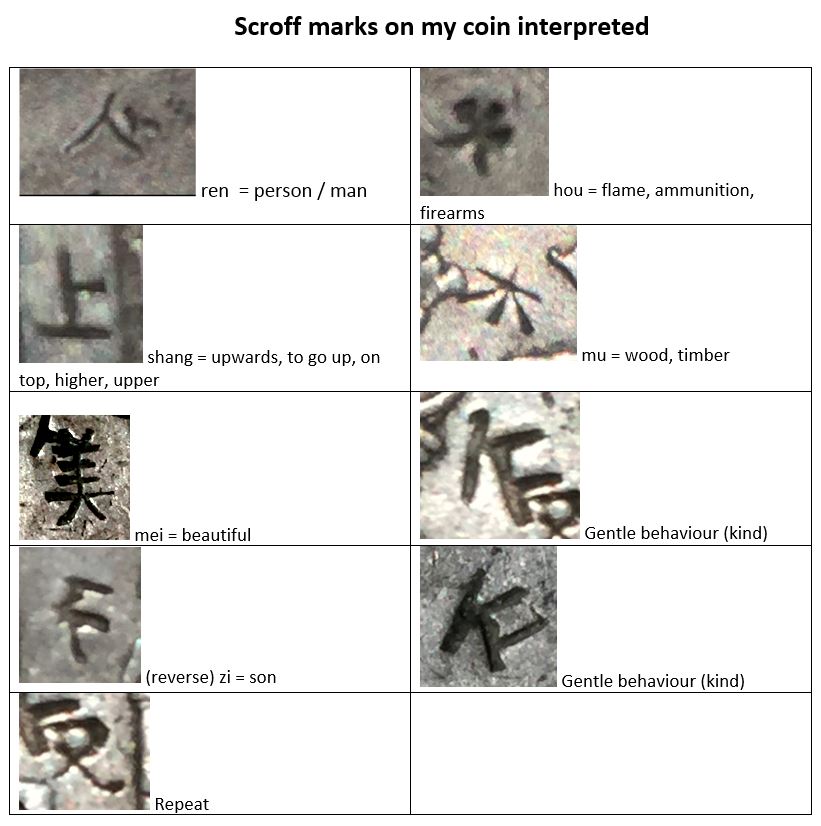
i have been fortunate to meet up with a colleague at work who's grandfather is from southern China. I showed my 8 Reale coin posted in this topic with the Chinese chop marks on it.
The elderly gentleman deciphered some of these for me. I have attached the scroff marks and their translations below.

It would be interesting to know if research has been conducted into linking these marks to particular establishments or even particular families or individuals that lived and worked in this region during this time.

That would add fascinating insight into the "life story" of this classic coin.

Squire

8-Reales-Edge-Question
Edited by Squire Wilson
05/19/2018 04:15 am
Previous TopicReplies: 51 / Views: 15,774Next Topic
Page: of 4
First Page Previous Page  Showing last 15 replies.
To participate in the forum you must log in or register.


Disclaimer: While a tremendous amount of effort goes into ensuring the accuracy of the information contained in this site, Coin Community assumes no liability for errors. Copyright 2005 - 2026 Coin Community Family- all rights reserved worldwide. Use of any images or content on this website without prior written permission of Coin Community or the original lender is strictly prohibited.
Contact Us  |  Advertise Here  |  Privacy Policy / Terms of Use

Coin Community Forum © 2005 - 2026 Coin Community Forums
It took 0.45 seconds to rattle this change. Forums