| Author |
 Replies: 38 / Views: 11,096 Replies: 38 / Views: 11,096 |
Page 3 of 3
|
|
|
|
Valued Member
Canada
472 Posts |
|
|
Pillar of the Community
United States
4253 Posts |
|
|
Pillar of the Community
United States
5155 Posts |
That new style is super dee-duper nice  , that must have set you back quite a bit.  Very very nice.  Edited by Ancientnoob
08/15/2012 12:50 pm
|
|
Pillar of the Community
United States
1316 Posts |
Dionysos, Wow,that's the coin that brought me to Ancients, haven't got one yet....Very nice.... ... you and stevex6 most buy from the same dealer.....  |
|
Bedrock of the Community
 United States
10045 Posts |
Wow is right! I especially like the centering and details on the first coin! |
|
New Member
Australia
5 Posts |
Hi Folks
These Attica, Athens coins are certainly one of the most famous coins that collectors can easily find. While for the most part they are not cheap for the high end specimens - there are many affordable examples around. Many people do not realise that these coins were struck abroad in places far from Athens such as Egypt. Because they were minted over hundreds of years its fascinating to track the style changes, minting variations and metal changes throughout history.
Regards
Cameron
|
|
Pillar of the Community
United Kingdom
2121 Posts |
I haven't bought an "old style" that wasn't damaged by test cuts or bankers marks yet let alone gone for a decent example.  I did purchase a decent early intermediate type which bridges the gap between the "old style" and the masses of "intermediate style" coins. The following information was provided by the dealer:- "Transitional style tetradrachms include all of the wide spectrum of variants with the eye in profile issued after the classic "old style" almond eye tetradrachms but before the broad thinner flan "new style" tetradrachms. Recent research has classified variations of the transitional style - Pi Type, Quadridigité Style, Heterogeneous Style and sub-groups of the styles, and proposed chronologies for the different styles and groups. This coin is the earliest transitional type, the first Pi style type, essentially identical to the "old style" with the exception of the eye in profile. The "Pi" designation is based on the P shape of the floral spiral and palmette ornamentation on the helmet bowl. The coin can be classified as Pi style, group 1. The floral ornament on examples this early do not yet resemble Pi."  The intermediate style coins tend to be on smaller flans and thus seem to be more difficult to obtain with full design detail on both sides. Mine was a placeholder.  The non-Athens, imitative coins fascinate me and I had the opprtunity to purchase one from Egypt (with test cut). I am always on the lookout for others but have never been able to obtain one as yet. From the Harald Ulrik Sverdrup Collection. Ex CNG. From a small hoard of 5 Athenian and 4 Athenian imitative issues. Comment provided by dealer- "Athenian tetradrachms with this droopy eye and bent back palmette have been identified as Egyptian imitative issues because they are most frequently found in Egypt and rarely in Greece. Early in his reign the Egyptian Pharaoh Hakor, who ruled from 393 to 380 B.C., revolted against his overlord, the Persian King Artaxerxes. In 390 B.C. Hakor joined a tripartite alliance with Athens and King Evagoras of Cyprus. Persian attacks on Egypt in 385 and 383 were repulsed by Egyptian soldiers and Greek mercenaries under the command of the Athenian general Chabrias. Perhaps these coins were struck to pay the general and his Greek mercenaries."  Martin (not yet an owl-aholic) |
|
Pillar of the Community
United Kingdom
2624 Posts |
I love the coin and will take the opertunity to post my one also, but did anyone else notice this thread is nearly a year old? 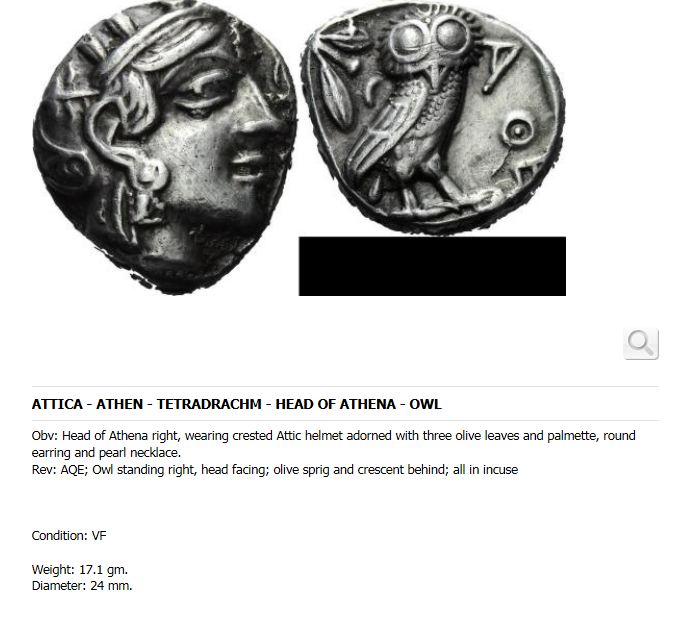 |
|
Bedrock of the Community
United States
37163 Posts |
Some great coins shown. Judging by the price of those I have looked at, I will be very lucky to even have one with many test marks.
|
|
Moderator
 United States
23731 Posts |
All very beautiful coins.
|
|
Pillar of the Community
United States
7842 Posts |
I have been lurking in the Ancients for a little bit, and this type would probably be the one that I would want to be represented.  Question: How much would this type of coin buy "back in the day"? What would be comparable these days? $20? $50? More? Less?  Really nice examples. My daughter was walking past and saw the "owls" and that got her attention! She loves animals of all sorts, but LOVES owls!  Edited by oih82w8
01/09/2013 1:14 pm
|
|
Bedrock of the Community
United States
10045 Posts |
Great to see this thread revived and see new Athens owl tets! Great coin David--the owl looks very similar to mine. Even the dealer who sold me the coin dropped by--never expected that, welcome! oih82w8, I have tried to figure out the purchasing power of these coins, but no real luck so far. These coins were nearly pure silver, so they had good value, and were seldom used in normal commerce. I've read they were used for larger transactions, such commerce between regions, hence their wide appeal. |
|
Pillar of the Community
United States
2044 Posts |
A tetradrachm, worth four drachms, was probably the equivalent of about four day's wages of a common laborer, or about $200 in today's money.
|
|
Pillar of the Community
United Kingdom
2838 Posts |
Quote:
I have been lurking in the Ancients for a little bit Glad you've started posting I suspect this is one of the most 'lurked' areas on the forum, cant help with the purchasing power of an owl just wanted to welcome you to the ancients section  |
|
New Member
Australia
5 Posts |
Some very nice coins there. I have an egyptian minted athens coin. Stylistically its quite different to the Athenian issues and the artistry is not as good nor the engraving of the die!
|
|
Page 3 of 3
|
Replies: 38 / Views: 11,096 |
Page 3 of 3
|







 First Page
 Previous Page


 Posted 08/15/2012 12:37 pm





