| Author |
 Replies: 20 / Views: 3,105 Replies: 20 / Views: 3,105 |
Page 2 of 2
|
|
|
|
Pillar of the Community
France
1591 Posts |
It was proof, but it is not fingerprint proof ;)
Nevertheless, it looks beautiful.
|
|
Valued Member
United States
230 Posts |
mvojnovic, I think your coin is the real .500 silver coin. It is only 0.1 grams underweight, which is absolutely acceptable for any coin. As for the damage, I am not sure if it post mint or not, but remember that 50% (a rather large amount) of the coin is made of copper and probably some nickel, so it can have some strange non-silver coloring.
|
|
Pillar of the Community
 Serbia (Srbija)
576 Posts |
Im really confused now  I dont know what to think....  |
|
Pillar of the Community
Canada
1610 Posts |
I'm 100% sure it's real. Unless someone had a LOT of free time on their hands, I don't think they would make dies with exact same design and a copy with the exact (0.1g doesn't matter) same weight as a real one. If it was rare, I would probably be in doubt, but this coin is quite common.
Trust me, it's real.
|
|
Pillar of the Community
Serbia (Srbija)
576 Posts |
Ok thanks Apollo, but as sel_69l said there are silver ones and nickel-copper ones. The question is know is this one silver?
|
|
Bedrock of the Community
Australia
21792 Posts |
My coin certainly looks to be copper nickel, but from the aforegoing discussion, that may very well NOT be the case. The only way to find out for sure is to do a ring test in comparison with another Bermuda Crown.
I must admit, I was never particularly excited about the prospect of having an unusual coin.
These coins are common enough, it should not be too hard to locate another one for comparison. I will take my coin to a long time coin dealer buddy of mine to find out.
|
|
Pillar of the Community
Serbia (Srbija)
576 Posts |
|
|
Moderator
 Australia
17006 Posts |
I'm just bumping this old thread because the OP asked about it again in another more recent thread. Mvojnovic, I'm fairly certain that official cupronickel versions of this coin do not exist. I can't find anyone on the Internet, apart from sel, claiming to own one or offer one for sale. Your coin is either a genuine silver coin, or a fake. Right now I'm leaning toward genuine, but damaged. The "damage" is curious, as it looks in your picture almost like an altered image, rather than actual damage. Can we have a closeup of the damaged area, please? And, if possible, a closeup of the side of the coin at the damaged point. If I had to guess a cause as to how damage like this might occur on a genuine coin, I would assume it had been attached or mounted onto something which has later been removed. Don't say "infinitely" when you mean "very"; otherwise, you'll have no word left when you want to talk about something really infinite. - C. S. Lewis
|
|
Pillar of the Community
Canada
2786 Posts |
i have a fair number of .500 UK coins that I would never guess had any silver content at all if it weren't for krause. they show the same "cupro-nickel" characteristics as yours.
I'm no metalurgist but is it not possible to have a poorly mixed alloy similiar to woody pennies etc?
|
|
Pillar of the Community
Canada
2805 Posts |
I'm always going through junk bins, and I've found cupronickel that looks like silver and silver that looks like cupronickel (mostly the former...). It's amazing how diverse the toning you'll find is - although the biggest giveaway is that silver is just plain lighter than cupronickel. But if it's toned - then you have to start using your brain...
|
|
Pillar of the Community
United States
864 Posts |
I do not believe in the existence of a cupronickel 1964 Bermuda crown. The alloy used was something like 500 silver, 400 copper, 50 nickel, 50 zinc, & under bad conditions of toning can look like cupronickel, as I have had occasion to observe with any number of world coins struck in a similar alloy.
|
|
Pillar of the Community
Serbia (Srbija)
576 Posts |
Quote:
I'm just bumping this old thread because the OP asked about it again in another more recent thread.
Mvojnovic, I'm fairly certain that official cupronickel versions of this coin do not exist. I can't find anyone on the Internet, apart from sel, claiming to own one or offer one for sale. Your coin is either a genuine silver coin, or a fake. Right now I'm leaning toward genuine, but damaged.
The "damage" is curious, as it looks in your picture almost like an altered image, rather than actual damage. Can we have a closeup of the damaged area, please? And, if possible, a closeup of the side of the coin at the damaged point.
If I had to guess a cause as to how damage like this might occur on a genuine coin, I would assume it had been attached or mounted onto something which has later been removed. Ok thanks for reply sap. I will post pictures this weekend when I get home. Damage is really strange looking, it doesn't look to me like its been attached but rather like if the coin is plated and than piece of this plateing is torn of and under you can see copper color. Thanks again. My collection on Numista page: 7500 different coins and counting... https://en.numista.com/echanges/pro...hp?id=129798 |
|
Pillar of the Community
United States
864 Posts |
One thing to remember is that low-fineness silver coins are typically "blanched" at the mint. In other words, they are boiled in a solution of sulphuric acid, which washes away the base metal from the surface, leaving a porous crust of silver. When struck between the dies, this crust is packed down, leaving a very silvery surface. Wear will then expose the under-layer, which is more reddish (if the alloy is copper) or yellowish (if it is copper-nickel-zinc). If what you have is a lamination error, in which a small part of this surface layer broke off before striking, that might account for the appearance â€" but, please, do post better images!
|
|
Pillar of the Community
Serbia (Srbija)
576 Posts |
Here is picture of damaged place without metal piece that come of, and as you can see it has copper color. Sorry but I cant post better pic then this. Hope it helps. 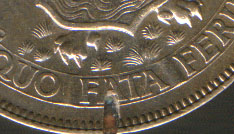 My collection on Numista page: 7500 different coins and counting... https://en.numista.com/echanges/pro...hp?id=129798 |
|
Pillar of the Community
Serbia (Srbija)
576 Posts |
Quote:
One thing to remember is that low-fineness silver coins are typically "blanched" at the mint. In other words, they are boiled in a solution of sulphuric acid, which washes away the base metal from the surface, leaving a porous crust of silver. When struck between the dies, this crust is packed down, leaving a very silvery surface. Wear will then expose the under-layer, which is more reddish (if the alloy is copper) or yellowish (if it is copper-nickel-zinc). If what you have is a lamination error, in which a small part of this surface layer broke off before striking, that might account for the appearance -- but, please, do post better images! Looks like you are right according on what I saw on coin. So its real then?  anyway I put in collection from fake pile  |
|
Page 2 of 2
|
Replies: 20 / Views: 3,105 |
Page 2 of 2
|







 First Page


 Posted 03/27/2012 01:00 am


