| Author |
 Replies: 21 / Views: 6,477 Replies: 21 / Views: 6,477 |
Page 2 of 2
|
|
|
|
Valued Member
United States
230 Posts |
Another vote for real... I don't see anything suspicious at all.
|
|
New Member
 Taiwan
5 Posts |
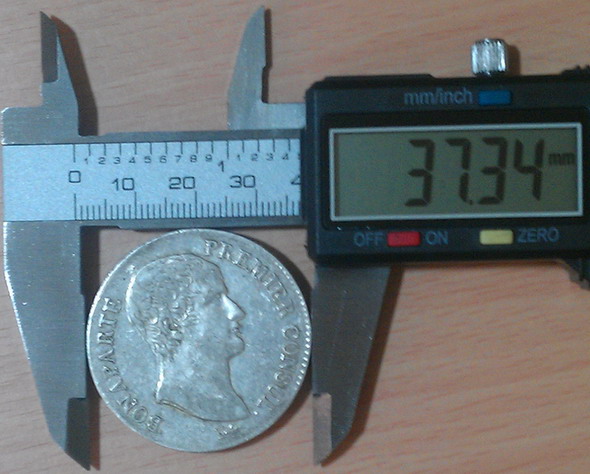
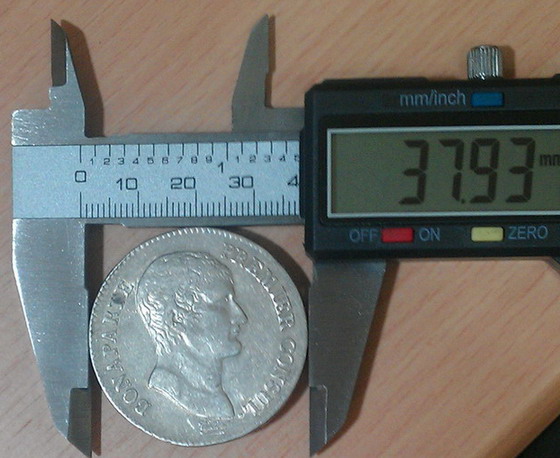
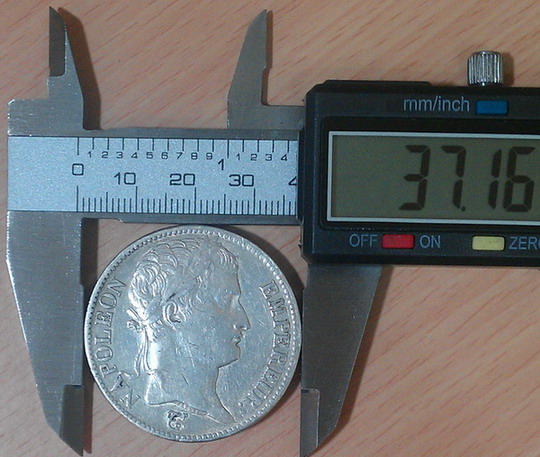
The coin is beautiful to me, indeed. But the question is mainly about its size. I have about 10 Napoleon coins, each with 37mm diameter. But this one is 38mm, obviously larger than others. So I'm very confused. Of course I hope it to be genuine, but I never heard that there is 38mm francs.
|
|
Pillar of the Community
United States
2120 Posts |
I guess a Good question where did you buy it?
And still wondering, how precise are your calipers.
|
|
New Member
Taiwan
5 Posts |
I don't know how precise my calipers is, but I'm sure that each other Napoleon I have is 37mm, and only this one 38 mm. And, while I pile them up, this one is obviously bigger than others. I bought it on an internet shop, which guarantee its authenticity.
|
|
Pillar of the Community
Hong Kong
1270 Posts |
I have the same one but much poor grade. Same year, same mint, 37mm exactly.
|
|
Pillar of the Community
United States
2120 Posts |
Perhaps this would a good coin to have authenticated by a TPG. |
|
Pillar of the Community
Luxembourg
588 Posts |
At the beginning of the 19th century the manufacture of the flans has not yet been as precise as some 50 years later.
You can also find many coins with adjustment marks which is a sign that the flan has initially been too heavy.
The diameter can also vary a lot. My largest 1/4 franc for instance is 2mm bigger than the smallest in my collection.
|
|
Pillar of the Community
United States
5362 Posts |
I own only 2 real and 8 counterfeit Napoleon 5 Francs - but to my eye the coin looks fine. I see no surface details that scream fake. I normally do not use diameter as a criteria before the use of the collared press. Do you know when the collared press was introduced for 5 Francs?
That said - France was noted for a VERY progressive mint facility (Paris anyway) and standardization dates to before the time of Napoleon. Many of Matthew Boulton's innovations used in the UK first at Soho in the 1790's came either directly or indirectly from France.
So I think the key question is the type of press used in AN 12. Let me know what you find about how the edge was added.
|
|
Pillar of the Community
Luxembourg
588 Posts |
I believe collared press could be translated as virole in French?
If so, it has been introduced in 1807 with some experimentation in 1797.
|
|
Pillar of the Community
United States
5362 Posts |
maudry Thank you for that bit of information. I am a bit surprised at that date since the Soho mint was actually using a collared press in 1797. I will have to re-read my sources in that context.
However a date of 1807 (An 15) means that the coin was produced in an open sized press. That in turn means that there is an acceptable range of diameter based on how well the silver was annealed and the strike pressure. It also may not be quite round - a feature often seen on non-collared strikes.
In a collared press the force of the strike FILLS the collar and since the collar is a fixed diameter - the coins produced are a standard size.
|
|
New Member
Taiwan
5 Posts |
|
|
New Member
Taiwan
5 Posts |
To swqmperbob and maudry: So French coins before 1807 are likely to have various size and might not be so round, right?
This is good information.
|
|
Pillar of the Community
United States
5362 Posts |
akira0518 - Absolutely true and your measurements are proof of that. The final size of the coin depends not only on the starting diameter but also on the striking pressure used. The higher the pressure - the greater the diameter. This is why the best struck coins are often just a bit larger than a weak strike EVEN if the planchets were identical.
The coins made without a collar may also be slightly out of round as well. The collar (the third die) in a modern coin press does NOT allow for the coin to spread as it would (does) in an open collar press. Stress on the silver blank varies by the shape of the dies - at the highest points of stress (the point where dies normally fracture due to fatigue) typically at the ends of raised features like the point of Napoleon's bust nearest the rim - you can expect a small bit of extra displacement of the flan.
So yes, this fact is CRITICAL to know when hunting for real coins. But the key to using the fact is an accurate dating of when the technology changed.
The later French 5 Francs will be perfectly round (unless they have received post strike damage or unless the planchets were defective.
So once again, research your series BEFORE you buy. Know what they should look like and how they were made BEFORE dropping a lot of money on a fake. And finally always be extra cautious when faced with a great bargain.
|
|
Pillar of the Community
Canada
3692 Posts |
That doesn't look like a weak strike to me. Looks more like wear because of the scratches.
|
|
Pillar of the Community
United States
3364 Posts |
Here's a real 12 AN Paris that comes in at 37.86mm. Most are 37mm but not the case here. I've noticed a lot of diameter and thickness variations in the French copper from this period, but haven't paid much attention to the silver. http://www.cgb.fr/5-francs-bonapart...73410,a.html"Two minutes ago I would have sold my chances for a tired dime." Fred Astaire
|
|
Page 2 of 2
|
Replies: 21 / Views: 6,477 |
Page 2 of 2
|





 First Page

 Posted 06/20/2012 11:19 am