| Author |
 Replies: 36 / Views: 4,870 Replies: 36 / Views: 4,870 |
Page 3 of 3
|
|
|
|
Valued Member
 United Kingdom
115 Posts |
And thanks for your concern, BadThad, but may I respectfully suggest that you might read the post before expressing your disdain. Perhaps that is a little lesson for you?!
|
|
Valued Member
United Kingdom
115 Posts |
So here are the pics if anyone is interested; First one is uncleaned original sitting in DI; Second, after it had soaked for a while, then frozen; Third, the stripped finish, working from the centre, outwards. I note that the detruitus has taken on a waxy finsh. Longer in the H2O2 would have probably gone on to remove this entirely, however I was not concerned about cleaning it and so removed it. 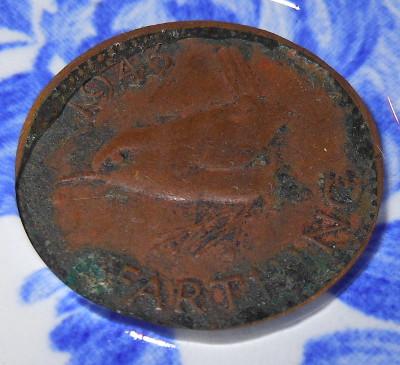 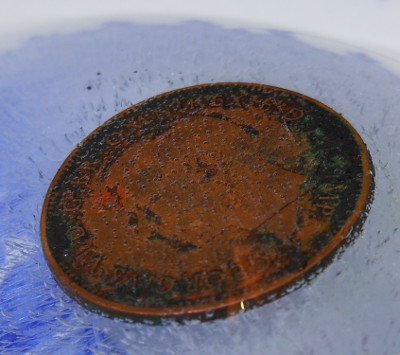 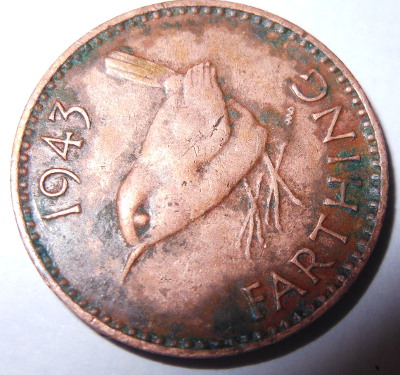 |
|
Pillar of the Community
United States
3755 Posts |
Thad, ok, so WHY is peroxide so bad? What does it do to the penny?
|
|
Bedrock of the Community
United States
20043 Posts |
Look at the post above. LOLOLOL
Lincoln Cent Lover!VERDI-CARE™ INVENTOR https://verdi.care/
|
|
Bedrock of the Community
United States
20043 Posts |
Quote:
And thanks for your concern, BadThad, but may I respectfully suggest that you might read the post before expressing your disdain. Perhaps that is a little lesson for you?!
Not a lesson, just a failure to read all the posts. I just don't want noobs reading and following some of the appalling suggestions I've seen in this thread. |
|
Valued Member
United Kingdom
115 Posts |
Quite right sir, I was a little shocked myself to see the first suggestion of soaking it in nail polish remover for a week!
The pictures of the farthing are a good illustration of what NOT to do, and the resulting destruction of the patina, although I note the pictorial evidence was still questioned by someone.
I really am most grateful for folks' suggestions, certainly professionals with experience. I love my H2O2 for other cleaning uses, and I wanted to try for myself on an old coin
|
|
Bedrock of the Community
United States
20753 Posts |
Quote:
Thad, ok, so WHY is peroxide so bad? What does it do to the penny? The H2O2 explains that this solution is sort of top heavy with Oxygen. Oxygen is the first thing that attacks Copper and does so readily. If you read the posts about coin cleaning, cleaning coins, Acetone and all the other similar posts available by using the Search Tab at the top, you sould see or should many discussions about most of this. There is possibly many, many items people claim they have used or read that someone used on coins with only great or OK success. And possibly some are true but more than likely what you read on the internet is from people that really just guess, repeat something someone else said or make it all up. Over the years I've read about Baking Soda and water, Orange Juice, Tomato Juice, Olive Oils, Spit, Nail Polish Remover, Acetone, Laquer thinners, Mineral Spirits and on and on and on. Such experimentation is fun but shouldn't be attempted on a coin of a value over face value. And even then it could be the ruining of a coin for someone in the future. It is not smart to sand down a 500 year old table. It is not smart to rewrap a 2,000 year old Mummy. Nor would it be smart to run King Arthurs Sword accross a bench grinder wheel, it there was such a Sword. As a general rule it is always best to let sleeping dogs lie. Old saying. |
|
Pillar of the Community
United States
8534 Posts |
Somebody said lighter fluid was really good for taking off gunk. I dont remember the member.
Oregon coin geek.....*** GO BEAVS ! ! ! ***
|
|
Valued Member
United States
110 Posts |
Agree.......although....there are ways 8).......
|
|
Pillar of the Community
United States
979 Posts |
If it's not water or acetone, things get ruined. You shouldn't clean something unless its the way YOU want the coin. I for one cleaned some REALLY rusty 43 steel cents, because I wanted a steel cent not a rusted chip of metal! (I thought they were copper cents until I used a magnet on them, THAT was a lot of rust) I figured they weren't valuable, and to me they were ugly. So its your coin. if you like how it turned out, good! It's your piece. Just know that if you touch a coin with harsh solvent (anything past water/acetone) It a james bond coin: For Your Eyes Only </opinion based post> Edited by Broseph
11/16/2012 8:52 pm
|
|
Rest in Peace
United States
7075 Posts |
 I am sooooo glad that you took before and after pictures. (Love that little bird!) What is the reason for freezing the coin? Is that so you can lift off the gunk? (sigh) I know so little about this and I haven't ever tried anything...but I get the urge when I see the greasy black crud on my coins. |
|
Valued Member
United Kingdom
115 Posts |
My (not at all scientific or proven) reason for freezin' was to see if the expansion, then thaw cycle provoked enough movement on a molecular level to remove some of the crud. My theory was that when the DI froze around the coin and subsequently expanded, this was maybe enough to remove some, in the most gentle fashion. Since the crud appears to be petroleum based (grease), rather than organic, this wasn't particularly efficacious.
As I mentioned in another post, I'm popping over to a metalurgist friend next week to have a borrow of his XRF gun. This man could talk the birds out of the trees when it comes to chemistry/metalurgy, so I shall be speaking to him regarding the finer points of the oxygen/copper/ionic reactions which are taking place, and more importantly, what sort of chemical reaction I want to precipitate in order to achieve the desred result (crud removed; patina/colouration retained)
In response to something mentioned earlier, I'll make sure I photograph and time the experiment.
I know it is probably tantamount to blasphemy to a numismatist, but I am sure, with my rudimentary knowledge, that the coin could probably be stripped clean to bare copper, then have the patina/colour restored with some sort of CVD process. A wee bit far for a £20 coin, but interesting nonetheless. My experience in semiconductor engineering suggests to me that there is little that cannot be manipulated on an ionic/atomic level, assuming the appropriate gasses, temperatures and pressures.
I also must make clear that I am in no way attempting this to rip some poor bugger off with a "1st class specimen". I'll be keeping the coin whatever happens, so my motive is not to deceive! I just don't want gunky coins!
|
|
Rest in Peace
United States
7075 Posts |
I know that freezing works for removing gum that gets stuck on clothes or whatever. But you have to work fast because the moment it warms up, it is gummy again.
The problem with removing the gunk is that you don't know what's under it. I think it could leave a spot that is stained or brighter than the rest of the coin.
Anyway, as far as I know there are no mild solvents that can remove dirty grease. So I think we'd better enlist the microbes.
|
|
Pillar of the Community
United States
3755 Posts |
I am aware that peroxide is an oxidating agent. I know the effects an oxidating agent has on metals. I was asking Thad to explain it as the only comment was don't use it it is horrible. I thought a clarification would be a good thing.
Next time I will just keep my fingers shut. Sheesh.
|
|
Rest in Peace
United States
3039 Posts |
40% H2O2 can oxidize your skin also. Careful! I wouldn't use it on a coin either.
|
|
Page 3 of 3
|
Replies: 36 / Views: 4,870 |
Page 3 of 3
|








 First Page
 Previous Page
 Posted 11/15/2012 10:22 pm


