| Author |
 Replies: 26 / Views: 3,725 Replies: 26 / Views: 3,725 |
Page 2 of 2
|
|
|
|
Valued Member
 Australia
236 Posts |
Have a look at this roo from Bombay Mint in 1942. 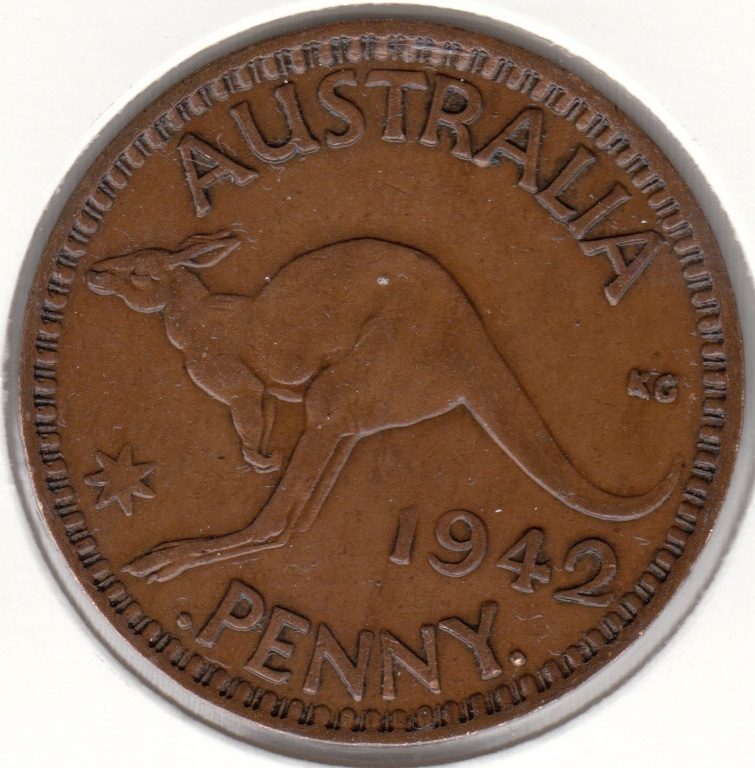 |
|
Pillar of the Community
Australia
4411 Posts |
The roo is the same as the 1943 issue but the denticles are longer on the 1942 issue as I recall.
I would love to see side by side pictures of all the different sized roos you have identified.
|
|
Valued Member
Australia
236 Posts |
Hi! enworb as I come across them I will take pics and put them up.
Your comment about the denticles suggests you have read or participated in some discussion about the various apparent roo sizes, can you point me towards this, if this is so please?
|
|
Pillar of the Community
Australia
4411 Posts |
The latest coin and banknote review has an article regarding denticle sizes/shapes on predecimal coins. That may be an interesting read for you. There has been no discussion on differing roo sizes that I can recall. If you read enough and carefully look at examples you will being able to culminate the information to form a resource for yourself, whether it be in your head or something you actually write down.
|
|
Valued Member
Australia
90 Posts |
There are six Penny reverses. Two different Roo Rev Type D 1938-1964 Melbourne "" "" E 1942 Bombay "" "" F 1943 Bombay "" "" G 1951-1955 Perth & London "" "" H 1953=1959 Melbourne "" "" I 1956-1964 Perth The Bombay Roo is the "Low Profile" All other mints utilise the "High Profile" Roo Jump onto Jon Saxon's site for more info. http://triton.vg/pennyRev.html#kangaroo |
|
Valued Member
Australia
236 Posts |
Hey Ford Prefect that is exactly what I needed Thank you.
I still believe there are several variations of the roos though, certainly more than 2.
I had noticed the high and low relief and that is a significant variation.
There is also variation in the rear of the jaw and where the head meets the neck. {Compare the photos on that site}
The 'about' to leap as opposed to finishing a leap is another.
I have measured very carefully and there is a variable range from 26 mm to 27.5 mm with 4 different lengths of roo within that range. (measurements between 1938 and 1944)
The definitive descriptions of COA coins is far from finished in my humble opinion.
Cheers, darge.
|
|
Formerly nancyc
Australia
5385 Posts |
My observations, looking at the images on Triton's site, I can see what appear to be differences with:
:shape of snout
:shape of jaw/head some are much more muscular
:length of ears
:shape of chest, some are much more muscular
:ends of tail - some are more curved backwards
:38 & 51 coins have a narrower font, most noticeable with the space between I and A
:Roos toenails are more pronounced on some images
Some of these differences are possibly due to quality of image and wear on coins.
life is a mystery to be lived not a problem to be solved
|
|
Pillar of the Community
Australia
674 Posts |
Do I see lots of doubling on that 42 Penny.!
|
|
Valued Member
Australia
236 Posts |
Yes Robster there is a lot of doubling on that coin. Hello nancyc at the risk of sounding obsessive (my secret's out now) I believe there are numerous differences that can't be explained by wear. Have a look at the back ear of the 1942 roo I posted and compare this with the ears of all the roos pictured on the triton site. The proportions of the front paws relative to the length of the upper back legs varies considerably too. From less than 40% to over 50%. (my guess) There are known differences that distort appearances like the very low relief of the roo on the 1942 I posted for example. The distance of the star, date and denomination from the rim in the Bombay minted coins also distorts spatial appearances. What is most convincing to me however is that these are different species of kangaroo. I'm not qualified to name them but having spent plenty of time around them I am qualified to hold at least an opinion on this.  |
|
Valued Member
Australia
90 Posts |
Quote:
The definitive descriptions of COA coins is far from finished in my humble opinion. Your first port of call Must be to NAA Site Obtain Dr Paul Hollands article 1937-1964 Pennie Die Types Link http://naa-online.com/pdfjournal/Vo...icle%201.pdf It is a "MUST READ" Article before you start. Good Luck, you will meet a frw  |
|
Pillar of the Community
Australia
4411 Posts |
Just had a very quick look at that article and it looks fantastic! I will be havng a good read when I get a moment.
|
|
Pillar of the Community
Australia
1607 Posts |
If you google images of Red Kangaroo's & then google images of Grey Kangaroo's that might help understand the differences between the 2 designs.
Red Kangaroo's have larger head & ears than the Grey Kangaroo.
I think some designs are of Red's & some are of Grey's.
|
|
Valued Member
Australia
90 Posts |
|
|
Valued Member
Australia
90 Posts |
Peter Quote:
I think some designs are of Red's & some are of Grey's.
Kruger's intent when he designed the "Roo" reverse was to combine the attributes of The Western Red and The Eastern Grey to produce a stylised representation of an Australian Roo. Each change to the Master dies introduces subtle variances to the Roo's appearance. For '64 penny lovers the Melbourne Mint utilised the Original 1937/8 Master Die as the reverse. |
|
Valued Member
Australia
236 Posts |
Thank you Ford Prefect that answers all of my questions but I will still study those links you provided.
Your knowledge is extensive and very much appreciated.
Thanks for all the thoughts and opinions. darge
|
|
Page 2 of 2
|
Replies: 26 / Views: 3,725 |
Page 2 of 2
|








 First Page


 Posted 12/19/2012 07:08 am


