| Author |
 Replies: 24 / Views: 7,317 Replies: 24 / Views: 7,317 |
Page 2 of 2
|
|
|
|
New Member
 United States
6 Posts |
 I have a few of those friends... |
|
New Member
United States
6 Posts |
it weighs almost 5.9 grams. it was a pawn shop scale so probably off a lil.
|
|
Pillar of the Community
United States
1234 Posts |
Scales are easy to calibrate, a nickel is exactly 5 grams, 3.2 for copper cents and 2.5 for zinc cents. Or check other quarters, I just tossed a few quarters on my scale and they are all 5.5-5.7, you might have something interesting there.
|
|
Pillar of the Community
743 Posts |
You should never scratch a coin. There are better ways of determining if it has been plated. One is to look at it under a strong loop. Find another plated coin and you will notice the differences.
|
|
Pillar of the Community
United States
1137 Posts |
|
|
Pillar of the Community
United States
586 Posts |
So it is slightly thicker and has a shade less diameter than a normal quarter. My only thought is they came out with a 3 coin ATB set for quarters which included an uncirculated P mint in 2012. I didn't see the year you have but may want to see if they have diff. Dimensions. Cool coin either way! Props |
|
Pillar of the Community
United States
586 Posts |
Oh and all silver quarters of 1964 weigh 6.25 grams. I have heard of a few 1965 examples that escaped a watchful eye
|
|
Bedrock of the Community
United States
17884 Posts |
Quote:
Scales are easy to calibrate, a nickel is exactly 5 grams, 3.2 for copper cents and 2.5 for zinc cents. Using random coins for calibrating scales is a bad idea. A nickel is "exactly" 5 grams.....+/- .2 grams so anywhere from 4.8 to 5.2 grams A copper cent is supposed to be 3.1 grams not 3.2 and it has a +/- .1 gram tolerance so 3.0 to 3.2 grams. The zinc cent also has a .1 gram tolerance so 2.4 to 2.6 grams Edited by Conder101
01/24/2014 10:57 am
|
|
Valued Member
United States
272 Posts |
|
|
Pillar of the Community
United States
2189 Posts |
In the very first picture I see a copper edge just like a normal quarter should be.
|
|
Pillar of the Community
United States
500 Posts |
Yeah, I see the copper edge too. In the right light, a solid copper edge on a nice uncirculated coin can seem silver, tricks me from time to time on dimes when I'm just looking at the edges.
|
|
Pillar of the Community
United States
601 Posts |
Coins struck on over or underweight planchets aren't considered collectible unless they have at least a 10% variance from mint specifications.
Usually, the simplest explanation is the correct one. You have a slightly overweight planchet that has been plated with silver, which further added a small amount of weight.
Edited by liveandievarieties
01/24/2014 1:04 pm
|
|
Pillar of the Community
United States
1003 Posts |
I agree with jasper62 and Dasalo. I see a copper edge.
|
|
Pillar of the Community
United States
5230 Posts |
Quote:
Coins struck on over or underweight planchets aren't considered collectible unless they have at least a 10% variance from mint specifications. Had to use the opportunity show these 2 again  I have clad halves ranging from 10.2g up to 11.8g. I guess that would place them at the limits of the 10% rule albeit not all that commonly found. 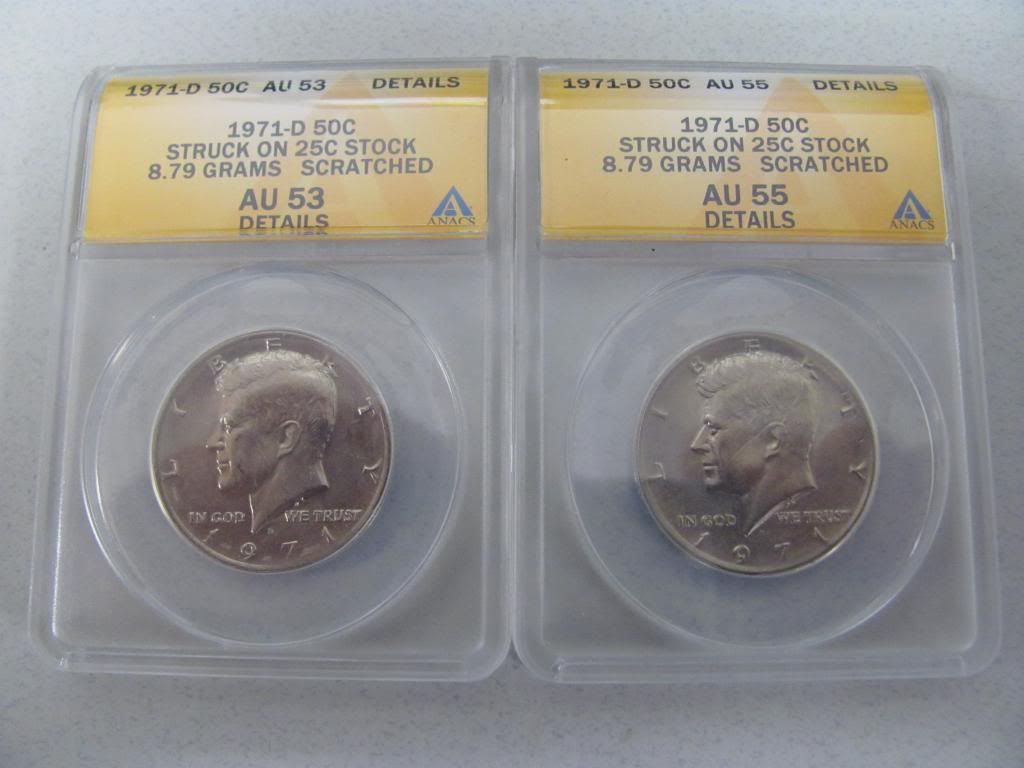  Edited by jack jeckel
01/24/2014 10:59 pm
|
|
Pillar of the Community
United States
523 Posts |
That is cool that ANACS would do that! I am glad I kept mine!
|
|
Page 2 of 2
|
Replies: 24 / Views: 7,317 |
Page 2 of 2
|







 First Page
 Posted 01/22/2014 7:39 pm





