| Author |
 Replies: 53 / Views: 9,570 Replies: 53 / Views: 9,570 |
|
|
|
|
Valued Member
 Australia
69 Posts |
I note that Nortje edited his post to remove any suggestion he had apologised on the BidorBuy forum at just before 8.30am Sunday morning 2nd April (South African time). You can see his latest edit time at the bottom of the post linked in my post above. So the link above will now reflect his latest edit and the screen dump here, which I had the foresight to make (knowing this devious man), will reflect what he edited out: http://gwb.com.au/nortjefraud.jpg
The screen dump was taken at about midnight, eight hours earlier.
What is interesting to me is that Karel aka Nortje (or his voice) keeps on suggesting in this same Bidorbuy forum that the book I published on the Strachan and Co tokens with Prof Clive Graham in 1978 was published in 1976.
Nortje knows this is a lie but does not EDIT that very old post seen here: http://forum.bidorbuy.co.za/forum/b...o-token-scam. When you read his comments you will quickly see why a 1978 publication date does not fit.For the record Prof Michael Laidlaw is a very well respected South African numismatist who will confirm that he forwarded Nortje's email (as cut and past above) to me this weekend. We now know who Karel on this forum really is.You can see the facts here while tokencoins.com is being updated: http://www.gwb.com.au/nortje.htm (some links to this page might not work for obvious reasons) Edited by tokensa1
04/02/2017 03:42 am
|
|
New Member
South Africa
29 Posts |
Hi Mr Balson,
I am delighted to read that you will be updating your website. Hopefully you will now delete the reference to the so-called trap that I have exposed you to have lied about on this forum (Interesting PDF on the Griquatown tokens (fantasy coins) and for which we are still awaiting an apology.
I am not Nortje, you should realise that now. The fact that Mr Nortje wants to bury the hatchet does not make the Griqua Town coinage any less important.
Like I have said before, your opinion on some in the South African Numismatic community should not distract others from a genuine "numismatic detective story". To quote augsberger "I think the point here is that history is based on what we know, and what we know can change from one day to the next".
History will never change because of politics or conquests or theories or wars -Paulo Coelho
Edited by Karel
04/02/2017 1:11 pm
|
|
Valued Member
Australia
69 Posts |
My last observation in this thread.
I spent thirty years researching this subject - material I personally unearthed that resulted in the rewriting and acceptance by just about everyone that the Griquatown tokens failed completely. Before my research it was claimed that they circulated widely for two years. In my view and most others not one Griquatown token ever circulated as money - if they did circulate back then it was as a gift or trinket.
Nortje spent two weeks selectively plagiarising this online research and writing a PDF which claimed the tokens circulated. For that he was given an award by the NNS whose Secretary is Brian Hern author of the coin catalogues that claimed the tokens circulated widely.
Nortje's work was fraud; mine was a lifetime of dedication.
Those are the facts.
Edited by tokensa1
04/02/2017 1:37 pm
|
|
Pillar of the Community
Germany
1073 Posts |
And your last statement shows why no one will take you seriously. Painting someone else a fraud, claiming it is a fact, simply because you don't agree.
|
|
Valued Member
Australia
69 Posts |
Actually the shoe is on the other foot. How can anyone take you seriously when you claim to be a pillar of the community? Nortje in his email above belatedly admits to blatant selective plagiarising of my research - something I exposed over 18 months ago - something he earlier refused to admit to even though it was a no brainer. Is plagiarising research fraud?Plagiarism is the appropriation of another person's ideas, processes, results, or words without giving appropriate credit. One form is the appropriation of the ideas and results of others, and publishing as to make it appear the author had performed all the work under which the data was obtained. A subset is citation plagiarism - willful or negligent failure to appropriately credit other or prior discoverers, so as to give an improper impression of priority. This is also known as, "citation amnesia", the "disregard syndrome" and "bibliographic negligence". Arguably, this is the most common type of scientific misconduct. Sometimes it is difficult to guess whether authors intentionally ignored a highly relevant cite or lacked knowledge of the prior work. Discovery credit can also be inadvertently reassigned from the original discoverer to a better-known researcher. This is a special case of the Matthew effect. Source: https://en.wikipedia.org/wiki/Scien...c_misconductYou obviously know little or nothing about research. What is described above from Wikipedia is exactly what Nortje did and one of the main reasons he has now agreed to return his NNS award. (See his email above). Edited by tokensa1
04/02/2017 10:52 pm
|
|
New Member
South Africa
29 Posts |
The author of this catalogue commented on the research by Ms Stuart on another forum. Here is an extract of this:
So, money whether in trade or barter as such, was circulated as it would have been present in most part of the communities that had years of exposure to western influences. It is recorded there was a shortage of circulated coinage; beads and barter was still largely used and traded. Therefore, we can deduce that the intent of the LMS, as stipulated in the report, was to introduce Community Coinage to compensate for the shortfall of coinage at the time and perhaps, in so doing, establish a unique Griqua currency. The fact that it is recorded (Helm 1821) it was distributed at too cheap a rate only can be accounted for that it was issued but unfortunately not recorded as received. Yes, distribution must mean something given in return but we could not account for what that was.
So, to answer your question, it is most logical to surmise that a method of trade or barter needed to come about in line with the western method of transactions and as such various monetary means did indeed circulate to those inhabitants who understood money. As to the influence of who and how many understood money at the time - this was not part of the report and we can only speculate that if the Missionaries believed that there was a need for a monetary medium then there must have been grounds for that. The costs of 250 pounds to approve mintage of coinage would have been a great financial outlay for the LMS at the time. We can assume that the Quorum established would have provided justification for the coinage.
Unfortunately, the introduction of the Griquatown Community coinage did not materialize as the defacto currency and as such other monetary currency transactions are recorded that prevailed".
This type of educated and unbiased view is what stimulates and drive debates and further research.
|
|
Valued Member
Australia
69 Posts |
As someone who researched the Griqua for 30 years let's be quite clear about one thing.
The overwhelming majority of the Griqua at Griquatown in 1817-20 had no understanding of money. (This view is supported by Prof Arndt - yes they understood traditional barter like beads which they could string around their neck.)
Not only that but the findings of both Ann Stuart (undertaken recently on behalf of the publisher of the catalogue) and I are that there is no record anywhere of a single token actually circulating. In fact her report is headed the FAILED tokens....
Intent does not equal success regardless of how much money the LMS threw at it it.
The publisher of the catalogue has quoted the wrong word used by Helm... he states and I quote - according to your post:
"The fact that it is recorded (Helm 1821) it was distributed at too cheap a rate only can be accounted for that it was issued but unfortunately not recorded as received. Yes, distribution must mean something given in return but we could not account for what that was..." The word used by Helm is DISPOSED NOT distributed - distributed is only ever used by Nortje in his fraudulent research. Disposed means to get rid of permanently - it does NOT imply circulation. Stuart and I quote the correct word DISPOSED, used by Helm, in our research.
As the publisher of the catalogue also points out on Stuart's research "As to the influence of who and how many understood money at the time - this was not part of the report and we can only speculate that..."
That is the difference between my 30 years of research on the people and Stuart's very focused research on just the tokens. I have a very clear understanding of the environment at Griquatown at that time - where Stuart had no understanding of this. How you can ignore the environment of the people back then defeats me.
I give you the six key facts confirming that not one Griquatown token ever circulated - there are many others. It's plain logic:
1 When Anderson returned to Griquatown from Cape Town in 1814 the people there had lost faith in him. In fact the major Griqua families left Griquatown leaving the settlement a ghost town until 1820.
2 There was no shop in Griquatown in which to trade the tokens.
3 There was no hole in the tokens to facilitate carrying them with their beads.
4 The people there had no understanding of money (Prof Arndt)
5 The tokens are never listed as assets anywhere, at any time, by the LMS at Griquatown
6 There is not one reference to them by Campbell in his second book covering his trip to South Africa and Griquatown in 1820. In fact Campbell's only related comment in this book is that "regular trades do not exist in Griquatown".. the resident missionary at the time, Anderson, makes no reference to them at any time despite writing a large number of letters and keeping journals.
The publisher of the catalogue advised me a couple of weeks ago by email that although he recognises the Griquatown tokens were a complete failure he would be speculating that a few might have circulated. I have no understanding of the outside forces that might have forced this concession by him but speculation is not fact.
As a direct result of this speculation I have withdrawn my support of his coin catalogue. I advised him a couple of weeks ago that he could not use my research on the Strachan tokens in his coin catalogue. I had earlier freely supplied this to him at his request. I withdrew my permission because I could not ethically be seen to support what his new coin catalogue claims.
I am happy to wait for the time when logic prevails and speculation is cast aside and the FACT that not one Griquatown token ever circulated as money is finally accepted.
The fact is that until a direct reference from that time to the tokens circulating is found it is incorrect to claim that even one circulated. This fact is not rocket science.
Edited by tokensa1
04/05/2017 5:41 pm
|
|
New Member
South Africa
29 Posts |
Hi Mr Balson, Your reply. Quote:
I have a very clear understanding of the environment at Griquatown at that time - where Stuart had no understanding of this. How you can ignore the environment of the people back then defeats me. What environment are you referring to. Through Legassick's research we know that around 1812, at least 5 years before the Griqua Coinage, the Khoisan herders, in some instances, were paid wages of 6/- to 7/6 per month by the Griquas instead of a portion of the offspring or milk etc. Why ask for cash if there were no understanding of a cash economy. The Kok family, who regularly traded with the Cape Colony, alone had perhaps 45000 (forty five thousand) sheep. I think what you are insinuating is stereotypical, stale and needs updating. Edited by Karel
04/07/2017 2:45 pm
|
|
Valued Member
Australia
69 Posts |
I am not going to respond to "Karel" who hides behind a non-de-plume.
If he has the courage to reveal who he really is I will happily debate him on this subject.
|
|
Pillar of the Community
Russian Federation
5186 Posts |
I suspect his name is really Karel, for what it's worth, but in that case I'm not sure how he could realistically prove it. (Not without breaking site rules, anyway.)
And there's a huge gulf between "none could possibly have circulated at all" and "widely circulating".
Both are probably false as stated, but the latter is likely the only one that can be reasonably proven false (unless maybe some metal detectorist digs up one of the few circulated examples, which is terribly unlikely but theoretically possible), and definitely the only one that can be proven true if by some circumstances it turns out to be so (it almost certainly isn't, of course, but that's beside the point).
|
|
New Member
South Africa
29 Posts |
Hi january1may, Anyone interested will find that the missionaries in general used money, virtual and real, as a method of teaching. Some of the missionaries themselves became traders, so it would have benefitted them to introduce and teach the relationship between commodification and money to the local population. They were also expected to find ways to make the various mission stations self -sustainable. The trade by the missionaries were frowned upon, but accepted on condition they do not make a profit. "God's bankers indeed". We know that the Griqua Town tokens reached their destination and were issued. I include a pic of a circulated token, showing light wear. More circulated examples have also been found. Point is, I am not making a case for more or less widely circulated. I am simply saying that the tokens are a good example of a numismatic event rich in history. We know that the author of this catalogue will now include this in his new updated catalogue, and quite rightly so. That tokensa1 is not in agreement is neither here nor there. The "new corrected coin book" will now be corrected. 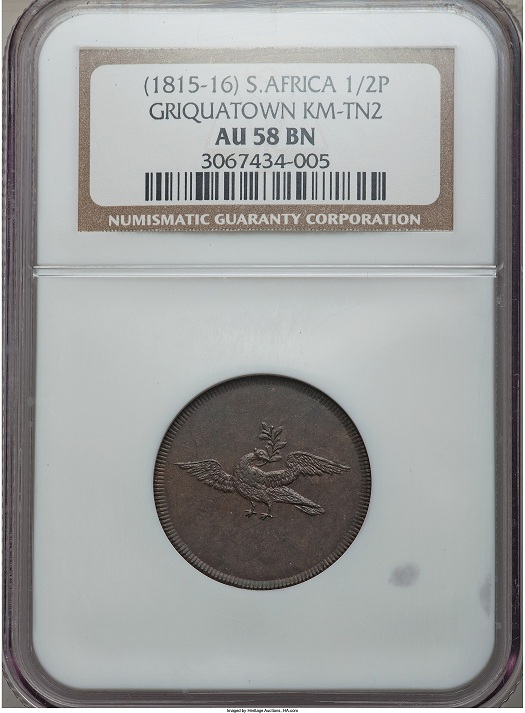 Edited by Karel
04/09/2017 10:51 am
|
|
Valued Member
Australia
69 Posts |
Just one simple observation.
Poorly stored coins get worn.
When did that ever equal circulated?
And Karel is not Karel the person behind Karel is, with little doubt, Nortje; but he can hide behind anonymity.
Just don't expect me to respond to his posts here.
And I knew several weeks ago that the new catalogue would insinuate that a few Griquatown tokens "circulated briefly" despite the publisher's own paid for researcher and my earlier research confirming there is absolutely NO evidence of this.
I discussed this more fully in an earlier post so I won't repeat the points here.
What I will repeat is that I have withdrawn my permission for the publisher to use my research on the Strachan tokens in his catalogue because I will not be associated with what I believe to be an ethically compromised book.
Edited by tokensa1
04/09/2017 10:23 pm
|
|
Valued Member
Australia
69 Posts |
I have updated my one page PDF explaining the "environmental reasons" behind the fact not one Griquatown token ever circulated. Here they are:It is a fact that Spink & Son now distance themselves from Parsons booklet and support the more recent research by Scott Balson who finds that the silver tokens were produced as day and half day labour tokens but completely failed. ie not one token ever circulated even though they did arrive in Griquatown c1817. Recent research by Ann Stuart demonstrates Parsons research is flawed. andIn fact the only direct reference to the Griquatown tokens is by Helm who replaced Anderson in 1820. He asks the LMS "what am I to do with the greatest part of them" and refers to Anderson disposing of a few in the past at "too cheap a rate". Disposed means to "get rid of permanently" and too cheap a rate is likely to be a polite way of saying Anderson gave them away - not confusion over their value as previously claimed. In no way does this statement imply any circulated. Source: http://gwb.com.au/summation.pdfEdited by tokensa1
04/11/2017 10:27 pm
|
|
Valued Member
Australia
69 Posts |
And here is the proof of who "Karel" is. http://forum.bidorbuy.co.za/forum/b...an-co-debateand this new expert on this subject can't even spell researcher Ann Stuart's name right. Here is a link to the screen dump taken today before he edits it again: http://gwb.com.au/apr17.jpgwe now know that "Karel" is Pierre Henri Nortje (as I suspected). A coward who hides behind the non de plume of Karel (associated with Karel Schoeman who, ironically, is the researcher who is Nortje's nemesis). Nortje never was a researcher. He always was a fraud.As I said before I will not be responding in the future to any posts here from "Karel" (Nortje). And here is a copy of the email Nortje sent to me just days ago apologising for his fraud and asking how he could send his ridiculous award for "his research" back:FROM THE HORSE'S OWN MOUTH:
From: Pierre Nortje
Sent: Saturday, April 1, 2017 6:18 PM
To: Michael Laidlaw
Subject: Re: South African Numismatics
Michael
I have decided to bury the hatchet for once and all - I have publicly acknowledged that I have personalty attacked Scott Balson on the forum.
I also acknowledges that I have copied some of his research so that I can reply to it.
I have now publicly and unequivocally apologized to him - see my latest post on the BOB forum.
I do not know how to return my NNS plaque (to whom must I send it?) but will do it if he wishes me to do that.
I do not wish to be in confrontation with Scott anymore and have posted the reasons for this publicly on the forum today.
Can you please forward this email to him?
Kind regards
Pierre
------------------------ It is so sad to see the poor state S African numismatics has fallen into. There are many real numismatists who despise the deceit of Nortje and I know who you are, and thank you. Edited by tokensa1
04/13/2017 03:30 am
|
|
Pillar of the Community
Germany
1073 Posts |
Yes, I think we got the point that you have a lot of hatred for anyone who doesn't agree with you. I think, and I'm sure a lot of other people would think the same, that this isn't the place for your personal vendetta.
|
|
|
Replies: 53 / Views: 9,570 |
|






 First Page
 Previous Page

 Posted 04/02/2017 12:44 pm


