| Author |
 Replies: 25 / Views: 4,244 Replies: 25 / Views: 4,244 |
Page 2 of 2
|
|
|
|
Pillar of the Community
United States
7067 Posts |
Finn, 2/97 does not appear to be a laureate obverse but rather an elephant or lion skin (I think more likely elephant). I think your first inclination - Ptolemaic - is correct. It may be a smaller obol of Ptolemy I or II, imagery similar to this: http://www.forumancientcoins.com/ca...sp?zpg=11701Edited by Kamnaskires
01/20/2016 08:33 am
|
|
Pillar of the Community
 United States
6130 Posts |
I suppose you are probably right about that one. The posture of the eagle is unusual for the type however--the head is not drawn back, and the breast is not pushed out as far as is normal for the Ptolemaic eagle. How much variation did these coins have from one another? Possibly just an engraver deviating from the standard a bit? I did find a close match on vcoins: https://www.vcoins.com/en/stores/fo...Default.aspxAlso, aren't the bronzes of Ptolemy II supposed to have the central dimple? |
|
Pillar of the Community
United States
7067 Posts |
Not all Ptolemaic bronzes had centration dimples, Finn. If you scan through the coins pictured at Ptolemybronze.com, you'll see some of the earlier ones, near the top of the page, without them. These include a couple of the elephant scalp types. http://ptolemybronze.com/ptolemy_series.htmlYou'll also see some eagles that come close to matching yours. It seems to me that the eagle on the coin you linked to looks a lot like yours too...and that one has no dimple either. |
|
Pillar of the Community
United States
6130 Posts |
Forgot to upload this one earlier: 4/97: AE 9mm 0.59g Another tiny coin with a cross; again doesn't match the typical late Roman designs.   I managed to identify a few more and sort the rest out into groups by origin. I'll post those as soon as I get them imaged. |
|
Pillar of the Community
United States
7067 Posts |
|
|
Pillar of the Community
United States
6130 Posts |
5/97: Constantius Gall us AE2, DEL TEMP type. Aquiela mint. As pointed out, LXXII in reverse field, indicating that the coin was 1/72nd of a Roman pound of bronze.   It was mentioned before that this type is rare or scarce... I wasn't able to find it listed as anything but common or scarce on any online catalog I searched. Does anyone have more info on this one? I am assuming that due to the corrosion on the obverse and the rough edges, the value is mostly gone from this one. Coin 6/97: Elagabalus, provincial AE of Antioch, Syria. Delta-epsilon within wreath   Terrible shame about those huge pits... would have been a nice coin otherwise. This is a nice thick coin, and the one in the portrait goes almost all the way through the coin. I assume someone took a power drill to a spot of BD. Edited by Finn235
02/05/2016 10:34 pm
|
|
Pillar of the Community
United States
949 Posts |
Quote:
Terrible shame about those huge pits... would have been a nice coin otherwise. You don't think they were intentionally added by the mint authorities as a comment on the condition of the emperor? |
|
Pillar of the Community
United States
6130 Posts |
|
|
Pillar of the Community
United States
7067 Posts |
Edited by Kamnaskires
02/05/2016 8:00 pm
|
|
Pillar of the Community
United States
949 Posts |
Quote:
Does anyone have more info on this one? Presumably you want to know specifically about this type with the LXXII element in the reverse left field. Kent in RIC VIII reports a series of coins of this type in a slightly reduced AE2 module minted from 351-355 at Siscia, and another from 352-355 at Aquilea for both Constantius II (Cs2) and Constantius Gallus (Csg). In both cases the obverse bust has a letter "A" behind it. Though a bit obscured, yours has that feature: 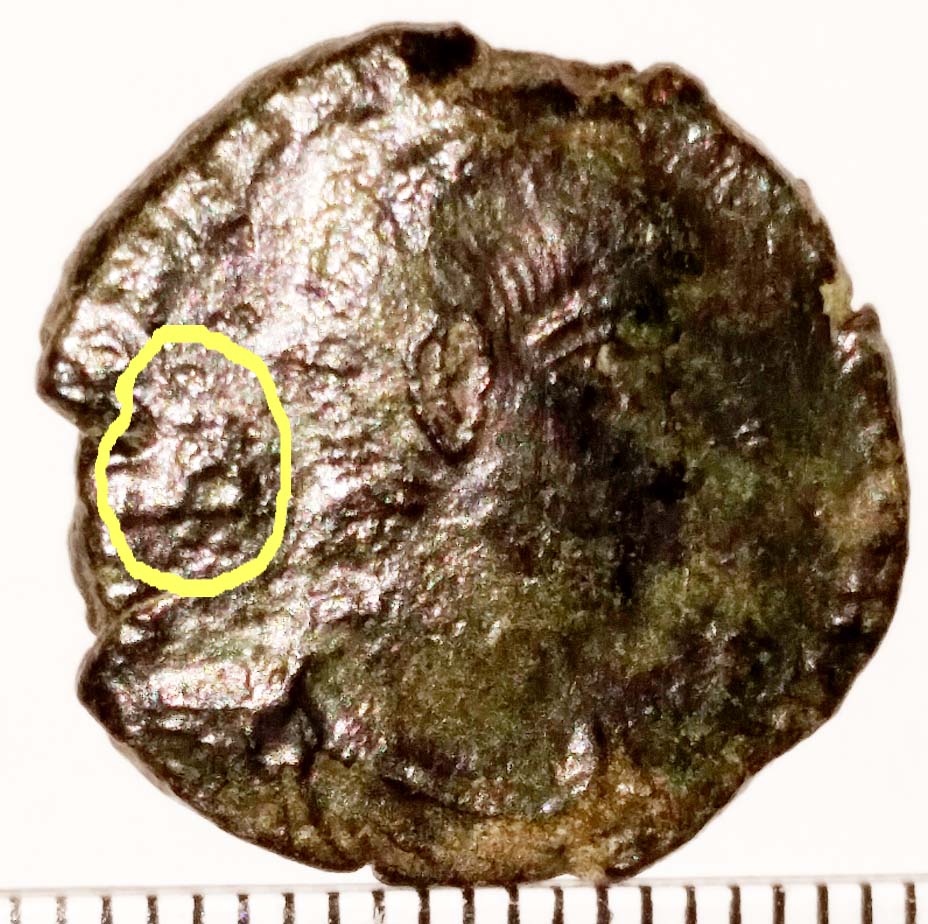 However, in the area I have circled, just below the letter "A" I think I see two balls which normally appear at the ends of the diadem for Cs2. Since the coins of Csg are bareheaded, your coin may in fact be attributed to Cs2. I am not sure of that, since the bust does not seem to show clear evidence of a diadem. On the other hand it doesn't show the obverse letter "A" very well either, so I leave the matter open. Bob linked us to a CNG pic of a clear example of this coin type from Aquilea for Gallus. Here is one from my collection for Cs2, also from Aquilea: 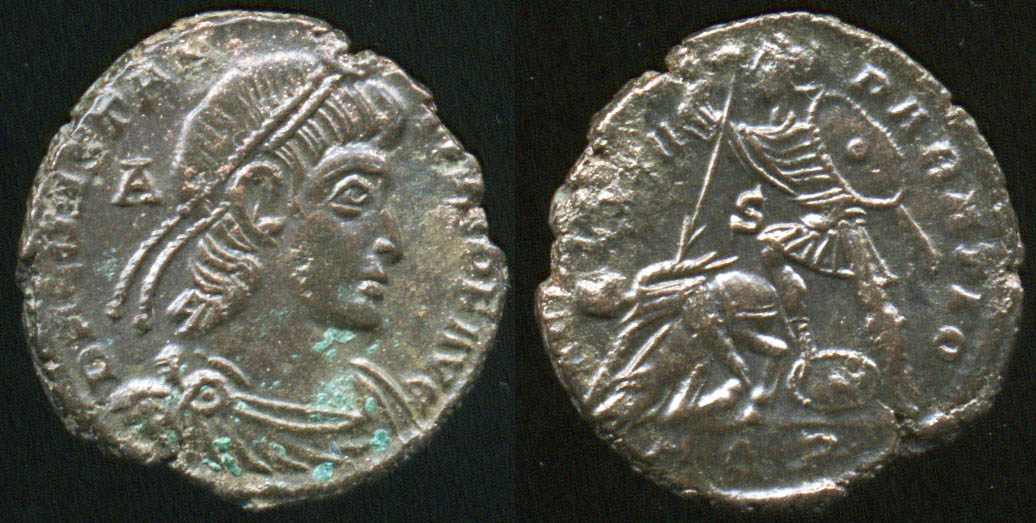 Kent makes no comment about any special meaning for the use of the Roman numeral LXXII (72), but his associate in the LRBC project, Robert A.G. Carson, wrote in his survey Coins of the Roman Empire, "...the number LXXII in the reverse field indicates the standard of 72 to the pound." This is as you reported earlier, Finn. This represents a reduced module from the size of the Falling Horseman type introduced earlier as the AE2, so-called "Centenionalis," but it is still larger than the AE3 module which had been replaced by the new bronze, and to which the AE2 eventually gave way later. There are several combinations of field marks for these coins, all of which bear the FTR falling horseman reverse. The OP coin has the same combination of marks as my example for Cs2, with an "S" near the reverse center in addition to the numeral along the left edge. The RIC numbers for this combination are Cs2= #193; Csg = 194. Both of these are rated as C (common) in RIC VIII. As a matter of scale I acquired my example in 2001 for slightly less than US$4, so these are not rare coins by any standard. I hope that's enough background, but if not, let me know. |
|
Pillar of the Community
United States
7067 Posts |
Hmmm. For the balls/diadem-ends to be right under the "A" the ties would have had to take a path right through the letter. Are there Cs2 examples where the balls are directly below the "A"? On your example, Irbguy, there is a healthy distance between the motifs, with no crowding or overlap. Maybe the balls are just bumps in a bumpy surface? I dunno...
|
|
Pillar of the Community
United States
949 Posts |
Quote:
Are there Cs2 examples where the balls are directly below the "A"? I'm going to retract that speculation, Bob. After going over a couple hundred examples, I found: 1. That in every case where a letter appears behind the bust on an obverse of Constantius II the letter is always BELOW the ends of the diadem. 2. That on some examples of coins of Constantius Gallus, a vertical pair of dots is sometimes found below the level of the obverse letter, but very close to the neck of the bust about where a shirt collar would appear today. I think his coin is a Csg. That said, based on the scan and the coin's condition, I cannot be 100% sure the position of the obverse letter A is right where I put it. But it appears that way to me. |
|
Pillar of the Community
United States
7067 Posts |
Makes sense...good reasoning.  |
|
Pillar of the Community
United States
6130 Posts |
Thanks to you both! That does clear things up--I was confused as to why that coin was initially called out as "very rare" but could not find any catalog which supported that. A few searches turned up no shortage of this coin type, so I will assume a rating of "common" is correct.
|
|
Pillar of the Community
United States
6130 Posts |
Been on and off from this lot in the past few weeks. Making progress on the Ptolemy bronzes and LRBs, but this one has me stumped: 7/97: Obverse: Tiny, off-center portrait wearing some sort of helmet. A little goofy looking.  Reverse: Standing figure holding (lightning bolt?) and something that looks like a modius. I might see a faded Greek letter Phi in the left field.  Did not have my scale handy, but the coin is very small and light, around 12mm, about 1g. I am getting a Seleucid feel maybe? Edited by Finn235
03/05/2016 3:46 pm
|
|
Page 2 of 2
|
Replies: 25 / Views: 4,244 |
Page 2 of 2
|








 First Page


 Posted 01/20/2016 10:37 pm


