| Author |
 Replies: 27 / Views: 3,700 Replies: 27 / Views: 3,700 |
Page 2 of 2
|
|
|
|
Pillar of the Community
Spain
629 Posts |
Sometimes you can find roman coins counterstamped in the reigns of Philip III and Philip IV of Spain like maravedis coins...
|
|
Pillar of the Community
United States
3499 Posts |
Athalbert- Do you have any picture of such coins? I've seen counterstruck maravedis coins, but never Ancient Romans struck with a denomination in maradevis.
|
|
Pillar of the Community
United States
3495 Posts |
I distinctly recall reading that western travelers in Afghanistan (early 20th century) were surprised to find well worn drachms of Alexander circulating in the market places.
Whether they had spent that entire period above ground is in a sense a question without meaning.
People did not have banks or safety deposit boxes. The only "safe" place to deposit ones wealth was to bury it someplace.
I believe it is safe to assume that all ancient coins were at some point below ground. Whether they were ever lost is impossible to gage.
|
|
Pillar of the Community
Spain
629 Posts |
|
|
Pillar of the Community
Poland
3201 Posts |
Thanks for the examples! What was the reason for them being used 1500 years later in this particular case?
|
|
Pillar of the Community
Spain
629 Posts |
Well, I suppose that those coins were used as small change and when the coinage was counterstamped the coiners were in a real hurry, they must counterstamp millions of coins in a few weeks so they were not very carefull with coins of very small value...
Sometimes you can seen coins of neightbour kingdoms counterstamped like french, portuguese or Navarra...
|
|
New Member
United States
15 Posts |
Not sure but the Vatican Numismatic Museum would be a good bet.
|
|
Pillar of the Community
United States
5155 Posts |
Rome, Italy Roman Empire Domitian Caesar Flavian Dynasty (b. AD 51- 96 d.) AE As (s. AD 73/4 under Vespasian) (cm AD 520-530 Ostrogoths) 27 mm x 12.64 grams Obverse: CAESAR AVG F DOMITIAN COS II: Bust of Domitian, laureate and drape, right Reverse: AEQVITAS AVGVST S C: Aequitas standing left, holding scales and rod. Ref: (Host Coin) RIC II, Part 1 (second edition) Vespasian 657 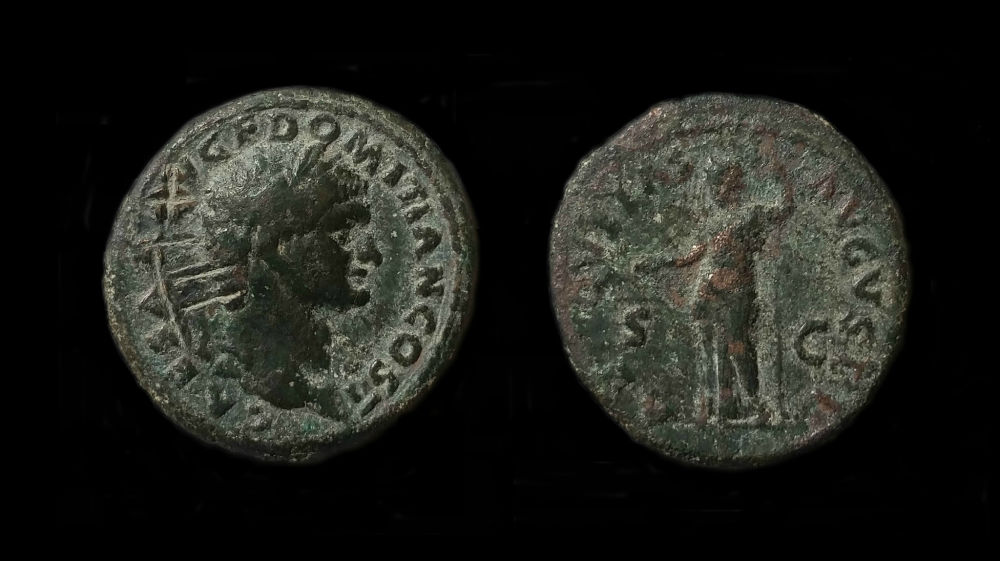 and... Italy Roman Empire Claudius II Gothicus AE Ant. 16 mm x 2.10 grams (s. AD 269) Obverse: MP CLAVDIVS AVG, Radiate head right Reverse FIDES MILITVM, Fides standing facing, head left, holding spear or sceptre in left hand and standard in right hand, epsilon in right field. Note: Counter marked VII by Ostrogoths (AD 520-530) 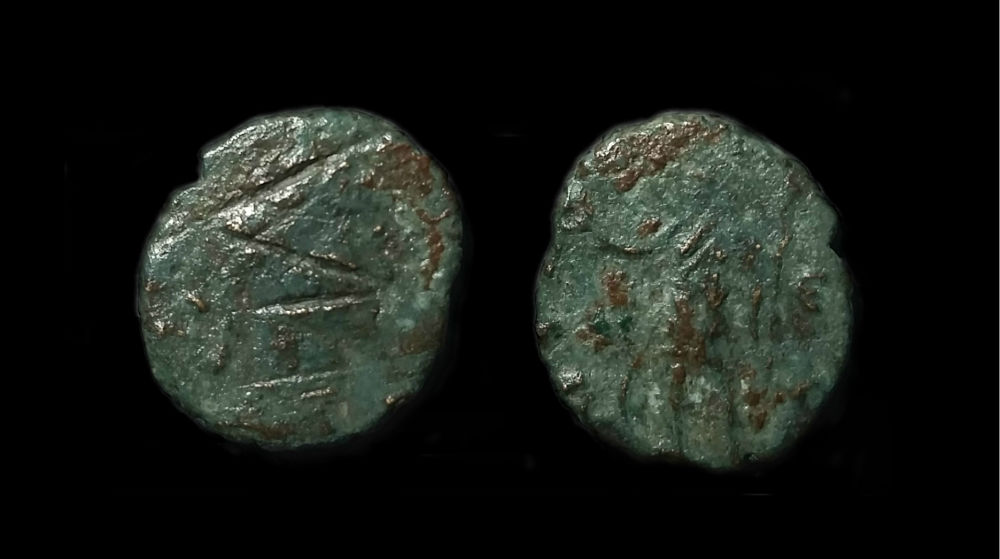 |
|
Pillar of the Community
 United States
6130 Posts |
I just remembered reading somewhere (don't remember where) that after the fall of western Rome, the silver coins remained in circulation but were hacked to pieces to make change until the pieces were no longer usable and were melted down to make current coinage.
|
|
New Member
Australia
23 Posts |
I don't know of any ancient coins that were never lost, but my family does have a collection of Chinese cash coins that may have been assembled over the past 300 years. My dad says my great grandfather handed him the coins in 1964, and told him it was handed to him by his grandfather, and so on. It appears that each generation of my family has plucked a few of the circulating coins at the time and added them to the collection. My parents and I have added a few modern issues too. Of course, I don't have any auction records or old books to prove this - but it's an intriguing story nonetheless because it would constitute an unbroken chain of provenance all the way back to when the coins were still in circulation in the 17th century. The collection includes: 3x Kangxi (1654-1722) 5x Qianlong (1735-1796) 1x Jiaqing (1796-1820) 5x Guangxu (1875-1908) - these added by my great-grandfather 2x Republican (1912) 1x Vietnamese (1925) 2x Republic (1935-1941) 6x PRC (1980-present) - added by my parents I've excluded the ones I've added to the collection. Anyway, here's a pic: 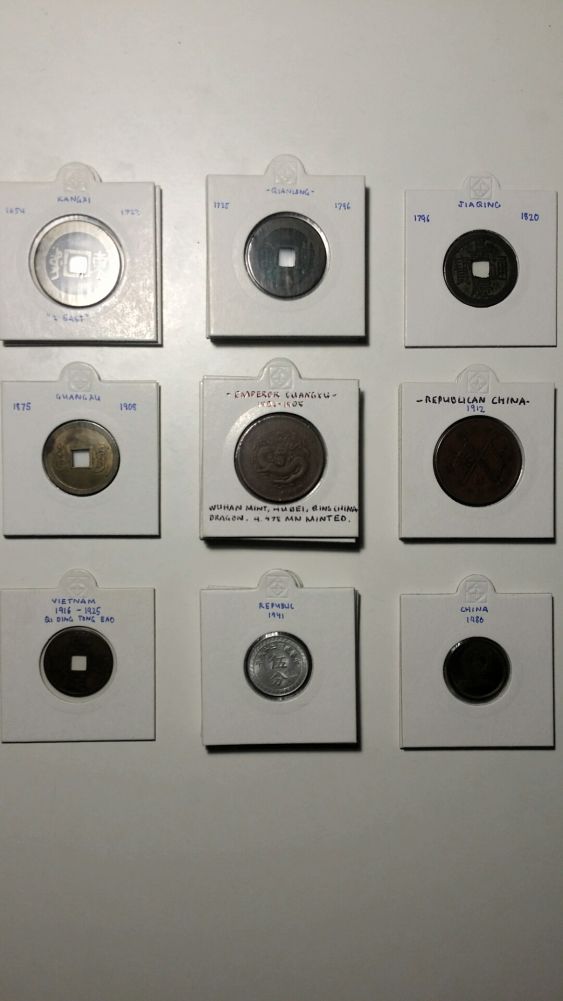 They probably wouldn't go for more than $200 as a lot on the auction block, but given the family history I will certainly be keeping them. My ancestor who started the collection wouldn't have known of the existence of much of the landmasses of the Southern Hemisphere at that time. Who knows, in the future one of my descendants may be enjoying them from the comforts of another planet! |
|
Pillar of the Community
United States
6130 Posts |
That is a very cool collection, Marketeer!
China is certainly a candidate, since the Himalayan mountains prevented all but the handful of experienced traders from keeping an open line of communication between the East and West. As such, the "dark ages" of 500-1000 AD were a time of relative stability for China. The Chinese made very robust coins; I have heard that in the very early 20th century cash coins of the Kangxi emperor were still in circulation, and that receiving one would have been interpreted as a sign of longevity and prosperity for the recipient. The problem is, the 13th century was largely marked by the complete subjugation of China by the Mongols under the Khanate. The Mongols issued their own coins and were brutally efficient in wiping out indigenous nationalism, which would have probably included the keeping of Song and earlier dynasty coins as mementos.
At this point, I am thinking that the best bet would either be a coin that changed hands from a Byzantine collector to Muslim collector (they did preserve the classics of ancient literature; it would not be a stretch to imagine that a scholar would keep a few coins as well), or else a coin kept in India, where there is a deep cultural tradition to keep and build a "rainy day fund" of gold.
|
|
Pillar of the Community
United States
6370 Posts |
Quote:
Now, the history of coin collecting is older and stronger in China; there may be some collections older than 1000 years over there. I'm not familiar enough with the scene there to comment. But in the West, the Dark Ages were simply too long and too dark to allow for such a luxury. Chinese numismatics began during the Song Dynasty. As far as the coins being in circulation, the coins tended to circulate 400+ years before being lost. In a hoard of wu zhus datable to the 500's AD, I found a Ban Liang and a Huo Quan, as well as a myriad of wu zhu types. In a hoard of Song coins unearthed in Java (that was probably buried in the Ming Dynasty) I found many Tang coins. |
|
Moderator
 Australia
17002 Posts |
To have "coin collections", you logically need "coin collectors". And to have "coin collectors", as opposed to "antiquarians" like Augustus or "hoarders" like wealthy merchants, you need numismatic information available in a readily distributable form - some way to let the potential collector know exactly what is out there to be found. You need, in short, "coin catalogues".
As far as we can determine, nothing even remotely resembling a coin catalogue was ever created in ancient Greek, Roman, Egyptian, Persian or Indian societies. The oldest surviving coin catalogue is Chinese, and dates from the Song dynasty. This "book", however, quotes in turn from an even earlier, now-non-existent catalogue, which seems to have been written down sometime around AD 500, before the start of the Tang Dynasty.
Don't say "infinitely" when you mean "very"; otherwise, you'll have no word left when you want to talk about something really infinite. - C. S. Lewis
|
|
Pillar of the Community
United States
6130 Posts |
I highly doubt that Romans were interested in assembling a set of coins based on mintmark or reverse type, but we do know that Augustus' coins were organized and identified, and not "here's a hoard of old coins we found." The coins were probably valued beneath the other antiques in his personal collection, but a collection based on artistic merit or historical value is still a coin collection, even within the scope of a larger collection.
If someone had a display case of artifacts from the California gold rush, including an assortment of California Gold fractionals and early San Francisco gold, I would absolutely consider that to be a coin collection within the context of a larger, historical collection.
The Romans had a phenomenal historical record, much of which survives today. A "catalog" isn't needed to have a list of every emperor, and to acquire one coin from every person on that list.
|
|
Moderator
Australia
17002 Posts |
We really don't know anything at all about the nature of Augustus' "collection". All that we can know, assume and guess at is extracted from a single line in a single verse in Suetonius: Quote:
Festivals and holidays he celebrated lavishly as a rule, but sometimes only in a spirit of fun. On the Saturnalia, and at any other time when he took it into his head, he would now give gifts of clothing or gold and silver; again coins of every device, including old pieces of the kings and foreign money; another time nothing but hair cloth, sponges, pokers and tongs, and other such things under misleading names of double meaning. He used also at a dinner party to put up for auction lottery-tickets for articles of most unequal value, and paintings of which only the back was shown, thus by the caprice of fortune disappointing or filling to the full the expectations of the purchasers, requiring however that all the guests should take part in the bidding and share the loss or gain.
Suetonius, Twelve Caesars, Augustus 75:1 There's plenty of wriggle room to define this "collecting" however you wish. First, it doesn't directly describe him collecting things, it describes him dis-collecting them, giving them away apparently at random - which isn't something a "true collector" usually does. Perhaps he was merely giving away his "duplicates"; Suetonius doesn't say. The line about "old pieces of the kings" is likewise open to interpretation. It can't truly mean "old coins dating from the time of the Roman monarchy", because there are no such things; Rome had no coins at all way back then (753-509 BC). It seems that either Augustus or Suetonius (or both) were unaware that the "old kings" didn't actually issue any coins, which does not speak well of the general numismatic awareness of the society. Some coins of the later Republic period were minted that featured portraits of the old kings, struck by people who claimed to be their descendants, and it is usually assumed that it is these Late Republic pieces which Augustus actually gave away. Again, we don't know. There is much else that we don't know and can only speculate about. "Foreign money" was mentioned in the things given away; were they given away because he didn't want them and no-one else wanted them (ie they were "gag gifts")? Did he know anything at all about them other than the fact that they were "foreign"? Moving on to the nature of any possible "collection" in the absence of anything like a "coin catalogue": yes, you could try to assemble a one-from-every-emperor set... but for anyone other than the emperor himself, such an undertaking would have been a difficult and dangerous thing to do. In the ancient Roman mindset, to possess something was to honour it and even revere it, and coins were seen as an extension of the personage of the emperor that issued them. If the current emperor had come to the throne by means of a coup or palace intrigue, the old coins would usually be promptly withdrawn and melted down. So, proudly owning an undefaced coin of one of the current emperor's predecessors would be tantamount to declaring that you believed that the current emperor was illegitimate and that you were siding with his predecessors, or that you at least longed for the "good old days" when the current emperor was not around. Many wealthy aristocrats in Rome lost their heads to a paranoid emperor for less serious offences than coin collecting. This leaves a geographic collection as an option. Suppose you wished to assemble a collection of one coin from every mint-city in your province. Without an ancient equivalent of a "provincial coin catalogue", how were you going to find out which cities should be on your list? Not every city minted coins, and not every city that minted coins did so consistently, year after year. If you were wealthy and powerful enough, you might send slaves/servants off to obtain examples of coins from nearby cities and you might eventually have them visit every single city and town in the province, and this would obtain for you the coins "currently in circulation" - though you'd miss out on the old, obsolete coinages. Certainly a typical money-changer would be both wealthy enough and have enough access and exposure to "foreign coins" to attempt such a collection. Doable? Yes. Did anyone ever actually do it? We simply don't know - there's no evidence. Don't say "infinitely" when you mean "very"; otherwise, you'll have no word left when you want to talk about something really infinite. - C. S. Lewis
|
|
Page 2 of 2
|
Replies: 27 / Views: 3,700 |
Page 2 of 2
|






 First Page


 Posted 04/30/2016 8:48 pm





