| Author |
 Replies: 23 / Views: 10,524 Replies: 23 / Views: 10,524 |
Page 2 of 2
|
|
|
|
New Member
United States
28 Posts |
well, if it was against the will of the Dutch people they should vote them out of office!
|
|
Valued Member
Netherlands
309 Posts |
The working class would like to see the gov go, believe me!!
But unfortunally, it's here just like the states, money rules :'-(
Greetings, Carl
|
|
New Member
United States
28 Posts |
One of my students' uncles is a member of your Parliament...he's a socialist.
|
|
Pillar of the Community
Australia
3841 Posts |
Let's think about it this way: people who travel to Europe in the past had to change their currencies when they travelled from one country to another. The people who profitted the most are obviously the money changers as they can charge from some 5%-10+% in some places. No one else profited from this, especially the tourism sector. However with the switch over to the Euros, the tourism sector DID improve as tourists didn't have to worry about changing currencies.
Trust me, I had plenty of useless european currencies left over from the trip I last went back in 1997 and who knows how much is left over. For instance if one is to keep 20 dollars left over in each foreign currencies and one is to travel around 10 countries in Europe, that is a waste of 200 dollars per tourist.
My partial coin collection http://www.omnicoin.com/collection/gxseriesMy numismatics articles and collection: http://www.gxseries.com/numis/numis_index.htmRegularly updated at least once a month. |
|
Rest in Peace
United States
3730 Posts |
Just back from Europe.
Beautiful countries.
Things were so expensive there however.
Things in the United States -- gasolione, health care, insurance, transportation -- are so high that it takes two incomes to make ends meet.
Maybe another world-wide depression is on the way?
Regarding the Euro, I must say that I didn't see much enthusiasm for it during our trip to Europe. On the other hand, English people, and people from Scotland, seemed proud of their currency, and happy they were holding on to it.
As a collectible, I have really enjoyed the 2 Euro Commemorative coins I have received from Terry. I also have an album containing the coins from the various countries, issued during the first year. However, when it comes to collecting, Euros would rank far below my interest in U.S., Canadian, Australian, and British coins.
|
|
Rest in Peace
United States
3730 Posts |
Speaking of returning from Europe with currency, I'm happy with the 200 coins I brought back. However I also have #60 US in Euro paper, and $80 in English and Scottish paper. I'm not sure how I can get the paper exchanged back to US. Any suggestions?
|
|
Pillar Of The Community
Turkey
1205 Posts |
The easiest way for you would be to sell them I suppose.
|
|
Pillar of the Community
Australia
1079 Posts |
paper can be exchangesd at trvelex or Thomas cook etc.
|
|
Pillar of the Community
Australia
1092 Posts |
Banks will often exchange small amounts of foreign notes for a fee. Coins...just add them to your collection! I collect all those coins and used the doubles to trade for other coins from other countries. Coffee. It Australia you can get a "large" cup of coffee about the size of an US "small" cup. In the USA a large cup is eyepopingly BIG. In Europe, they serve the smallest cup of coffee I've ever seen. I took a picture of it in Belgium because I thought no one would believe me, It's like a childs "tea set". Of course the prices for these vary, but generally it's on a par as you are paying for the service not the coffee. Just don't get thirsty in Belgium you'll go bust. 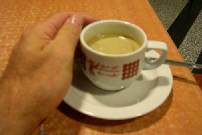 And yes, the cup wasn't filled to the top. (it actually looks bigger in the photo) You guys in the USA don't know how lucky you are!!! From a coffee addict. Edited by toast
06/11/2006 05:33 am
|
|
Pillar of the Community
United States
2365 Posts |
Oh my stars! I would go broke drinking coffee in Europe! Thank heavens for "Starbucks"!
Isn't European coffee more like "Espresso" with more power to it? Unlike U.S. imported coffee such as Folgers that's pretty weak here!
Edited by dsking
06/11/2006 09:51 am
|
|
New Member
Australia
9 Posts |
um, so I don't know if you said something about this before (things were getting a bit long for me) but I read that the euro came in in 2002 yet I have some euros and cents that have 2001 and 1999 on them (france, netherlands, spain and some other 50c with some fat dude's head on it) so just wondering about that.
|
|
Pillar of the Community
United States
4589 Posts |
quote:
Originally posted by DondaLonda
um, so I don't know if you said something about this before (things were getting a bit long for me) but I read that the euro came in in 2002 yet I have some euros and cents that have 2001 and 1999 on them (france, netherlands, spain and some other 50c with some fat dude's head on it) so just wondering about that.
yes it's true they did produce some Euro's then I think they were done by the individual countries ahead of time , but not from the whole union. Maybe they were used to test the popularity and or duability of the coins. Welcome to the forum and I hope you enjoy your stay  |
|
Valued Member
United States
230 Posts |
quote:
Originally posted by scoutjim99
quote:
Originally posted by DondaLonda
um, so I don't know if you said something about this before (things were getting a bit long for me) but I read that the euro came in in 2002 yet I have some euros and cents that have 2001 and 1999 on them (france, netherlands, spain and some other 50c with some fat dude's head on it) so just wondering about that.
yes it's true they did produce some Euro's then I think they were done by the individual countries ahead of time , but not from the whole union. Maybe they were used to test the popularity and or duability of the coins. Welcome to the forum and I hope you enjoy your stay
Production of Euro coinage began in 1999. Some of the EU countries, due to individual laws regarding the minting of coins, put the actual date the coin was produced, while other nations, with less strict laws, dated all the coins 2002 (the official date). Bear in mind, that each individual country had to have sufficient stocks of the Euro coinage on-hand prior to the "big switch", so that they could get all the exchanges done with as little confusion as possible. And not all countries produced their own coinage, so it was necessary for some of the bigger mints to produce coinage for multiple countries. The Greek coins were minted all over Europe, including Spain, Finland, and France (I am not sure about France, but I know there was a third country involved). Regardless of the date on the coin, they were not legal tender for cash transactions until Jan. 1, 2002. |
|
Pillar of the Community
United States
4589 Posts |
good info I did not know that Thanks Did you get my email kuhli
|
|
Pillar of the Community
Germany
1238 Posts |
quote:
Originally posted by kuhli
Production of Euro coinage began in 1999. Some of the EU countries, due to individual laws regarding the minting of coins, put the actual date the coin was produced, while other nations, with less strict laws, dated all the coins 2002 (the official date).
Ahem. Production of the euro and cent coins began in May 1998. It's just that some countries chose 1999 as the first year to appear on the coins because on 1-1-1999 the euro replaced the national currencies, while others chose 2002 because as you wrote on 1-1-2002 the euro cash became legal tender. Similarly, the new € coins "from" Slovenia, produced this year, all have the year 2007 because that is when they become legal tender there ... Christian |
|
Page 2 of 2
|
Replies: 23 / Views: 10,524 |
Page 2 of 2
|








 First Page

 Posted 04/22/2006 06:50 am


