|
This page may contain links that result in small commissions to keep this free site up and running.

Welcome Guest! Registering and/or logging in will remove the anchor (bottom) ads. It's Free!
To participate in the forum you must log in or register.| Author |
 Replies: 25 / Views: 4,221 Replies: 25 / Views: 4,221 |
Page 2 of 2
|
|
|
|
Moderator
  United States
23731 Posts |
When the old computer died, I bought a device that helped me retrieve all the data from the old hard drive. The problem was that I was using MS Works for the data base which isn't capable with windows 10. I've tried several different programs to convert it over, but nothing worked. I don't mind doing the work and I'm really in no hurry getting it done.
|
|
Pillar of the Community
Russian Federation
5186 Posts |
Catalog? What do you mean, catalog?
I try to "catalog" my coins by putting them on Numista, but for ancient coins this is exceedingly imperfect (both because Numista is still missing many ancient coin types, and because many of whatever types it does have are organized by sub-variety).
But other than that...
...I have a ziploc bag next to me on this desk that contains 19 ancient coins that I bought from a particular dealer a few months ago. For many of the coins, I'm still not entirely sure what they even are.
Some of those 19 did end up photographed to be posted for identification on CCF; I think one or two actually made it to CCF.
I'm looking at those 19 coins now. There's a badly cleaned Kushan and what looks like a barbarous radiate, a huge Byzantine follis next to a tiny Chach - I think it was Chach? - copper. For some others I don't know what they could be at all.
I'm pretty sure one of them is a late medieval silver. I don't even recall if I successfully identified that silver.
Catalog? What catalog? Haha don't be silly.
(But I should definitely actually go and take at least some pics of those 19 coins, and then actually post them on CCF. Let's make it my project for this weekend: the 19-coin lot identification day.)
...I estimate that my collection contains about a hundred assorted ancients, by the way.
Though the boundary is somewhat fuzzy - I do, after all, have a coin from every century (all 26 of them, that is).
|
|
Bedrock of the Community
Australia
21792 Posts |
I collect in all cultures all eras, ancient to modern. I am a generalist, not a specialist. Nevertheless ancients are my first numismatic love. I have been collecting for more than 50 years.
For ancient coins in my collection over 1,000 years old:
11 gold coins: (Greek, Roman, Byzantine, Pre Roman Celtic, Indian and Islamic).
65 silver coins: (as above, but includes 2 south-east Asian coins)
145 bronze coins: (as above also, which includes 11 Chinese coins).
1 lead coin: (South Indian)
These are included in a collection of about 4,000 coins.
Perhaps needless to say, I have an extensive numismatic library to support such a collection. Despite this, I still heavily rely on others in the CCF, who have the specialist knowledge that I lack. You would expect that from a generalist collector, such as myself.
I have been very fortunate to have support when I need it for most of my numisamatic life, from some very highly qualified numismatic professionals, who I consider to be my personal friends who are lifetime members of the Australian Numismatic Society, which recently celebrated it's 100 birthday. That is why I have been able to build my collection with confidence.
I have all coinage metals and alloys from which circulation coins have been struck except antinimony.
No need to recover my information.
It is all recorded in writing on the 2x2 which protects the coin. When the collection is re arranged occasionally with new additions, the information moves with the coin.
|
|
Bedrock of the Community
Australia
21792 Posts |
Greek gold:
Macedon Philip 11 gold stater, Pella, 8.56 grams. Thunderbolt below chariot, Le Rider 121. Bought from Spinks London 1978, GB680 Pounds. Have sale documents and polaroids.
Roman gold:
Augustus aureus. Rev. Caius and Lucuis Casars. BMC513, C42, Ric 350. Bought from collection of Seaby's employee, Sydney 1992, for AUD $750. Have sale documents and polaroids.
Vespasian Aureus, Rev. 'COS.ITER.TR POT' Pax seated left. 6.96 grams, struck Rome AD70. Ric 10, BMC26, sim. Sear 672.
Bought Spinks London, 1977. Have sale documents and polaroids.
Constantius 11 Solidus, Nicomedia Mint, Sim Sear 3988. 4.6 grams. Rev, Roma & Constantinopolis seated holding shield 'GLORIA REPVBLICAE in shield 'VOT.EX.MVLT.XXX' BOUGHT Sydney, 2013, for AUD 795.
Leo 1 (457-74) Solidus. Constantinople. Bought Sydney, Aud $600, 2013.
Byzantine:
Phocas (602-10), solidus. Rev. angel standing left, holdinfg staff and globus cruciger. 4 83 grams. Bought Sydney, 2014, AUD 525.
Constantine 11 (668 685) tremmissis. Constantinople. Ex D.J. Foster collection. (Noble Numismatics records) Sear 1160. Bought for AUD 300, 2015.
Theophilus (828-42) solidus, Syracuse mint. thick dumpy flan. Sear 1670. ex D.J. Foster collection (Noble Numismatic records). Bought I.S Wright for $795, 2016.
Indian:
Kushan gold stater, Kipananda, 330-60 AD, Obv. king standing, rev. Ardoshoko enthroned, Mac 3584, Bought Sydney, I.S. Wright for AUD 400, 2013.
Ceylon Chola gold kahavanu, 3rd type. c/- 990 1070 AD. Ref. Michener non Islamic 625. Bought AUD 450, Spinks Noble Sydney, 2013.
Celtic Britain:
Durotrigues c/- 58-45 BC base gold stater, 5.2 grams. Spinks Noble lot1684. Sale 111., 2014. Mack 317.
The earliest Isalmic gold that I have just misses out in being more that 1,000 years old. (Ghazvavid and Sulayhid dinars). I needed help to have those coins properly authenticated and attributed. Noble Numismatics helped me out in this regard.
All coins in either Fine or very Fine condition.
Edited by sel_69l
09/29/2017 5:41 pm
|
|
Bedrock of the Community
Australia
21792 Posts |
Some of my more intersting silver ancients:
Greece:
Athens tetradrachm: struck between 443-13 BC. Bought for AUD 295 Spinks, Sydney, 1991.
Thyrrheium: (Colony of Corinth) didrachm, (250 -29 BC), Obv. Athena wearing Corinthian helmet, amphora behind head, Rev. Pegasos flying left. Bought Spinks Noble, Sydney, 1991, for AUD 270.
Caria, Rhodos, didrachm:, (C/- 240 BC) 6.6 grams Obv. Helios facing, similar Sear 5034. Bought for AUD 300, I.S. Wright for AUD 380, 2014.
Thasos, tetradrachm: (after 148 BC) Obv. head of Dionysos right, Rev. Heracles standing left. Bought from I.S. Wright, for AUD AUD 275, 2013.
Egypt tetradrachm: Ptolemy X11, (53-52BC,) 12.8 grams, Obv. head of Ptolemy 1 right, Rev. eagle on thunderbolt. Sear 7947-8 variation, ex Geroge Coulayis collection. Bought for AUD 325, 2014.
Roman Syria: tetradrachm: Trajan, Rev. eagle standing on club right. Sear 1077. Bought for AUD 210, 2011.
Roman Syria tetradrachm: Tyre, Trajan, Rev. head of Melquarth facing right.
Roman:
Julia Domna antoninianus 4.91 grams In good quality silver, Rev. Venus seated right. Lovely coin in EF condition, well centered and struck. Bought for AUD 290 Noble Numismatics 2012.
Maximianus argenteus, Rev. tetrachy sacrificing in front of camp gate, in exergue: 'X. Bought for AUD 350 2011. I.S. Wright, Sydney.
South East Asia:
Mon Kingdom of Hamsavati, stater. 5th Century, 9 grams, Obv. ankh shell, Rev, temple, two pellets below. Mitchener SE Asia 517 -8. Bought for AUD 190, 2016. Noble Numismatics, Sydney.
Area of Bactria, (white Huns of Asia):
Hephthalites, drachm: 3.27 grams, Bust with bull head dress right, Rev. fire altar with attendants. Sharply struck, EF. Bought for AUD 130 2012, I.S wright, Sydney.
All coins Fine or better.
Edited by sel_69l
09/29/2017 09:20 am
|
|
Pillar of the Community
United States
9395 Posts |
It looks like I have 14 coins prior to 500AD. My catalog system is to keep symbolic links (to the real photos) in a single directory. The file names tell me what the coin is. For example:
[520]_480BC-450BC_TR_Paphlagonia_AR_drachm_mSinope_1o_2016-09-02-00.56.53 ZS DMap.tif

[849]_151BC_IT_Roman_Republic_AR_denarius_mRome_1o__2016-08-19-07.45.46 ZS DMap.tif

[938]_62BC_IT_Roman_Republic_AR_denarius_mRome_1o_2016-08-03-04.56.48 ZS DMap.tif

80_IT_Roman_Empire_AR_denarius_mRome_1sNGC_DPP_2016_08_05__0027.TIF
One thing to notice here is that he first three images were processed by Zerene Stacker (hence the "DMap.tiff" at the end |
|
Pillar of the Community
Canada
1269 Posts |
I currently have 62 coins in my collection. As for my catalogue system, I list my coins on FAC so I always have a description and photo in the case of theft. I have a word file that I update everytime I add a coin. This file has a description, attribution, price paid, provenance, and where purchased. I have a flip for each coin and these are stored in a red box. I also have a personal website where many of my coins are listed and described. I also keep a 3 ring binder which has plastic sleeves that hold all of the information about my coins including a copy of the FAC pages, a copy of the Word file, and all the receipts for my coins. This binder also holds all of the documents on provenance as well as import/export certificates and certificates of antiquity.
My coins
3 Greek Coins
18 Medieval coins ( English, French, Anglo-Gallic and 2 Islamic gold coins)
5 Byzantine coins (all gold)
9 Silver Republican coins (including 5 imperatorial coins)
2 Constantinian folles
3 Egyptian tetradrachms
1 4th century gold solidus of Valens
19 silver denarii of the 1st century AD
2 denarii of the 2nd century AD
Edited by orfew
09/29/2017 12:49 am
|
|
Moderator
United States
23731 Posts |
I need to catch up on some photos, I maintain a separate file with all my photos and use a reference number on the catalog to where the photo is located. Someday if I ever get around to it I would like to catalog the collection in this manner. 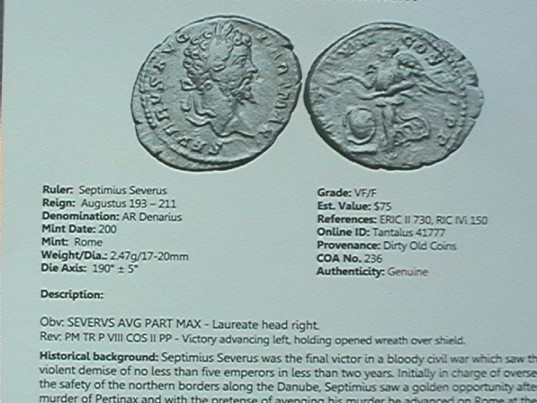 |
|
Pillar of the Community
Norway
1358 Posts |
I have about a handful of ancients right now. The oddest one is probably a Persian silver drachme from the Khusru I era. I think it's in VF condition. Otherwise I have some Roman / Byzantine coins now.
|
|
Rest in Peace
United States
18456 Posts |
Hope you guys don't mind me stepping in but just wanted to say that I don't have a single ancient coin in my 50 + year collection . Not because I don't find them interesting and loaded with history but because in my mind I feel that they are too easy to FAKE . I've always been fascinated with ancients ,but have no knowledge of them so I kept my distance from ancients all those years . Do any of you guys worry about fakes ,or is there an easy way of knowing genuine coins from the ones that are created in someone's basement ?  |
|
Pillar of the Community
United States
949 Posts |
Quote:
is there an easy way of knowing genuine coins from the ones that are created in someone's basement ? When you don't know the material well, the surest way to be safe is to buy from a reputable dealer. Stay at that level until you know what to look for. Gradually, knowledge will take over and fear, which comes from ignorance (i.e. lack of knowledge, not stupidity), will decrease. To deprive yourself of this enjoyment just because it is not already familiar to you would be an unfortunate mistake. On the matter of cataloging a collection, I have struggled with that for years, and it has just gotten worse as my collection has grown. I used to use dBase III, and then Paradox, and then MS Access. But the first two phased out, and the third got to be too cumbersome, though I still have the old software. But when it got to about the 3000 coin level for all the ancients (about 15 years ago) I stopped counting or trying to keep a database. Since then, the writeups I have encoded on the flips are my principle method for linking items and pictures to a common collection, grouping in pages and binders as necessary. The key point of linkage is the coding system I derived for image file names which gets written on each flip. The image files are archived and backed up, in some cases on DVD or Blu-Ray discs. It is enough for collecting, but the blend of technology and manual operation is not automated enough for keeping a sales inventory or records. Edited by lrbguy
09/29/2017 12:30 pm
|
|
Valued Member
United States
90 Posts |
I think I'm back up to around 70 this time around, mostly Parthian with some Seleucid, Bactrian and Indo-Greeks thrown in. When I collected strictly Greeks I was over 250 but sold them to re-focus my collection. I use an old program I picked up called Bento. You can design it any way you want - adding different colors, categories, drop down boxes, etc. - whatever information you want to capture. You can also format it any way you want by moving the data field around in almost any configuration you want. Seems to work great and has survived several updates to my MAC operating system. It's not sold anymore (I think it was a Filemaker product) but perhaps can be found on ebay. Steve S. |
|
Pillar of the Community
United States
6130 Posts |
Thankfully, the only truly dangerous fakes (the type that could fool an expert) are pretty much confined to classical Greek and Roman silver and gold, Chinese early coins (knives and spades mostly) and some other miscellaneous, usually gold coins. Most ancients (especially Roman bronzes) are too common to justify convincing fakes - by the time you have made it, it would be cheaper to just go out and find them with a metal detector. Can't speak for everyone here, but my collection totally falls into the 80/20 rule; 80% of the coins make 20% of the value and vice versa. I only buy the big bucks coins from vcoins or very trusted ebay sellers. Lots of coins from inexperienced sellers are good ways to get solid deals, make some cash, or both. I think I bought one fake coin (lesson learned; don't buy ancients from Eastern European ebay stores, period.) Fakes aren't as prevalent as you may think. A while ago I had a few "budget ancients" threads on here; night have to give those a little revival! There are some amazing coins that can be had very cheap! |
|
Bedrock of the Community
Australia
21792 Posts |
I have always been intrigued by the coinage of post Roman Europe, up to 1,000 AD, which is always expensive and very difficult to obtain.
The only representatives in my collection that covers this period is a rather humble Anglo Saxon bronze sceat of Eanred, and two silver Islamic dirhems, (Umayyad and Abbasid).
Perhaps not surprising, because very little coinage was needed during the European Dark Ages. Some contemporary Islamic coinages did find their way into Europe in this period.
The rest of my Islamic silver is more than 1,000 years old, and I needed professional help in it's attribution.
The only reasonable book in my library that covers this period is
Coins of Medieval Europe, by
Philip Grierson.
Edited by sel_69l
09/30/2017 02:03 am
|
|
Moderator
United States
23731 Posts |
Thanks everyone for your comments.
|
|
Page 2 of 2
|
Replies: 25 / Views: 4,221 |
Page 2 of 2
|
To participate in the forum you must log in or register.
Disclaimer: While a tremendous amount of effort goes into ensuring the accuracy of the information contained in this site, Coin Community assumes no liability for errors. Copyright 2005 - 2026 Coin Community Family- all rights reserved worldwide. Use of any images or content on this website without prior written permission of Coin Community or the original lender is strictly prohibited.
Contact Us | Advertise Here | Privacy Policy / Terms of Use
|
| Coin Community Forum |
© 2005 - 2026 Coin Community Forums |
| It took 0.39 seconds to rattle this change. |
 |
|
| |
| |






 First Page

 Posted 09/28/2017 8:44 pm


