| Author |
 Replies: 24 / Views: 2,737 Replies: 24 / Views: 2,737 |
Page 2 of 2
|
|
|
|
Pillar of the Community
 United States
5240 Posts |
@coop, I believe I know now what you are getting at. It isn't from the feeder finger, this is coming from the die itself as it is pressed into the planchet. Meaning it is coming from a die that has stress cracks.
|
|
Bedrock of the Community
United States
62064 Posts |
Getting closer. A feeder finger becomes bent. Probably from get struck when it was not out of the way yet:   This alteration of the feeder finger affects what (?) to cause these marks? Answer: _______________________________________________ |
|
Pillar of the Community
United States
5240 Posts |
@coop, because I do not know exactly how a feeder finger functions I am going to say that because the feeder finger is harder than a planchet the feeder finger actually damaged the die after the die struck it.
Edited by Jim0815
02/23/2018 10:42 pm
|
|
Bedrock of the Community
United States
62064 Posts |
Correct. Now we are getting closer. If the damage is on the die, why does it flow behind the shield and the rim? Answer: ______________________________________________________ Clue: The die is a negative on a coin. https://www.coincommunity.com/forum...erse_Die.jpg |
|
Pillar of the Community
United States
5240 Posts |
@coop, because the die is negative relief, that is the only part of the die that came in contact with the feeder finger.
Edited by Jim0815
02/24/2018 1:16 pm
|
|
Bedrock of the Community
United States
62064 Posts |
And what area of the die is affected. The devices (sunk into the die) or the fields? (outside portion)
|
|
Pillar of the Community
United States
5240 Posts |
@coop, it cannot be the devices as the are sunken in. The answer is the fields.
|
|
Bedrock of the Community
United States
62064 Posts |
Correct. That is why it passes behind the devices and rim....... 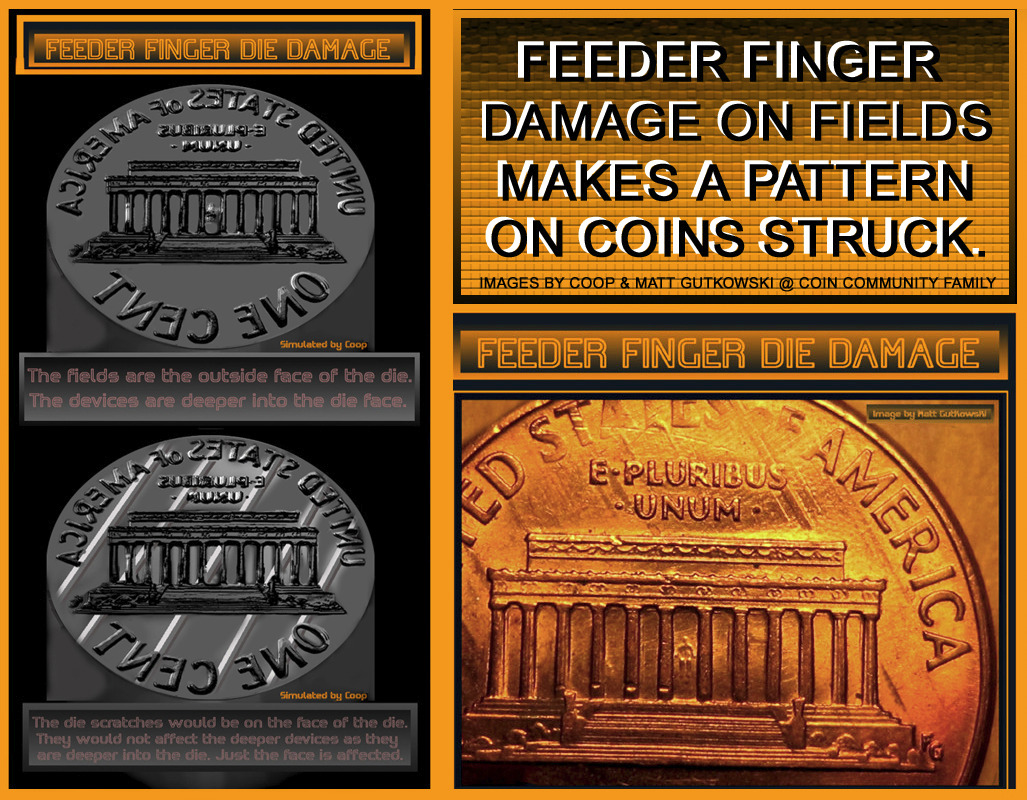 You've figured it out. |
|
Pillar of the Community
United States
5240 Posts |
@coop, and it didn't take 500 posts!
|
|
Bedrock of the Community
United States
62064 Posts |
Well that wasn't what I meant. LOL   But your comment did make me laugh out loud. Now you have learned something new today. But just not you, but others as well that followed this discussion. Maybe they will chime in and thank you for this question. You get an 'A' today... Edited by coop
02/24/2018 3:11 pm
|
|
Pillar of the Community
United States
5240 Posts |
Thank you! I had a pretty good teacher. @coop, I've ran machine presses for years. 8 ton all the way to 32 ton presses. I think if I ever learn the whole process it will be a lot easier for me to determine what, if anything is wrong with a coin just by looking.
Edited by Jim0815
02/24/2018 2:08 pm
|
|
Bedrock of the Community
United States
62064 Posts |
It takes a lot of patience to figure out how the machine works, how the dies work, the striking process, ejection process. Then when you get that all down, sometimes the machine just breaks down, throwing a new curve ball at you. Then factor in the creation of the coin, the die process of making them, the heating/tempering of metals, coins and scrap. And then factor operator error, die fatigue, die breakdown, and on and on. That is why the site err-ref.com is a good source to see what comes out the other end of the process. You could spend a lifetime reading over there. But it makes it simple with an explanation and a lot of images.
|
|
Pillar of the Community
United States
5240 Posts |
Thank you Mr. Coop for the advancement of knowledge. Glad I didn't fail this particular course!
|
|
Pillar of the Community
United States
5964 Posts |
Cool!  |
|
Pillar of the Community
United States
1260 Posts |
Good thread, thanks for the lesson coop. |
|
Page 2 of 2
|
Replies: 24 / Views: 2,737 |
Page 2 of 2
|








 First Page


 Posted 02/23/2018 10:06 pm


