| Author |
 Replies: 32 / Views: 8,031 Replies: 32 / Views: 8,031 |
Page 3 of 3
|
|
|
|
New Member
United States
45 Posts |
When I find myself with grimy coins - Coin Community comes to me - Speaking words of wisdom - Let it be.
|
|
Valued Member
292 Posts |
|
|
Valued Member
United States
150 Posts |
I'd agree with paralyse around $30'ish, definitely under $50 I'd say.
|
|
New Member
United States
1 Posts |
This coin looks very similar to the 1858 Flying Eagle I have. Best advise is not to clean it. Could totally destroy the value of the coin.
This advice was given to me by a coin appraiser. But th en he said "do what you have to do to satisfy yourself"
|
|
Bedrock of the Community
United States
10635 Posts |
Please, Please PLEASE Do NOT clean your coin(s)! Cleaning destroys value! Honest dirty coins have more value than cleaned ones! Please fight that inter-desire to have a shinny coin! (We love coins here and want save as many coins as we can) Please, we sincerely hope you'll stick around and learn more about care of your coins  |
|
Pillar of the Community
 United States
2703 Posts |
Accept it for what it is, and cherish it. If you clean it, you will be this guy  |
|
Bedrock of the Community
United States
12057 Posts |
Quote:
Please, Please PLEASE
Do NOT clean your coin(s)!
Cleaning destroys value!
Honest dirty coins have more value than cleaned ones! There is a difference between conserving a coin (using safe methods to remove dirt, contaminants and other harmful items which will damage its surfaces) and cleaning a coin (using chemical or mechanical methods to alter the surface of the coin or the metal itself.) Conserving a coin can in many cases not only prevent further damage, it can increase the value and protect the coin against future problems related to surface contaminants such as dirt, grease, fingerprint oils, smoke, and the like. Cleaning a coin with the intent to "improve" its appearance -- whether that's a dip, scrub, wipe, or whiz -- alters the metal surface of the coin and removes originality. Please don't conflate the two as they are very different processes with very different intentions. Regardless, conserving coins requires experience and care, and should not be attempted on anything you value greatly until you have learned the proper techniques, methods and substances involved. Member ANA - EAC - TNA - SSDC - CCT #890 "Most of the things worth doing in the world had been declared impossible before they were done." -- Louis D. Brandeis |
|
Valued Member
 United States
63 Posts |
Hello everyone! I am just revisiting this thread and am surprised to see that an extra page of comments has been added! I will let you all know that I both KEPT the coin and LEFT IT ALONE! It is now resting in an airtight capsule to be admired :))
Thank you all for the comments, information, opinions, and wisdom!
|
|
Moderator
United States
196100 Posts |
Quote:
I will let you all know that I both KEPT the coin and LEFT IT ALONE! It is now resting in an airtight capsule to be admired :)) Excellent!  |
|
Pillar of the Community
United States
2703 Posts |
|
|
Pillar of the Community
United States
2227 Posts |
cropped and rotated for you-- 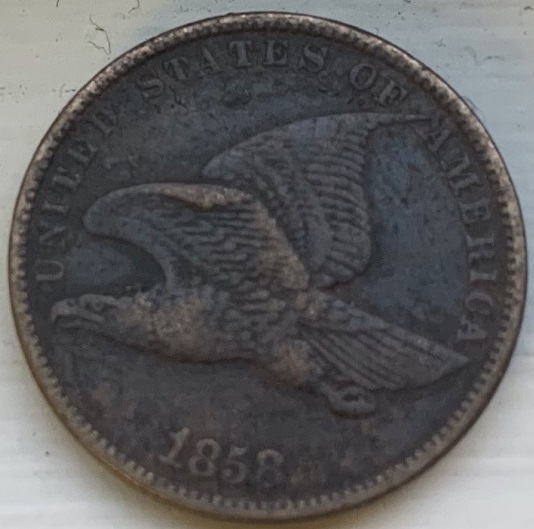 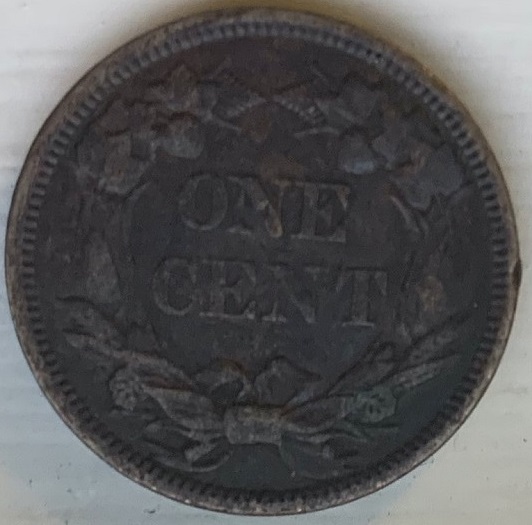 |
|
Valued Member
United States
63 Posts |
|
|
Valued Member
United States
112 Posts |
great date and no doubt part of our us history. dont clean, and to be honest in my opinion cleaning it will not change the value significantly as it is likely a Fine Details grade regardless. This looks more wholesome. Good luck!
|
|
Bedrock of the Community
Australia
21792 Posts |
From a distance, it looks a bit like a small black disk, with all detail very difficult to see. They must have looked fabulous, with a lighter bronze, slightly silvery color, when freshly minted. Because they were smaller than the previous traditional bronze large Cent type that preceded it, I guess that at the time, the admixture of 12% nickel in the alloy helped to give an impression of extra value to compensate for it's smaller size. That is why I prefer lighter colored examples of this type. Even so, the heavier weight over the standard bronze Indian Head cent which followed it, and the flying eagle Gobrecht inspired reverse helps to make this type forever popular among collectors. ------------------------------------------------------------------------------------------------------------------------------------ Switzerland was the first country to alloy nickel in their billon coinage in 18 50: 15%Ag 50%Cu 25%Zn 10%Ni. British used 50%Ag 40%Cu 5%Zn 5% Ni 1927-1946. (quaternary metals) Edited by sel_69l
09/19/2020 09:24 am
|
|
Pillar of the Community
United States
992 Posts |
If you think you paid too much, do What I do when that happens..
Keep it as a learning tool. BTW, it happens less and less as you gain more experience..
|
|
Page 3 of 3
|
Replies: 32 / Views: 8,031 |
Page 3 of 3
|





 First Page
 Previous Page


 Posted 01/27/2020 05:55 am





