| Author |
 Replies: 61 / Views: 7,656 Replies: 61 / Views: 7,656 |
|
|
|
|
Valued Member
United States
180 Posts |
Quote:
I would love a sky like that! Best I ever saw was at 9000 feet on Mauna Kea.
Nice! When did you visit? That photo was taken from the inside of Gemini North on Mauna Kea. Been living in Hawaii as an astronomer for just over a decade now. |
|
Pillar of the Community
Russian Federation
5186 Posts |
Quote:
I was 10 when I learnt to tie my shoes and ride a bike at 13. Quote:
Again, similar for me. I learned at to tie my shoes at around 10 and bike at 15. Two, three, or four wheels on the bike? I learned to tie my shoes around age 5; the bike thing is complicated though. As far as I can tell, on October 8, 2000, my instructor at the time (a family friend) finally managed to get me to actually ride a two-wheeled bike long enough (about half a block, I think?) to believe I learned it. On October 9, 2000, both families did a trip to the sea together, with me, as usual, on the luggage seat of his bike. On October 10, 2000, my family returned home, and since then I never had the opportunity to practice with him again. To the best of my knowledge, after 2000 (when I was not quite 9 years old), I have been on a two-wheeled bike... maybe two or three times, with many years in between. I'm still not sure if I've learned it or not. |
|
Pillar of the Community
Canada
5298 Posts |
You know, as you get older, which I am to some degree, the designations of "nuts" or any medical diagnosis or abilities when young becoming increasingly unimportant. They all get blended into your life experience, and interests and abilities change. Perhaps the star athlete from high school now raises wiener dogs and you are now the best of friends due to your same interest, even though he laughed at your inability to throw a basketball.
I try to look at people in a wider perspective and find that everyone has "quirks".
|
|
Pillar of the Community
 5464 Posts |
Okay, for you astronomers out there.
So when I (we) look at those planets or stars, we are looking back in time or at history.
If I'm looking up at a specific star tonight, say it's 250,000 light years from earth and the star blows up and disappears, that explosion actually happened 250,000 years ago.
Edited by USSID18
05/19/2020 10:01 am
|
|
Pillar of the Community
United States
7398 Posts |
Quote:
So when I (we) look at those planets or stars, we are looking back in time or at history. Lets make it easy. We need light to see an object. Light has a finite speed of ~ 186000 miles per second. Same as electricity. Say for example you had a light switch and the wires went 186000 miles before it reached the light (lets take out resistance  ), it would take 1 second from the time you flipped the switch till the light turned on, if the wire was 372000 miles long, it would take 2 seconds, 930000 mile long> 5 seconds.... Its the same with stars and planets. The planets are actually relatively close so the time distance isn't days, but it is hours. For example the signal from New Horizons (the space probe that explored Pluto) took over 4 hours to get to Earth. So we see Pluto as it looked 4 hours ago. Quote:
If I'm looking up at a specific star tonight, say it's 250,000 light years from earth and the star blows up and disappears, that explosion actually happened 250,000 years ago. Looking at stars is like looking at the past. Our Milky Way galaxy is only 100000 light years long, so we wouldn't see any stars from 250000 light years away. In a non light pollutted sky the most distant star you see is about 4000 light years away. In a suburban sky most stars you see are close or big, the farthest star you can generally see is Deneb at about 2600 light years away, but Deneb is a hypergiant (larger than the distance to Mars), in a really dark sky you can see V762 Cassiopeiae at about 10000 light years away. So what it looked like 10000 years ago. To really blow your mind, in a dark location Andromeda the nearest large galaxy to us is about 2 million light years away so we see it the way it looked 2 million years ago. Space is really really really big. This was a picture I took of Andromeda (this is what it looked 2 million years ago). It has 2 dwarf galaxies orbiting it. 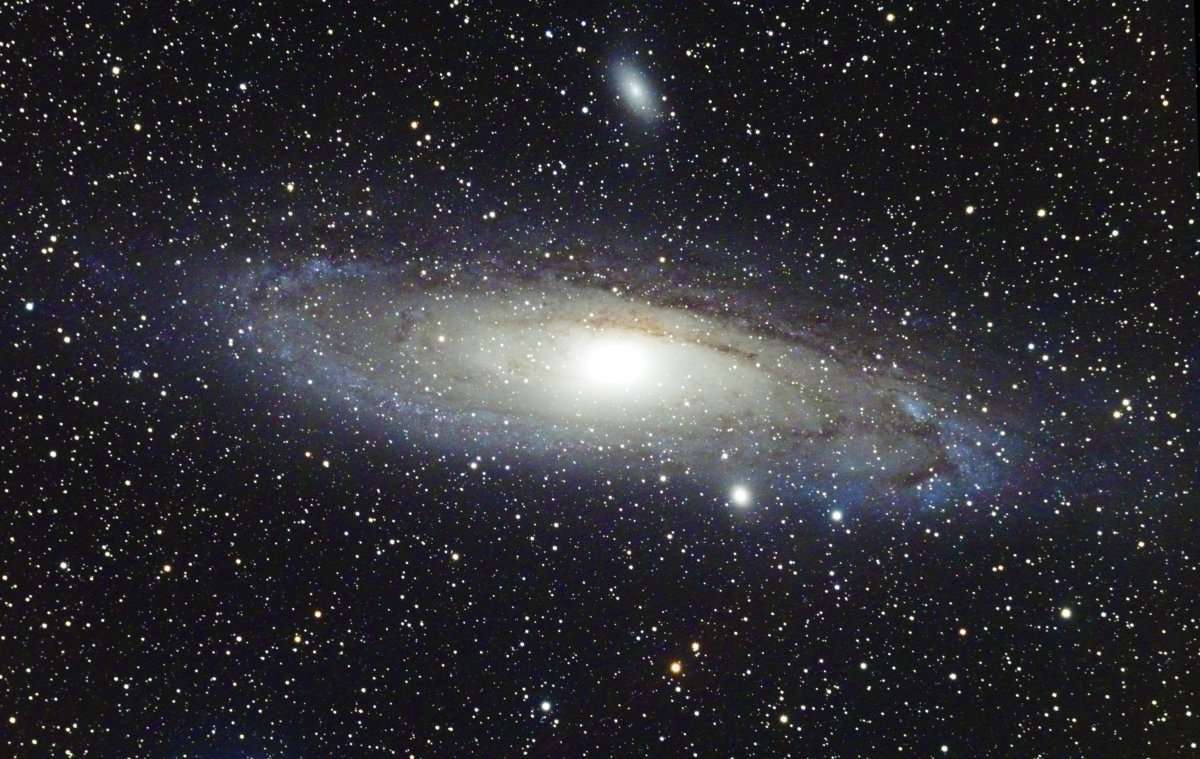 |
|
Pillar of the Community
United States
7398 Posts |
Quote:
Nice! When did you visit? That photo was taken from the inside of Gemini North on Mauna Kea. Been living in Hawaii as an astronomer for just over a decade now. I've been to the Big Island twice, once about 11 years ago and 4 years ago. Both times we stayed in Waikaloa. The first time I did a tour and stargazing. I only brought my Canon 50MM Image Stabilized binoculars no telescope, seeing the Milky Way in Hawaii = WOW , nicer than 1913 V Nickel The 2nd time we rented a pick up truck to drive ourselves to the top of the mountain. 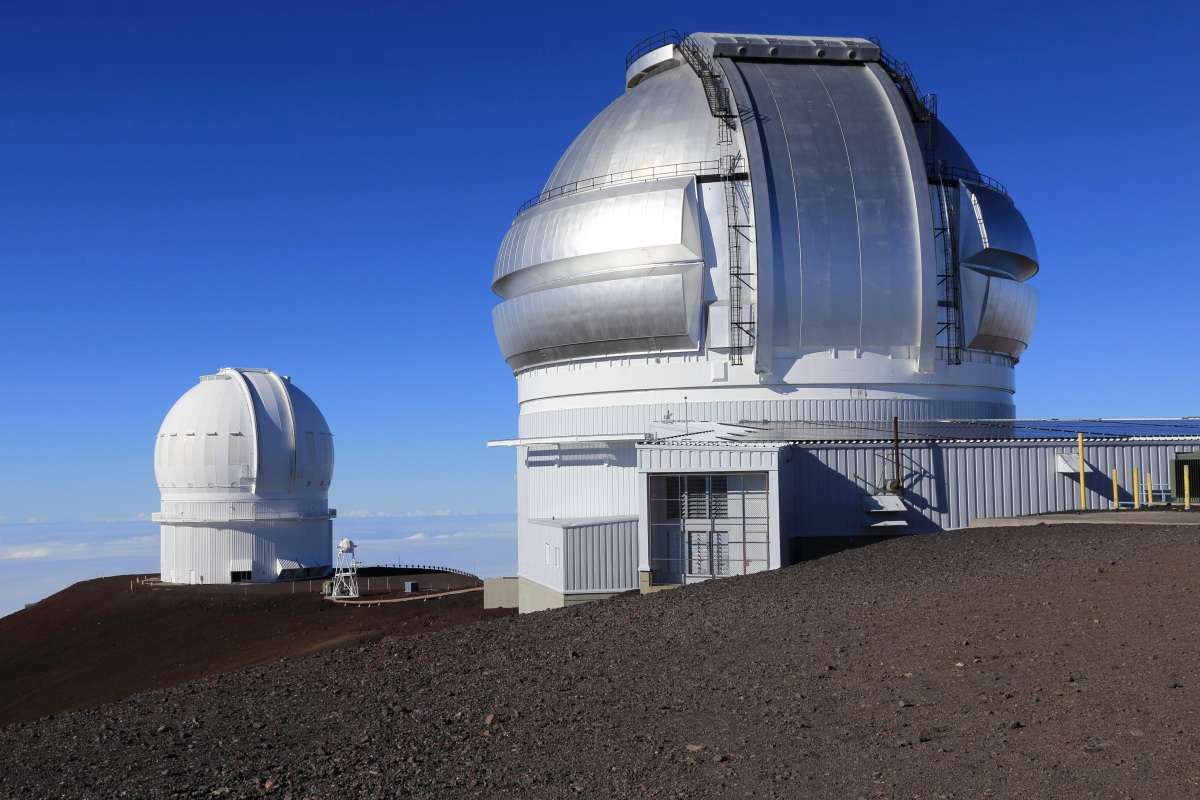 View from our Hotel  Edited by hfjacinto
05/19/2020 10:33 am
|
|
Pillar of the Community
5464 Posts |
Excellent synopsis hfjacinto!
So hypothetically, if I could sit on the head of a beam of light on my flashlight, turn that flashlight on and off for one second, me and that beam of light could travel around the earth 6 or 7 times in one second, correct?
|
|
Forum Dad
 United States
24236 Posts |
Quote:
If I'm looking up at a specific star tonight, say it's 250,000 light years from earth and the star blows up and disappears, that explosion actually happened 250,000 years ago. And if we had a plane that could fly faster than the speed of light, when you saw it, it wouldn't be there anymore. |
|
Pillar of the Community
5464 Posts |
Quote:
And if we had a plane that could fly faster than the speed of light, when you saw it, it wouldn't be there anymore. Okay, I gotta digest that a minute. |
|
Forum Dad
United States
24236 Posts |
Yep, the plane would be faster than the light it reflects, which is what you see.
|
|
Pillar of the Community
United States
7398 Posts |
Quote:
So hypothetically, if I could sit on the head of a beam of light on my flashlight, turn that flashlight on and off for one second, me and that beam of light could travel around the earth 6 or 7 times in one second, correct? Now we are getting into relativity, so this gets weird. Some basic concepts (all have been proven correct). 1) The speed of light is the ultimate barrier, nothing can travel faster (there has been proposed that faster than light particles exist called Tachyons, but there is no evidence they exist) 2) The faster an object goes the more its mass 3) The faster an object goes the slower time gets. 4) The faster an object goes the more energy it needs This is where we get E=MC^2. What this states is that the Energy = Mass times the speed of light squared. This may sound weird but everything from GPS to Nuclear Energy all rely on the above formula. Now using the above lets get to your example but lets change it up. If tried to reach the speed of light with your current mass you would need infinite energy so thats impossible. So lets say that you are massless particle with all your current knowledge and experiences, in essence you but no physical body. You are launched from Earth. Since you are traveling at the speed of light and since time slows down, the faster you travel the more time slows, till at ~186K MPH time stops. So now you traveled 1 light hour. You stop and look back and you are shocked to see Earth looks exactly like it did an hour ago. Because why Earth has rotated for 1 hour, you can only see it like it looked an hour ago, but to you since time stopped, you haven't aged an hour. Lets make this even longer. Its the year 2000. You are a 50 year old, you get on your light ship and travel 50 years. You are still 50 years old and if you could look on Earth, it would look like it was in the year 2000. You are still 50 years old, but you also traveled 50 light years from where you started. At the 50 light year distance, there is a mirror that will reflect you back to Earth. So now you travel 50 years to the mirror, bounce back and travel 50 years back to Earth. Since you never aged, you are still 50. Earth is now in the year 2100, your friends are all dead and you are in the future. If you used a telescope and looked at the light path, you would see Earth the way it looked 100 years ago. So we could in effect travel to the future, there just isn't a way to go back though.Hope I didn't blow your mind  Edited by hfjacinto
05/19/2020 11:44 am
|
|
Pillar of the Community
United States
7398 Posts |
Quote:
And if we had a plane that could fly faster than the speed of light, when you saw it, it wouldn't be there anymore. Well you can't travel faster than light (see above as to why). BUT, even if you could travel at the speed of light it would still take light 250000 years to get there, so by the time you get there its gone as it happened 250000 years in the past. Its like leaving your house to see an accident and by the time you get there its all cleaned up. |
|
Pillar of the Community
United States
7398 Posts |
Quote:
Yep, the plane would be faster than the light it reflects, which is what you see. The faster one can travel the less you can see behind them. At 50% the speed of the light the stars would red/blue shift depending on where they are (receding or getting closer to you). As you are moving so fast there is a cone of darkness behind you. The faster you go the larger the cone of darkness. Till at the speed of light its pure darkness, there is no light to see. |
|
Pillar of the Community
5464 Posts |
Quote:
Now we are getting into relativity, so this gets weird.
Some basic concepts (all have been proven correct).
1) The speed of light is the ultimate barrier, nothing can travel faster (there has been proposed that faster than light particles exist called Tachyons, but there is no evidence they exist)
2) The faster an object goes the more its mass
3) The faster an object goes the slower time gets.
4) The faster an object goes the more energy it needs
This is where we get E=MC^2. What this states is that the Energy = Mass times the speed of light squared. This may sound weird but everything from GPS to Nuclear Energy all rely on the above formula.
Now using the above lets get to your example but lets change it up.
If tried to reach the speed of light with your current mass you would need infinite energy so thats impossible. So lets say that you are massless particle with all your current knowledge and experiences, in essence you but no physical body.
You are launched from Earth. Since you are traveling at the speed of light and since time slows down, the faster you travel the more time slows, till at ~186K MPH time stops. So now you traveled 1 light hour. You stop and look back and you are shocked to see Earth looks exactly like it did an hour ago. Because why Earth has rotated for 1 hour, you can only see it like it looked an hour ago, but to you since time stopped, you haven't aged an hour.
Lets make this even longer. Its the year 2000. You are a 50 year old, you get on your light ship and travel 50 years. You are still 50 years old and if you could look on Earth, it would look like it was in the year 2000. You are still 50 years old, but you also traveled 50 light years from where you started.
At the 50 light year distance, there is a mirror that will reflect you back to Earth. So now you travel 50 years to the mirror, bounce back and travel 50 years back to Earth. Since you never aged, you are still 50. Earth is now in the year 2100, your friends are all dead and you are in the future. If you used a telescope and looked at the light path, you would see Earth the way it looked 100 years ago.
So we could in effect travel to the future, there just isn't a way to go back though.Hope I didn't blow your mind I knew that!   I do find basic orbital mechanics, satellite stuff, Isaac's laws and Kepler interesting. Edited by USSID18
05/19/2020 12:22 pm
|
|
Valued Member
United States
180 Posts |
Wow there's a veritable physics lesson going on here, cool lol.
I'll just add that everything hfjacinto said regarding special relativity is based on only 2 assumptions:
1) The speed of light is finite, and the same for any (inertial*) reference frame. Translation: No matter how fast you're moving the speed of light is always constant. So you can never go just a tad slower than c and "see" the light going ahead slightly faster.
2) All physical laws are the same for all observers/inertial reference frames.
Note that invariance of time wasn't an assumption, as Newton had thought! Which gives rise to a lot of interesting phenomena/paradoxes most of which have been verified experimentally.
*inertial just means you're not accelerating = not changing your speed or direction.
|
|
|
Replies: 61 / Views: 7,656 |
|
To participate in the forum you must log in or register.
Disclaimer: While a tremendous amount of effort goes into ensuring the accuracy of the information contained in this site, Coin Community assumes no liability for errors. Copyright 2005 - 2026 Coin Community Family- all rights reserved worldwide. Use of any images or content on this website without prior written permission of Coin Community or the original lender is strictly prohibited.
Contact Us | Advertise Here | Privacy Policy / Terms of Use
|
| Coin Community Forum |
© 2005 - 2026 Coin Community Forums |
| It took 0.4 seconds to rattle this change. |
 |
|





 First Page
 Previous Page

 Posted 05/19/2020 03:43 am


