| Author |
 Replies: 16 / Views: 2,978 Replies: 16 / Views: 2,978 |
Page 2 of 2
|
|
|
|
Bedrock of the Community
United States
94367 Posts |
Interesting. Does anyone know what became of these experiments in terms of actual paper changes?
|
|
Pillar of the Community
United States
7394 Posts |
Can you notice the difference in paper/finish?
|
|
Pillar of the Community
 United States
600 Posts |
I have 6 1928 $1 silver certificates, one of which is the special paper note pictured. There are variations due to overall quality of the notes, but I would never have guessed that the paper is different. Looks exactly the same side by side. Below is a close up with my digital microscope of two notes side by side. One is just slightly dirtier than the other. Maybe not super useful since I had to edit it down to 300kb. 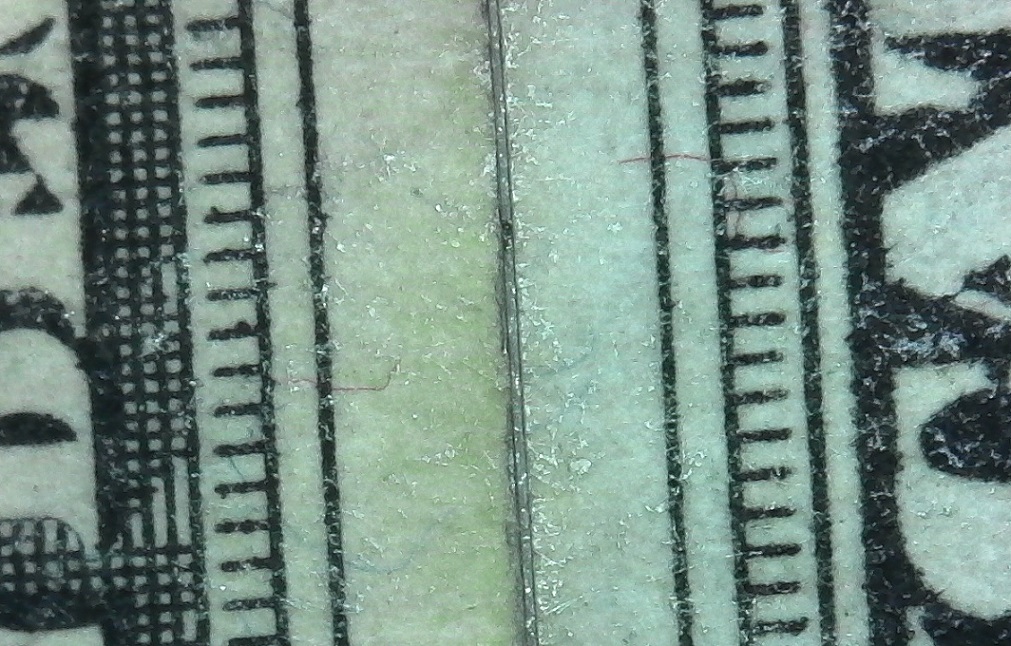 |
|
Pillar of the Community
United States
7394 Posts |
I guess we can say the testing was inconclusive  |
|
New Member
United States
5 Posts |
All of the Treasury's experiments in the 1930s with 1928 and 1935 $1 Silver Certificates were inconclusive. They made no changes to the surface treatment or composition of currency paper based on those experiments.
Edited by Jamericon
08/14/2020 9:21 pm
|
|
Pillar of the Community
United States
4705 Posts |
Basically a typical government fiasco. Put large red s and r on notes and people will think they are special and pull from circulation so little info to gather from this "experiment". Nonetheless, the notes are collectible.
|
|
Pillar of the Community
United States
600 Posts |
Not sure I'd call it a fiasco, but maybe I'm biased being a government bureaucrat. No results are a type of result and if they came up with a paper or finish that significantly improved the life of a note it would have been a worthwhile experiment. I do think that the more subtle approach using just serial numbers might yield more results than a big red S or R on a note. After all, many of us would immediately pull "special" notes from circulation for collection.
|
|
Pillar of the Community
Canada
2631 Posts |
Quote:
After all, many of us would immediately pull "special" notes from circulation for collection. True for collectors but most people ignore the SN & details in their cash (other than the marker for denomination). I had a rare treat in speaking with a Bank of Canada employee who happened to know a great deal about the history of our banknotes. We talked mostly about "insert replacements" because he was most amused by collectors' who desired to save them. By that time our Journey 'inserts' were merely odd prefixes discovered in bricks (usually with different prefixes & then identified) by other collectors who then fed that data to Charlton & other sources. The same practice occurs with the BOE in the UK. He said that most of decisions made at BOC (& our 2 printers) were made from economical perspectives (eg: to decrease the costs of printing special 'X' designated replacement batches) & they would never consider a collector's mindset. [So it was our printers who would have suggested getting rid of the designated replacement- not the other way around). I found this employee quite amusing as he always spoke to me like I was a reporter with such qualifiers as "off the record" or "you never heard that from me" (& I suppose management enforced a strict confidentiality work ethic there). The majority of test notes produced in Canada had innocuous (SR, GR, ER & RS) prefixes so were only later discovered/identified as such by collectors. The BOC employee stated that all test notes were generally field testing cheaper paper/inks in how the note faired from general circulation. I would suspect that the OP's 1928 & 1935 notes mentioned were employed for the same purposes. While some of the production runs were minor here (like our rarer old * replacements) the majority of test notes were printed in the millions but since collectors seldom successfully identified them (early to save them in high grade) few in high grades exist (& book values have remained high). |
|
Pillar of the Community
United States
5825 Posts |
The book I use for pre-FRN US currency is the "Standard Guide to Small-Size U.S. Paper Money 1928 to Date", 10th Edition.
Mine is the 2011 Krause Publications book.
I use it for the $1 bill from the 1928 Red Seal United States Note through the Silver Certificate era which ended with the 1957B series.
Paper experimentation was done a number of times during that period.
The 1928A Silver Certificates Experimentals were the first with the following serial number ranges:
-- X 00 000 001 B through X 10 728 000 B
-- Y 00 000 001 B through Y 10 248 000 B
-- Z 00 000 001 B through Z 10 248 000 B
The X-B and Y-B groups were on paper of different proportions of rag content.
The Z-B group was the control.
Later the 1928B Silver Certificates Experimentals had the same serial number ranges:
-- X 00 000 001 B through X 10 728 000 B
-- Y 00 000 001 B through Y 10 248 000 B
-- Z 00 000 001 B through Z 10 248 000 B
Then there was the 1935 Silver Certificates Experimentals with the following serial number ranges:
-- A 00 000 001 B through A 06 180 000 B
-- B 00 000 001 B through B 03 300 000 B
-- C 00 000 001 B through C 03 300 000 B
The A-B group was on distinctive paper with a special finish.
The B-B group was on special paper.
The C-B group was the control.
Then there was the 1935A Silver Certificates Experimental "R & S" notes.
Less well known were the two experiments done with FRN's about 1977 and 1981.
They are known as the Natick experiment and the Gilbert experiment.
Those notes carry a high premium.
Edited by kanga
08/15/2020 1:39 pm
|
|
Pillar of the Community
United States
2858 Posts |
Nice find! Experimental issues are kinda neat to find and can easily be cherry-picked. Here's my 1935 C-B block exp. 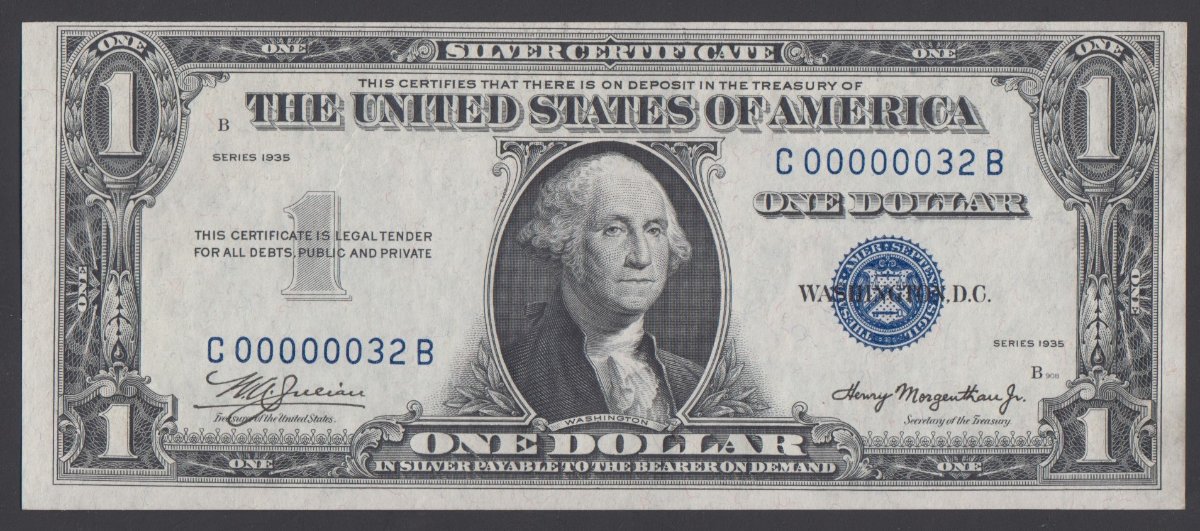 |
|
Bedrock of the Community
United States
94367 Posts |
Not being a scientific sort, what does "control group" mean here?
|
|
Pillar of the Community
United States
4637 Posts |
Quote:
Not being a scientific sort, what does "control group" mean here? I understand it to mean the status quo. No changes. |
|
Bedrock of the Community
United States
94367 Posts |
Do these "control group" specimens bring an auction premium despite being identical to regular notes?
|
|
Pillar of the Community
United States
2858 Posts |
Yes. They are still within part of the experiment, even though they weren't changed. Third party grading with usually give them their friedberg number followed by exp. They do pretty well at big auctions, especially in high grade.
|
|
Moderator
 United States
195802 Posts |
Jamericon,  to the Community! |
|
Page 2 of 2
|
Replies: 16 / Views: 2,978 |
Page 2 of 2
|







 First Page


 Posted 06/29/2020 7:54 pm





