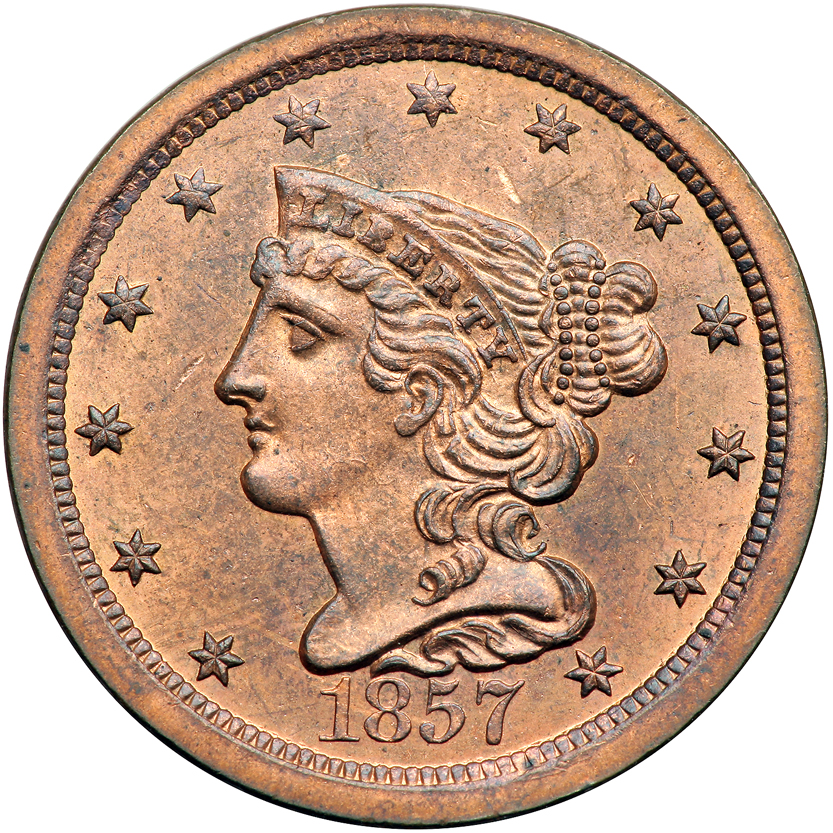
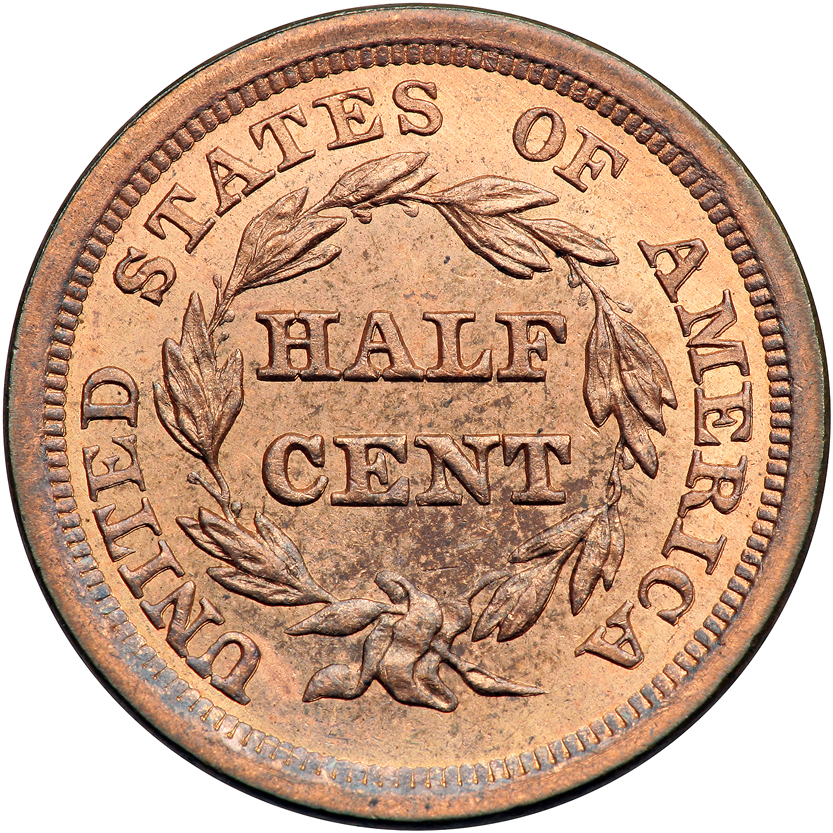
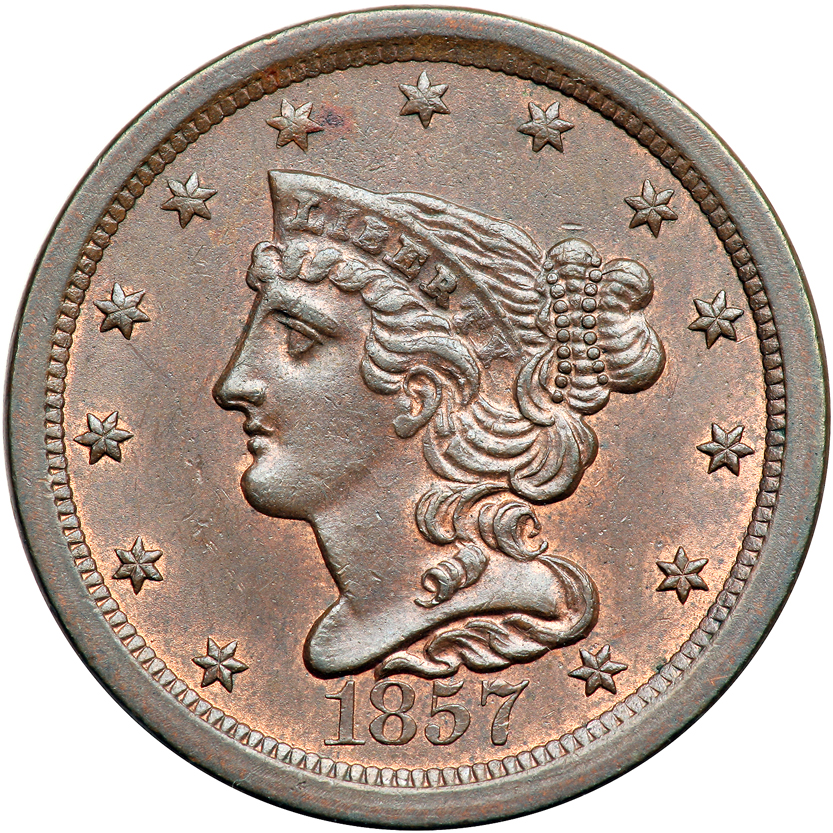
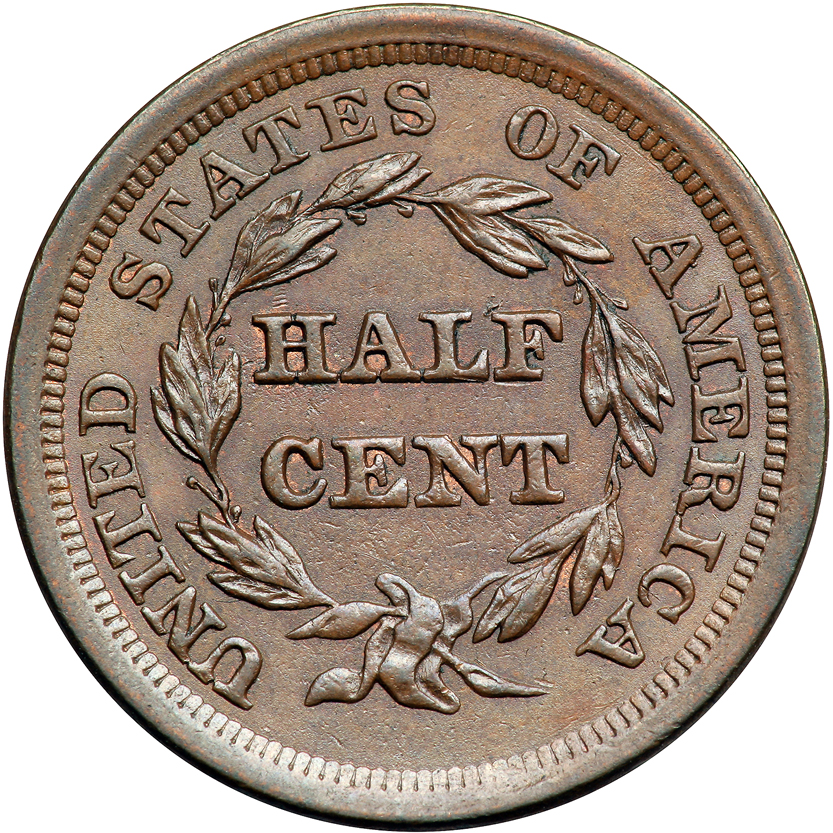
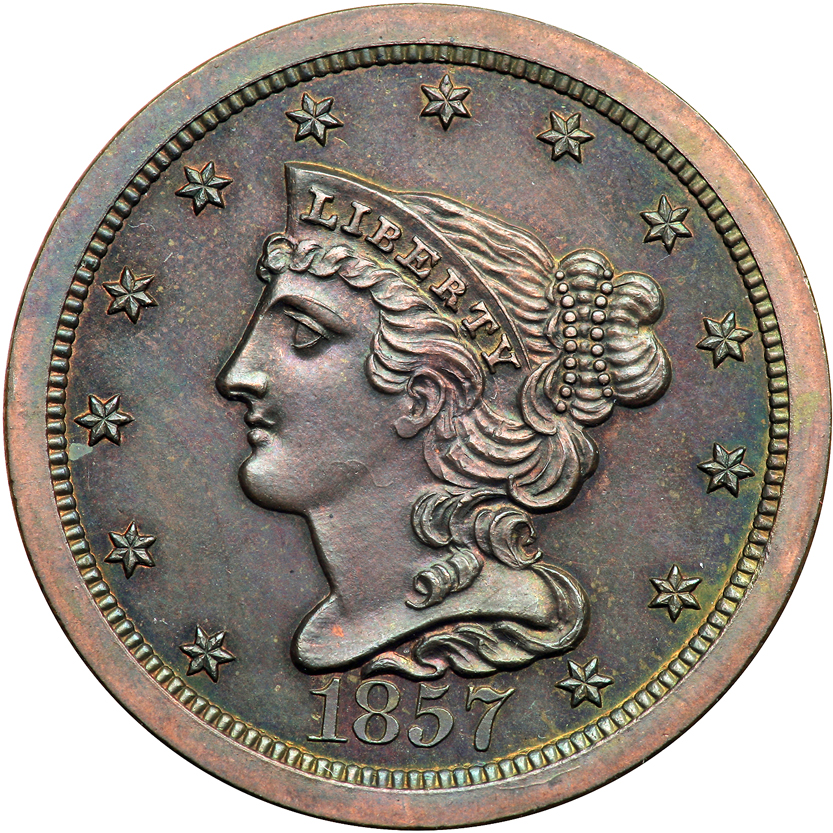
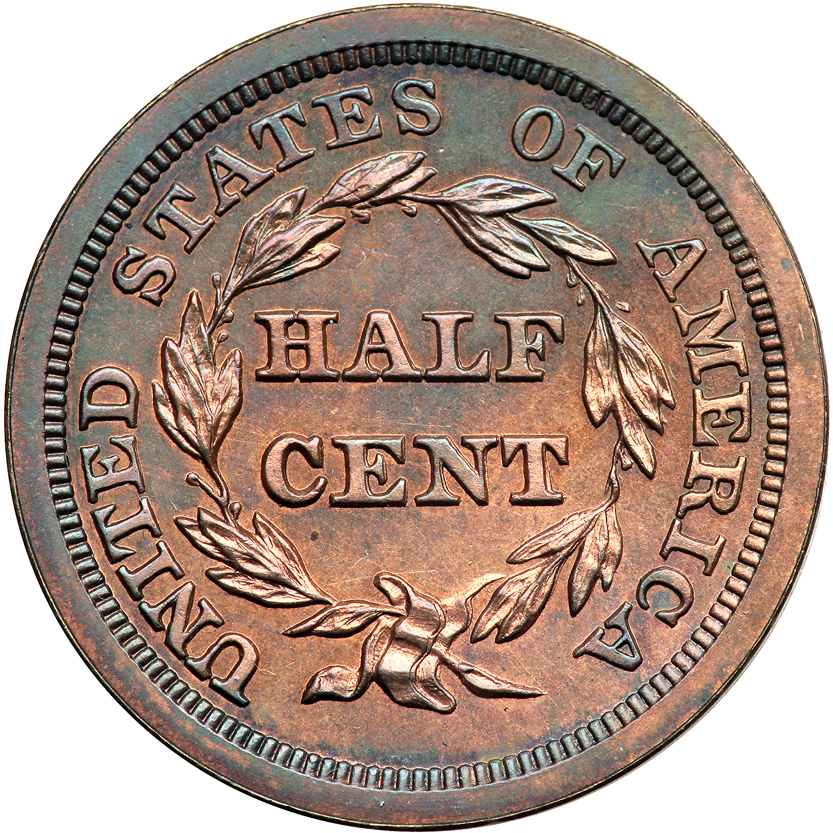
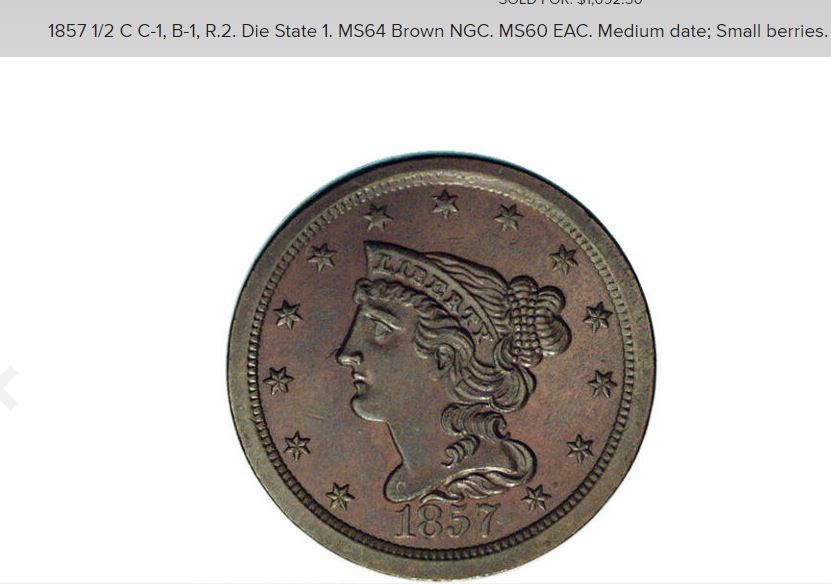
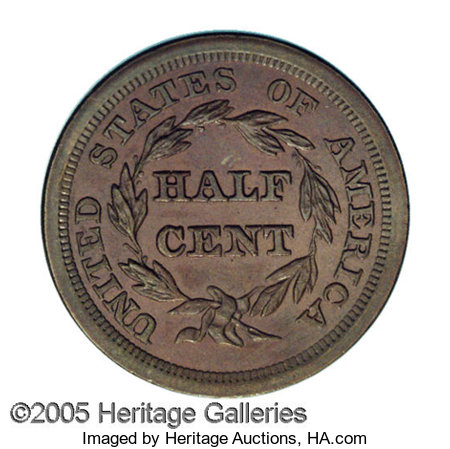
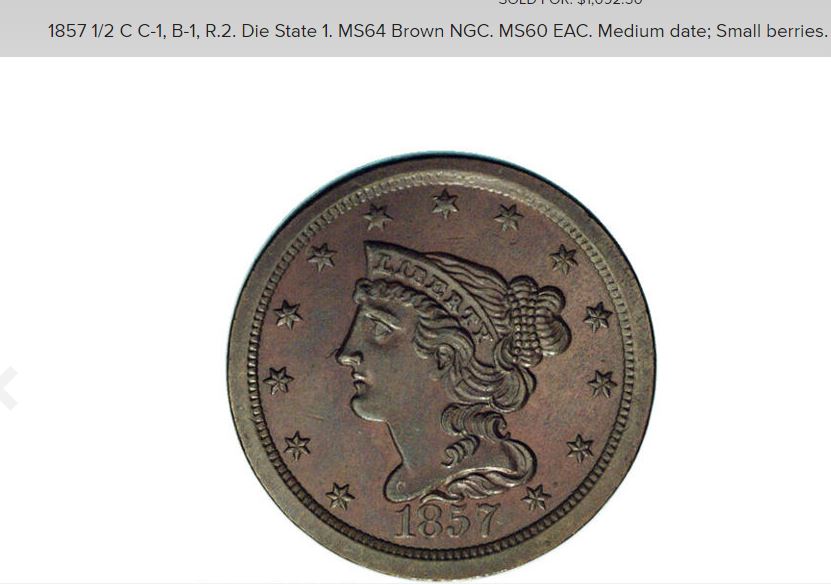
I just came across this EXACT coin auctioned at Heritage in 2006 in an NGC MS-64 BN holder. Not PF but MS. That is a huge value difference. Either NGC or PCGS got it wrong. What should I do?
I might consider contacting a dealer that specializes in copper. Maybe more than one dealer. They might also have a contact for you that can give this a good lookover. In my view, if the coin has all the characteristics of a Proof, especially sharp edges, then it's probably a Proof. Of course, an expert might be able to say definitively (as attempted in the above descriptions) based on what the known Proof dies were. If this coin was struck with dies only used to strike Business strikes, then it's a Business strike.
The dies themselves do not resolve the matter. Per Breen, there were 2 dies and both were used to strike business and proof issues. Does the auction house have any responsibility in disclosing the coin was previously in a MS holder?
My main focus points would be edges and the sharpness of the devices. My concern there would be the dentils are a bit mushy and not sharply defined in various areas. Other than that, I have no clue who could determine with no doubt with what intention they were struck. In fact, it might be moot. If they were supposedly struck with the same pressure, with the same dies, and the Mint just switched to pressing Business strikes...then it's literally an edge case with no viable 100% answer.
The closest comparison I can think of are 1884/1885 3CN. However, There are a handful of grading experts that are able to nail those down pretty well now. Some years ago, that was not the case and there was money to be made in finding Business strikes in Proof holders.
Quote: Per Breen, there were 2 dies and both were used to strike business and proof issues.
According to the Breen Half Cent book the B-2 dies were only used for Proofs, the B-1 dies were used for Business strikes and a FEW proofs.
This is the Proof B-1 from the Missouri cabinet and frankly it doesn't look as well struck as the OP coin. This is the Business strike B-1 from the same collection graded MS-65 and is the finest known brown coin fro the variety. It also appears to be better struck then the "Proof". The description of the proof indicates that it has "reflective fields with moderately deep mirrors", which are NOT apparent from the image
The early proofs were NOT struck to the same quality standards that we have come to expect from proofs today and cannot be judged by the same standards. But I feel that often determination of whether or not a piece is a proof is very subjective and open to a lot of conjecture. I also feel that only an in hand examination can even hope to to come to an actual decision. Even then another knowledgeable person could easily come to a different conclusion. That appears to be what we have here. One TPG has seen it and called it a business strike, another has called it a proof. And if it was cracked out there is no guarantee that PCGS would call it a proof upon a second examination. If the OP want to try to get the B-1 desgnation on it the best bet would be to send it in just requesting the die variety be put on the holder. That might get them to just add the variety without reconsidering the proof status, but there is no guarantee in that either.
Oh and this is the Proof B-2 form the Missouri Cabinet, this pairing was only struck in proof. Notice the extreme difference in quality between this proof and the B-1 "proof" After looking at the B-2 I have serious doubts about the B-1 "proofs, either the Missouri cabinet or the OP coin.
Thanks condor. From breens book on Half Cents I didn't conclude the B-2 dies were only used for proofs but I could infer it was since he only gives a rarity estimate for the proofs and not the business strikes. In any event it appears whether my coin is a proof or business strike is probably not conclusive. I see no reason to get a B-1 designation since that is self evident and if it is indeed a proof quite a rarity as such. If lucky it would be interesting to find early sales of this coin which is easily identifiable by the "lint" mark on the obverse.
I agree with Condor about adding the variety number added to the holder. Without it on the holder, the same questions will come up again and again if you ever decide to part with it.
I sent an EF/AU coin to ANACS that was a desirable variety with few examples or marker images to compare it to. ANACS did not add any variety number to the holder because of the limited number of official marker images at the attribution site.
You on the other hand have the Stacks description of the variety to provide with your re-submit. Best of luck to you either way.
Words of encouragement are one of the major food groups. We need to consume them regularly to thrive and grow.
Quote: I'd contact PCGS. Show them the previous sale as an MS. If they made a mistake I believe you can get them to pay you the difference in price.
I wouldn't count on that. The guarantee doesn't cover "mechanical errors", and as an example of a mechanical error they list "Proofs shown as regular strikes and regular strikes shown as proofs."
PCGS does NOT designate nor guarantee Breen numbers only Cohen numbers on Half Cents, says so right in their FAQ on variety submissions. https://www.PCGS.com/varietyfaq so it would be a waste of time and money plus the risk of sending the coin out.
I'd just keep the auction page cutout with the coin for when it's time to sell it. Bowers/Stack's are some of the more reputable dealers in EAC items. I think you would need to market this to a specialized collector when selling anyways, so maybe using a broker to sell it like McCawley/Grellman or similar.
There were two B1 dies in the Goldberg Missouri Cabinet Collection sale in 2014. A PR66BN (finest BN known) Lot 227 $9,488 and a PR65RB Lot 228 $12,075 I just happened to have the catalog sitting next to me when I found this thread. Condor101 is right on the money, I think the OP's coin is better struck up as well and a good shot at being the real deal proof as well. So yep it's a good upgrade and to get it into the holder I'd be happy with that alone. Many times the TPGs and even the EAC guys can't seem to agree on Proof or Business strike in these half and large cents from mid to later dates. I would not send it back to PCGS for any reason, it's in a holder hard enough to get as it is.
Quote: JustCarl: I'm always amazed at how anyone knows what is what from that far back.
Check out the e-Learning ANA videos from my friend Mark Borckardt he gets into what happened at the first US Mint in only 30 minutes. There are some other good videos posted there or at NNP (see below) as well (anything by Kraljevich, Wright, Heck or Eckberg:
"Buy the Book Before You Buy the Coin" - Aaron R. Feldman - "And read it" - Me 2013! ANA Life Member #3288 in good standing since 1981, ANS, Early American Coppers Member (EAC), Colonial Coin Collectors Club member (C4), Conder Token Collector Club member (CTCC), Civil War Token Society (CWTS) member, Liberty Seated Collectors Club (LSCC) & Numismatic Bibliomania Society member (NBS), USMex, Member in good standing, 2¢ variety collector.
For a what looks like a scanned image, it l-o-o-k-s like a Proof strike. If the edge is sharply squared (and better yet: retains some original bright surface) then, most probably, yup
Disclaimer: While a tremendous amount of effort goes into ensuring the accuracy of the information contained in this site, Coin Community assumes no liability for errors. Copyright 2005 - 2026 Coin Community Family- all rights reserved worldwide. Use of any images or content on this website without prior written permission of Coin Community or the original lender is strictly prohibited. Contact Us | Advertise Here | Privacy Policy / Terms of Use








 First Page




 Posted 08/19/2020 09:09 am