| Author |
 Replies: 20 / Views: 3,968 Replies: 20 / Views: 3,968 |
Page 2 of 2
|
|
|
|
Bedrock of the Community
United States
17884 Posts |
There is also the misconception that the Bronze composition of 95% copper 5% tin and zinc meant 2.5% tin and 2.5% zinc. Actually the percentage of each metal varied considerably but the combined amount of tin and zinc accounted for 5% of the total weight of the coin. Since the law did not specify set percentages, as long as there was a trace of tin in the alloy it complied with the law. Case in point after getting their allotment of metal from the War Production Board the San Francisco Mint had 50 pounds of Tin for their cent production. They struck 85,590,000 cents. That was 586,957 pounds of cents or a percentage composition of tin of .009% tin and 4.991% zinc.
From my understanding, after the shell case cent ended the amount of tin in the cents remained very low, well under 1%.
There is also the problem that both tin and zinc boil at temperatures below that of melted copper. That means that as long as the alloy is molten, tin and zinc are constantly vaporizing off which would make it very difficult to hit any specific composition or to hit it consistantly. So every melt would probably result in a slightly different composition.
|
|
Pillar of the Community
United States
787 Posts |
I saw 3 shell casing pennies listed at auction and did a quick web search on the topic. "Another forum" has members stating that spent casings were never actually used to mint coins during the war.
Can anyone confirm YES or NO? Curious...
|
|
Bedrock of the Community
United States
94367 Posts |
Learned a lot from this thread, thanks to all!
|
|
Pillar of the Community
 United States
4616 Posts |
I too have heard that shell casing was just a story.
I always thought that if they really had used spent shells from the firing ranges, somebody had to sort through and remove the occasional live round. Otherwise, you might find the melt being a little energetic.
I'm sure that would be the kind of task an enterprising Drill Instructor would use for minor malfeasance during training. Yet I never have seen a recollection from training camp of "I was caught smoking after lights out and the DI had me sort through two tons of shell casings to remove the live rounds".
-----Burton 50+ year / Life / Emeritus ANA member (joined 12/1/1973) Life member: Numismatics International, CONECA Member: TNA, FtWCC, NETCC, EveryCountry (online) coin club Owned by three cats and a wife of 40+ years (joined 1983) Author: 3rd Edition of the Sample Slabs book, https://www.sampleslabs.info/ |
|
Moderator
 United States
195203 Posts |
Quote:
I always thought that if they really had used spent shells from the firing ranges, somebody had to sort through and remove the occasional live round. Otherwise, you might find the melt being a little energetic.  Quote:
I'm sure that would be the kind of task an enterprising Drill Instructor would use for minor malfeasance during training.  |
|
Pillar of the Community
United States
787 Posts |
I did a search of the online Boston Globe newspaper archive via my library and not one mention of spent casings and pennies... that doesn't mean it didn't happen, it simply means it wasn't in the paper. I DID, though, see mention of a desire for Indian Head pennies to be put back into circulation...
|
|
Bedrock of the Community
United States
17884 Posts |
Quote:
Would there potentially be some 1947 made using the old planchets or 1946 on the standard composition? I wouldn't expect any change over to be 100% everywhere at one time. Instead gradual as suppliers ran out. Yes Quote:
Any reasonable at home way, to tell the difference between the 1947-1982 composition and the 1944-1946 composition? No. The only difference between the shell case cents and the post shell case cents was that the latter had some small amount of tin in them. Detecting that is going to take an XRF gun or something even more powerful. Or dissolve them in acid and do a qualitative chemical analysis for the tin. That last test requires the destruction of the coin. Quote:
I too have heard that shell casing was just a story. The "story" is true. In Roger Burdette's book on the experimental alloys used on the cents and five cent pieces during WWII he lists in the footnotes the location in the archives where the where the documents covering the operation may be found. Quote:
I always thought that if they really had used spent shells from the firing ranges, somebody had to sort through and remove the occasional live round. Otherwise, you might find the melt being a little energetic.
Part of the deal for using the shell casings was that the military would sort them to make sure there were no live rounds. |
|
Pillar of the Community
United States
787 Posts |
Quote:
The "story" is true. In Roger Burdette's book on the experimental alloys used on the cents and five cent pieces during WWII he lists in the footnotes the location in the archives where the where the documents covering the operation may be found. Nothing like a good footnote! :-) Did a little more searching and did indeed find the following: 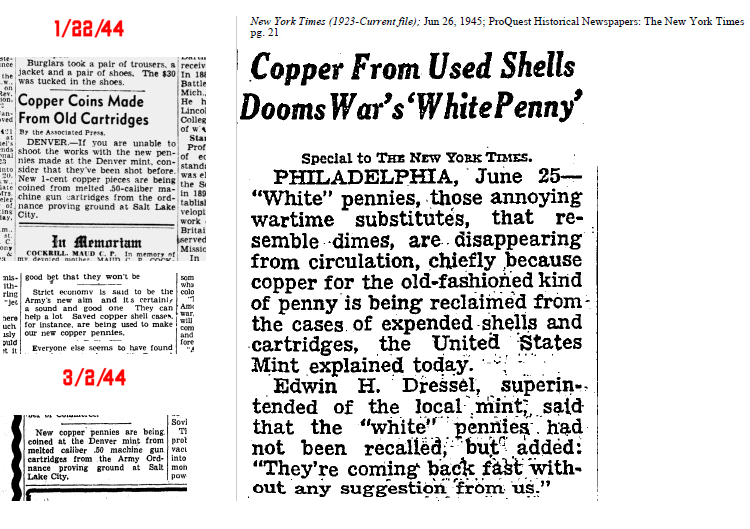 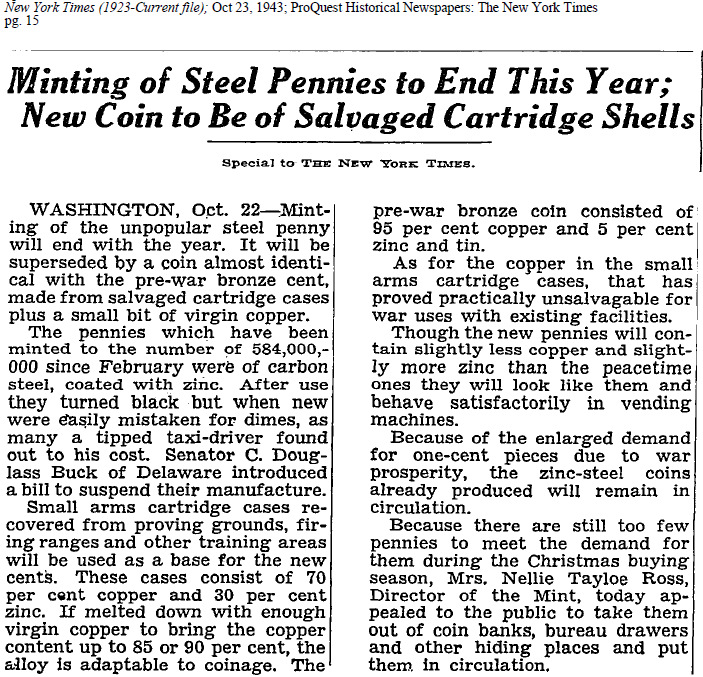 |
|
Moderator
United States
195203 Posts |
Fantastic sleuthing!  |
|
Pillar of the Community
United States
4616 Posts |
Except it doesn't say it was actually done. It lays out the result, but that could be from a small experiment.
They also don't lay out the amount of "Virgin Copper" required to achieve 85-15. The math says it's as much again as the mass of the 70-30 shell casings used.
1944 - 1.435 billion cents
1944D - 0.431 billion cents
total 1,865,978,000 coins
A 30cal carbine cartridge weighs approx. 4.6g
It works out to a bit over 1/2 billion cartridges and 2.4 million kg of virgin copper.
-----Burton 50+ year / Life / Emeritus ANA member (joined 12/1/1973) Life member: Numismatics International, CONECA Member: TNA, FtWCC, NETCC, EveryCountry (online) coin club Owned by three cats and a wife of 40+ years (joined 1983) Author: 3rd Edition of the Sample Slabs book, https://www.sampleslabs.info/ |
|
CCF Master Historian of Commemorative Coins
United States
12535 Posts |
Quote:
Would there potentially be some 1947 made using the old planchets or 1946 on the standard composition? Quote:
Except it doesn't say it was actually done. It lays out the result, but that could be from a small experiment. The Annual Report of the Director of the US Mint for Fiscal Year 1944 states that the use of an alloy of 95% copper and 5% zinc for the one-cent coin began on January 1, 1944. It also states that the zinc-coated steel cent was struck through December 31, 1943. The change back to a copper cent was "made as a result of the availability of fired brass cartridge cases, to which copper is added." The cartridge cases to be used were not 95% copper; depending on the cartridge, the copper content varied between 70 and 85% - pure copper had to be added to the melted cartridges to get the overall alloy up to 95% copper. The 1945 and 1946 Annual Reports continue to specify the 95% copper / 5% zinc alloy; in 1945 the Report references the fired brass cartridges, no such reference was specifically included in the 1946 Report. The Annual Report of the Director of the US Mint for Fiscal Year 1947, lists that the "shell casing" alloy of 95% copper and 5% zinc was used to coin 1,066,780,000 cents between between July and December 1946. Beginning in January 1947, an alloy of 95% copper, 2.5% zinc and 2.5% tin was used. As with the 1946 Report, there is no specific mention of fired brass cartridge cases being used. The 1947 Report does not discuss any calendar/coin date overlap of either alloy - of course, a small amount of planchets of one or the other alloy being used in the incorrect year is certainly possible (but not documented). Collecting history one coin or medal at a time! (c) commems. All rights reserved.
|
|
Moderator
United States
195203 Posts |
Fascinating! Thank you for sharing the additional information. |
|
Pillar of the Community
United States
3788 Posts |
I was getting ready to post a question on shell-case cents, but searching the forum I found this has been discussed at quite some length in this thread. Thanks for all the information and discussion - it was very useful and answered my question!
|
|
Pillar of the Community
United States
787 Posts |
Good updating of the updating... I had missed commems' post!
|
|
Pillar of the Community
United States
3729 Posts |
There are other factors to consider, in addition to composition.
The three mints had one goal: produce large quantities of coins as quickly and efficiently as possible. They weren't trying to produce pieces of art. They were trying to meet wartime commerce demands.
This played out in several ways.
First, alloy controls were loose. This accounts for the variation in color of the shell casing cents. It also accounts for the exceptional number of woodies and laminations during this era.
Second, dies were badly overworked. This accounts for the abundance of VLDS strikes, die cracks and chips, and poorly struck coins.
Third, everyone was eager to replace the zinc plated steel cents with anything. Nobody cared about the appearance or strike quality of the new cents. They did care that they worked in commerce. The widespread acceptance of the new cents simplified the task for the mints.
The abundance of shell casing cents in circulation through the 1970s attests to their durability and acceptance. Steel cents were found occasionally in the early 1960s, but very rarely after that.
Yes, the composition varies considerably from coin to coin. Still, they almost universally are within tolerance, and are definitely acceptable for commerce. The difference in color, from yellowish brown to chocolate brown, reflects slight variations in the zinc content in the alloy.
Bottom line: the alloy change is an interesting piece of history, but not consequential.
|
|
Page 2 of 2
|
Replies: 20 / Views: 3,968 |
Page 2 of 2
|








 First Page


 Posted 05/09/2021 6:24 pm


