| Author |
 Replies: 19 / Views: 5,188 Replies: 19 / Views: 5,188 |
Page 2 of 2
|
|
|
|
Pillar of the Community
United States
3342 Posts |
I enjoy the "Deep Dive" you always provide. Makes our hobby even more interesting! Thanks.
"Nummi rari mira sunt, si sumptus ferre potes." - Christophorus filius Scotiae
|
|
Pillar of the Community
2226 Posts |
Thanks commems for another great numismatic history lesson. This was one of my first commemorative coins added to my collection.  .  |
|
Moderator
 United States
15874 Posts |
As always commems I send along my enthusiastic acknowledgment of your tremendous contributions, elegant writing style and depth of knowledge that you regularly share with us. Thank you for all of the contributions. I will note that by chance at a coin show likely 15 years ago I happened to come across a Stone Mountain half in well worn state - purchased it, and over time developed a collection of circulated classic silver commemorative. This Stone Mountain half was indeed the coin that got me started on that pursuit. Hopefully adding some alternatie context to your thread: 1925 Stone Mountain Memorial Half Dollar - PCGS PO01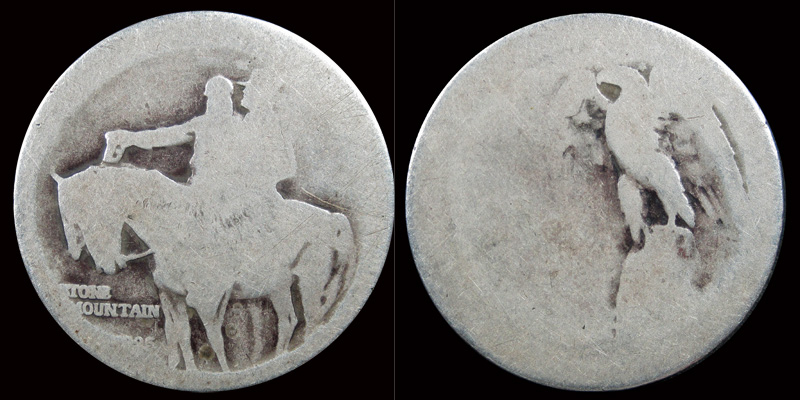 Edited by nickelsearcher
04/14/2021 6:33 pm
|
|
Bedrock of the Community
United States
94367 Posts |
That's truly an amazing specimen. I wouldn't really want to own it, price aside, but it's something to marvel at for sure.
Edited by Coinfrog
04/14/2021 7:06 pm
|
|
CCF Master Historian of Commemorative Coins
 United States
12515 Posts |
@Bump111 & southsav: Thanks for positive feedback. Always appreciated! @nickelsearcher: Thanks for supplementing the thread by adding images of your well-worn Stone Mountain and the story of how it came to be part of your collection. If I look at it while squinting, I think I see the remnants of one star on each side. Obviously, Borglum designed it that way so that one star on each side of well-worn examples would remain to represent the two opposing sides in the Civil War!  Collecting history one coin or medal at a time! (c) commems. All rights reserved.
|
|
Moderator
United States
195042 Posts |
Quote:
Hopefully adding some alternatie context to your thread: 1925 Stone Mountain Memorial Half Dollar - PCGS PO01 Smooth!  Quote:
Obviously, Borglum designed it that way so that one star on each side of well-worn examples would remain to represent the two opposing sides in the Civil War!  |
|
Pillar of the Community
United States
3725 Posts |
@commems, Fantastic write-up! I remember hearing a theory on the 35 stars at a coin club meeting eons ago. The argument made back then was that the Arts Commission intended the 35 reverse stars to be counted along with the 13 obverse stars, for a total of 48, matching the number of states in 1925, at issuance. If so, that was a subtle way of saying the 13 obverse stars represented the 13 original colonies, rather than the 11 states that seceded and two (Kentucky and Missouri) that had competing state governments during the war. James Earle Fraser was on the Arts Commission, did not at all like Borglum, and did not want to honor the rebels. As far as I know, there is no evidence to back up that reading, but it's the story I heard years ago. |
|
CCF Master Historian of Commemorative Coins
United States
12515 Posts |
@fortcollins: First, thanks for the kind words! Second, I wasn't aware of that theory before reading your post, but it was actually something I wondered about as I tallied the overall number of stars on the coin.
I ultimately decided that it made sense to consider the stars on each side as individual groups vs. two parts of a whole, however. So, that's how I crafted my post. I did so using the following lines of thought:
- if the 13 stars on the obverse represented the Confederate states, they were a very strong tie-in to the depiction of the Confederate Generals Lee and Jackson (i.e., they fit in with a strong Confederate theme on the obverse).
- the symbolic use of stars (or other devices) is most often tied to the time of the event being commemorated (e.g., 22 stars on the Alabama Statehood coin, 24 stars on the Missouri Statehood half dollar, 29 stars on the Iowa Statehood half dollar, etc.) vs. a future date. As the coin's commemorative theme was connected to the time of the Civil War, including a group of stars to represent the states in the Union at that time seemed very plausible.
- Borglum initially included a number of stars (36) that could be justified as representative of the number of states at the CW's conclusion - the loss of one star (for the reasons I noted above) would not be beyond reason.
All that said, your theory makes enough sense to me to make me want to dig a little deeper to determine if I can find supporting evidence for one theory or the other (or something completely different!).
Collecting history one coin or medal at a time! (c) commems. All rights reserved.
|
|
Pillar of the Community
 United States
697 Posts |
@commems, I like the way you think.
|
|
Moderator
United States
195042 Posts |
That is a fascinating alternate theory! I look forward to seeing what commems can dig up on that.
|
|
Valued Member
United States
143 Posts |
This is the coin that started me looking into commemoratives, so thank you much for the extensive information into it!
I'm kind of enjoying the idea of lowballer commemorative collection, nickelsearcher....
|
|
Moderator
United States
15874 Posts |
I like the alternate theory as well. Looking forward to what commems might come up with. If there is anyone who can dig up some research facts - well, that would be commems.
Take a look at my other hobby ... http://www.jk-dk.art |
|
Moderator
United States
195042 Posts |
Quote:
If there is anyone who can dig up some research facts - well, that would be commems.  |
|
CCF Master Historian of Commemorative Coins
United States
12515 Posts |
Quote:
The argument made back then was that the Arts Commission intended the 35 reverse stars to be counted along with the 13 obverse stars, for a total of 48, matching the number of states in 1925, at issuance. @FortCollins: I finally had the chance to review correspondence of the Commission of Fine Arts (CFA) regarding the design of the Stone Mountain half dollar, but could not find any discussion of the stars, their symbolism or specific direction the CFA provided to Borglum re: the stars on the coin. I must admit, the story does have a certain logic to it - but is that enough? The sculptor member of the CFA, James Earle Fraser, found multiple faults with Borglum's design which he communicated in letters to the artist, but they were directed at the figures of the Confederate generals within the design of the obverse, the head of Jefferson Davis' horse protruding into the obverse design from the right, the general style of the coin's lettering, the physical appearance of the eagle on the reverse and the crowded overall presentation of the coin's reverse design. I didn't come across any new direction/discussion re: the stars or the number thereof. The only reference to the stars on the coin that I found is in the book Give the Man Room by Robert Casey and Mary Borglum; the book tells the story of Gutzon Borglum and has a much wider scope than Stone Mountain. The volume recounts a conversation between Borglum and Secretary of the Treasury, Andrew Mellon in which Borglum coyly responds to Mellon's question about the 13 stars that are seen on the coin's obverse, by stating "It all depends on which side of Mason and Dixon's line you happen to live. They could, of course, stand for the thirteen rebellious states." (Of course, by "rebellious" Borglum meant "Confederate" vs. the original 13 colonies that rebelled against the British Crown.) Mellon reportedly laughed at Borglum's comment/joke and approved the preliminary design. So, while my lack of specific evidence to the contrary in no way disproves the explanations that you've heard, it does lead me to think that the stars were not a focus for the CFA. If they do, in fact, represent the 48 States of the Union in 1925, I tend to believe it was a design detail Borglum devised on his own. Collecting history one coin or medal at a time! (c) commems. All rights reserved.
Edited by commems
08/21/2021 1:58 pm
|
|
Pillar of the Community
United States
3725 Posts |
@commems, You are a gentleman and a scholar! Thank you for your kind efforts to run down the information on this question.
Like you, I have never seen or heard anything more on this issue. All that I heard was that one lecture at a coin club meeting decades ago. It stuck with me. (My wife calls those random thoughts my "useless trivia" moments. She has them, too!)
I agree, what can be known isn't enough to corroborate the theory. It may be one of those puzzles that will linger, and nothing more.
History isn't as remote as we sometimes think. In 1925, there would have been quite a few Civil War veterans still alive. (The last one died in my lifetime, in the mid-1950s.) The last widow of a Civil War veteran died just last year, and she was a child bride of a very old veteran. The last eyewitness to Lincoln's assassination was on TV in the 1950s on "I've Got a Secret."
Thank you for your passion, diligence, and scholarship. You are a gem, my friend, and I enjoy learning from you!
|
|
Page 2 of 2
|
Replies: 19 / Views: 5,188 |
Page 2 of 2
|







 First Page


 Posted 04/14/2021 5:31 pm





