| Author |
 Replies: 24 / Views: 3,911 Replies: 24 / Views: 3,911 |
Page 2 of 2
|
|
|
|
Pillar of the Community
Canada
3328 Posts |
Edited by Wrekkdd
08/22/2021 09:59 am
|
|
Pillar of the Community
 Canada
5653 Posts |
Again, NGC has depended upon conjecture. It's like getting a definition off of social media and printing it as fact.
|
|
Pillar of the Community
Canada
3328 Posts |
Ooo, my apologies I just researched it quick and found that. I guess I should be more aware of where the information is sited from when looking up any website.
|
|
Pillar of the Community
Canada
632 Posts |
Since pointed me by another collector, all pieces I ever saw (not that many and most by pictures only) have a 'doubled' 8 (re-entry?) and at least 3 pimples in the obverse planchet.
Mine is an optimistic NGC MS64RB. Not a rare grade but a quite nice coin. I love it
|
|
Pillar of the Community
 United States
1077 Posts |
 I'm concurring with everyone so far that conjecture and speculation are still all we have on this "so-called token." I do recall reading somewhere a long time ago that no one's seen examples in the marketplace that show signs of significant circulation, virtually all showing up in EF or better condition, and no reports have surfaced anywhere that it's ever changed hands in commerce...outside of the collecting world we all live in, that is. It pops up in online searches with a citation to a June 2020 Stacks/Bowers sale, where it was listed as "CH-250." Can one of our fellow CCF members out there fill the rest of us in on what Charlton has to say about it, if anything? What got me started looking into this little bit of exonumismalogical mystery? Earlier this year I came across two specimens that changed hands for big bucks (about $500 and $1600) as part of the Heritage Auctions Partrick sales, one in Part 1 and the other in Part 2. I'd forgotten I still had one of my own. Interestingly, HA labeled them "Patterns" with no further attribution or sourcing for that....just adding to the general unfounded and irresponsible rumormongering, in my humble opinion. (Harsh, I know...) Best to all! Tom "If everything seems to be under control, you're just not going fast enough."
--- Mario Andretti
|
|
Valued Member
Canada
222 Posts |
Quote:
Daltonista: It pops up in online searches with a citation to a June 2020 Stacks/Bowers sale, where it was listed as "CH-250." Can one of our fellow CCF members out there fill the rest of us in on what Charlton has to say about it, if anything? According to some, there are clues pointing to a Honduras origin (Minted by the Paris Mint). But personally, I've never been convinced. And to answer Daltonista, I don't know what the reference is, but it's not from the Charlton catalogs. From memory, I don't think it is listed in any Charlton catalog. And on the CoinsandCanada website, there is a mistake. Since the specifications given are those of the MT-4 token (Breton #567). I'm sorry if my English isn't perfect... I'm learning a little more every day.
Edited by ainsivalavie
09/21/2021 11:31 am
|
|
Pillar of the Community
United States
1077 Posts |
ainsivalavie, I've seen the hints toward Honduras too, but they're apparently based only on a rough similarity to a series of 1869-1870 patterns for 1/8, 1/4, and 1/2 Reals (etc.) with the denomination encircled in a wreath. No evidence, in other words. These can be viewed on Numista. As a check on that June 2020 Stacks/Bowers sale, I dug through a few boxes in my attic and came up with a 1962 Charlton, where the Anticosti Island token does indeed appear on page 59 as #250, under the heading "Miscellaneous Tokens." There's a pretty useless black-and-white photo -- because it's actual size -- and no attribution or descriptive information. Pasted in here are the headers and the single line of type devoted to this piece,
 I think t_y got it right when he said in this thread a month ago, "the only certainty is that we will never know."
"If everything seems to be under control, you're just not going fast enough."
--- Mario Andretti
|
|
Valued Member
Canada
222 Posts |
Quote:
As a check on that June 2020 Stacks/Bowers sale, I dug through a few boxes in my attic and came up with a 1962 Charlton, where the Anticosti Island token does indeed appear on page 59 as #250, under the heading "Miscellaneous Tokens." There's a pretty useless black-and-white photo -- because it's actual size -- and no attribution or descriptive information. Pasted in here are the headers and the single line of type devoted to this piece, It seems I didn't check far enough back in time. Since in the Charlton 1978, the #250 is a Sou Bouquet. After further checking, I just saw that it has the reference #299 in this edition. But you are right, because I just checked for example the Charlton 1970, Charlton 1975, and even the Charlton 1977, and it is indeed this token at #250. Sorry for the confusion. I never noticed that the reference #'s had changed in 1978 for the last regular edition of the Charlton containing the colonial and post-confederation tokens (I think?). I continue to learn everyday... I'm sorry if my English isn't perfect... I'm learning a little more every day.
Edited by ainsivalavie
09/22/2021 01:34 am
|
|
Valued Member
Canada
222 Posts |
Quote:
It seems I didn't check far enough back in time. Since in the Charlton 1978, the #250 is a Sou Bouquet. After further checking, I just saw that it has the reference #299 in this edition. Here is the scan in question with layout: 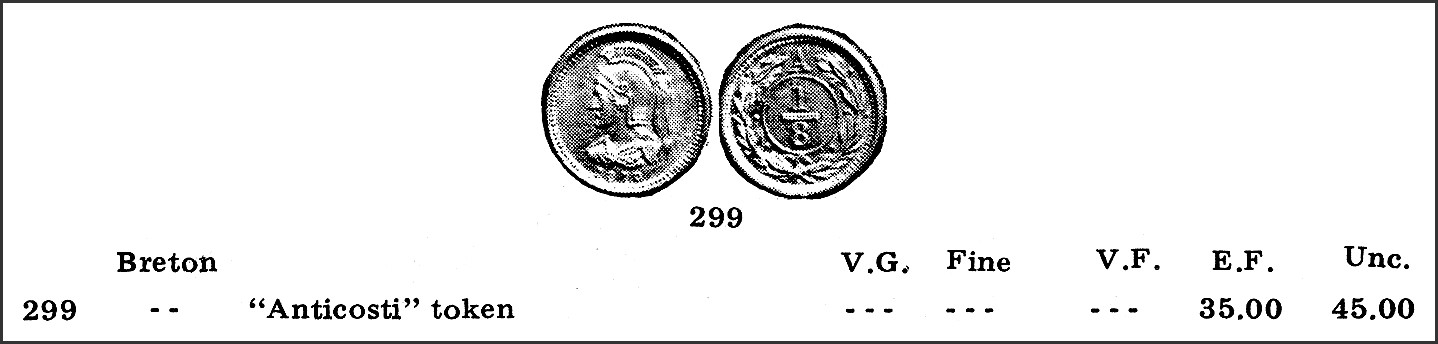 We notice that no value is indicated for grades lower than EF in this edition. I'm sorry if my English isn't perfect... I'm learning a little more every day.
|
|
Moderator
 Canada
10477 Posts |
Interesting how the word "Anticosti" is in quotations.
"Discovery follows discovery, each both raising and answering questions, each ending a long search, and each providing the new instruments for a new search." -- J. Robert OppenheimerContent of this post is licensed under a Creative Commons Attribution-NonCommercial 3.0 Unported License. See: http://creativecommons.org/licenses...0/deed.en_USMy eBay store
|
|
Pillar of the Community
United States
1077 Posts |
Quote:
SPP-Ottawa: Interesting how the word "Anticosti" is in quotations.
My guess is that's their shorthand for "So-called Anticosti Island token," which I've seen used recently by both Geoffrey Bell and Clement Chapados-Girard on their respective websites. ...just another way of saying "nobody knows anything" about an attribution for this piece! "If everything seems to be under control, you're just not going fast enough."
--- Mario Andretti
|
|
Moderator
Australia
17005 Posts |
For coins with uncertain or disputed origin, vested interests can get in the way of impartial discussion.
For a non-Canadian example: the Griquatown tokens of South Africa. These tokens are undated but he legend of their issue gives an 1815 date. They are highly valued because, if the legend is true, they would be "South Africa's first coinage". However, it seems highly unlikely that the Griquatown tokens ever actually saw circulation in South Africa; they are most likely a more modern concoction, made in Britain some decades after their purported issue and never being seen in South Africa until some decades further after that. However, the people who own these tokens, and the dealers who have them in stock and are trying to sell them, don't appreciate it when this is pointed out, as losing their "first coins in South Africa" status will likely see them drop in value. A few years ago, the Krause catalogues de-listed the Griquatown tokens from their main catalogues and shifted them over to the "Unusual world coins" listing.
I suspect something similar is happening with these tokens. Nobody who's paid good money to own one on the basis that they are "Canadian tokens" is going to like it if they hear logical arguments that "they're just play money" or "they're from Latin America", as acceptance of these theories will mean loss of interest and value.
My main issue with these being anything-Canadian is the denomination. 1/8 of what? A penny? "Pennies" as in British pennies, were long gone from Canada in 1870. And then there's the size: 1/8 of a penny is a half-farthing. Half-farthings are tiny things, and while I can't find any online dimensions for the Anticosti token (weight and size), all indications of these Anticosti objects is that they're way bigger than a typical half-farthing. Nobody makes tokens that are bigger and more expensive to make than the actual coins they are nominally replacing.
I'm not really buying the "Paris Mint Honduras pattern" theory either. That "A" is way too big to be a French mintmark. The Paris Mint's "A" is usually small and subtle.
I think a careful study of known provenances is required. Find out where and when they all first appeared on the marketplace. The "Anticosti shipwreck theory" sounds good, if it can be demonstrated that most of them originated from Eastern Canada. However, that would also make the original incorrect attribution of "A for Anticosti" a seriously improbable coincidence; far more likely is that they came from some other shipwreck, somewhere else in the world entirely.
Don't say "infinitely" when you mean "very"; otherwise, you'll have no word left when you want to talk about something really infinite. - C. S. Lewis
|
|
Pillar of the Community
Canada
5420 Posts |
All three of the Mint state examples that I have handled over the years came out of
Birmingham England . They were purchased from the same dealer but years apart .
Wonder if maybe these are a product of the Heaton Mint ?
As stated the style is certainly similar to the aforementioned Honduran Pieces .
|
|
Pillar of the Community
United States
1077 Posts |
Earlier today Sap said something about this so-called token that drove me back into my "vast holdings" so I could run this comparison: Anticosti Island 1/8 Something: 1.7g, 14mm Great Britain 1/2 Farthing: 2.35g, 18mm All that establishes, of course, is that the Anticosti piece is closer in diameter to the GB 1/3 Farthing, which is 15mm, and its weight (because it's thicker than the 1/3 Farthing) is about midway between the third- and half-farthings. None of that is important in real life unless you know which country (if any) or "entity" commissioned the striking of this token. Without that, the "denomination" of 1/8 continues to be meaningless. My further poking around the internet turned up a couple of mentions of the Anticosti Island token as "specious," as a "mint piece de caprice" and as a pattern. To cite one source in particular, this paragraph from the June 1969 ANS summary "Numismatic Literature, No. 82" is a brief abstract by Willey of a Bowman article that appeared in a the January 1969 Transactions of the Canadian Numismatic Research Society. 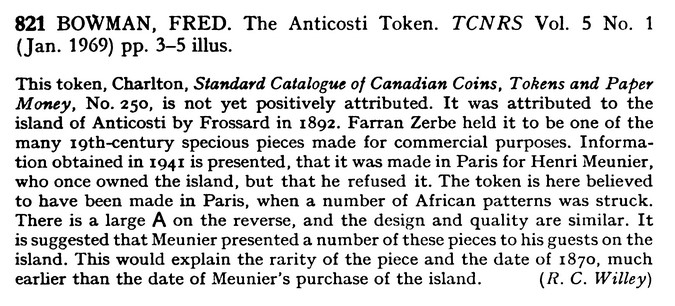 Meanwhile, Sap, it's intriguing that you shoiuld draw the analogy to the 1815 Griquatown Unusuals, as I've been speculating (quietly, to myself) that the Anticosti 1/8-something might have been some low-rent mint's idea of a sales piece. The coincidence here is that my analogy was to the 1890 and undated Griquatown pennies, which appear to have been just that: patterns or demonstration pieces that a German mint used in trying to drum up business in the Transvaal's Boer settlements. I addressed that topic a little (with photo) just a few months ago here: http://goccf.com/t/301479&whichpage=225. (Dated 05/15-2021.) "If everything seems to be under control, you're just not going fast enough."
--- Mario Andretti
|
|
Moderator
Australia
17005 Posts |
Quote:
Earlier today Sap said something about this so-called token that drove me back into my "vast holdings" so I could run this comparison:
Anticosti Island 1/8 Something: 1.7g, 14mm
Great Britain 1/2 Farthing: 2.35g, 18mm
All that establishes, of course, is that the Anticosti piece is closer in diameter to the GB 1/3 Farthing, which is 15mm, and its weight (because it's thicker than the 1/3 Farthing) is about midway between the third- and half-farthings. None of that is important in real life unless you know which country (if any) or "entity" commissioned the striking of this token. Without that, the "denomination" of 1/8 continues to be meaningless.
Really? Wow, I had no idea these things were so small. I suppose it supports the "token for 1/8th penny" argument - though as I mentioned earlier, if it is indeed supposed to be a 1/8th of a British penny, then the 1870 date implies its assignation to the Canadian provinces would be less likely. Don't say "infinitely" when you mean "very"; otherwise, you'll have no word left when you want to talk about something really infinite. - C. S. Lewis
|
|
Page 2 of 2
|
Replies: 24 / Views: 3,911 |
Page 2 of 2
|







 First Page
 Posted 08/22/2021 10:18 am





