| Author |
 Replies: 23 / Views: 8,426 Replies: 23 / Views: 8,426 |
Page 2 of 2
|
|
|
|
Pillar of the Community
United States
1882 Posts |
Kurt, That is some interesting stuff. I have thought trying some home SG testing to check out metal content...knowing that I would be testing myself more than the coins. :) Quote:
Another thought. A couple of years ago, I did a drive-buy purchase of a 1967 Canadian Half dollar. When I got home, I discovered that some were minted at 50% silver and others at 80% silver. As I researched this, everyone was saying there wasn't a non-destructive way to determine which coin (50% vs. 80%) you had. Why didn't anyone think of Specific Gravity?
Kabiye, if it is a half-dollar, it should be 80% silver. The quarters and dimes switched to 50% silver during mid-1967. Then to keep everyone on their toes, switched mid-stream to no silver in those two coins in 1968. Someone with the ability to make very accurate measurements should be able to non-destructively tell the difference...but the smaller the coin, the more accurate the measurements have to be. A dime doesn't displace very much water. |
|
Pillar of the Community
 United States
5318 Posts |
Quote:
...knowing that I would be testing myself more than the coins.  I viewed this exercise as a challenge to myself--and sought to quantify how much error my methods introduced, and whether anything could be interpreted from my results.  Maybe it suggests something, but I'll keep on testing when I get new coins. I should mention that I use a fairly accurate jeweler's scale (+/- 0.01 gram) which has tracked well to actual lab results on gemstones I own. My method for testing SG follows Swamperbob's post here. What's nice about this method is it doesn't attempt to measure water, only the coin. |
|
Pillar of the Community
United States
1882 Posts |
Cool...thanks for the link. I had missed your post from Christmas day where you started this whole process.
|
|
Pillar of the Community
United States
1882 Posts |
Hello again, Kurt,
It looks like the scale is hanging off the edge of the desk. I'm sure you checked this...the scale actually gives an accurate measurement like that?
Edited by steve199
01/14/2009 4:40 pm
|
|
Pillar of the Community
United States
5318 Posts |
Steve, Yes, the process by which I weigh a coin suspended varies little from weighing the coin normally on top of the platform. Naturally, every scale may differ in this respect, and here I am particularly careful to ensure reasonable accuracy. Obviously, nobody else can prove/disprove the accuracy of my own methods, so I suggest they work from Swamperbob's explanation using a good scale of their own, starting with a control sample of known compositions such as pure copper, nickel, and silver. Then, if after repeated tests an accurate methodology is established, continue on to coins of uncertain composition. And keep testing control samples at periodic intervals to ensure your methods haven't slipped (or the scale hasn't decalibrated). That's simply the approach I've taken to get my results. Let me stress here that I'm hardly an expert doing this--I'm just following the method linked above with my own equipment as accurately as I can. If you want to discuss methods further, feel free to post to my demo thread where this is discussed in more detail. Thanks!  |
|
Pillar of the Community
United States
1882 Posts |
Kurt, I was just asking if the scale is sitting flat on the desk...or if it has two feet hanging off. If the feet are hanging off, it somehow is not affecting the accuracy. I need to avoid get sucked into this, or I'll be at the house with a mad scientist hat on my head. |
|
Pillar of the Community
United States
5318 Posts |
Well, the first thread shows the scale hangs over the edge, and I just followed up to comment here on accuracy. As shown in that photo, the harness focuses the weight close enough to the sensor under the stage; the feet aren't a critical part of measurement, as indicated by tests. Mad scientist or not--I found these tests very interesting. |
|
Bedrock of the Community
United States
10982 Posts |
Thank you for the part two Kurt. Work's been crazy lately and I haven't had the chance to give this much thought but I'd love to see some data on pre-1933 U.S. gold.
Silver and copper are relatively close in SP while gold and copper are drastically different. When you get a hold of an Eagle or Double Eagle, please let us know what you find out.
|
|
Pillar of the Community
United States
5318 Posts |
I'm not a gold collector, but I wouldn't mind having some. This was an interesting project, but also a somewhat trivial pursuit. I'll test more coins as I get them. |
|
Pillar of the Community
United States
5318 Posts |
Just a minor update to this test: I spoke with a friend who sends a lot of melt silver to a smelter, and their assay typically doesn't reveal a difference greater than .895/900 Despite some apparently accurate readings using a good scale, I'll be the first to admit this throws my results into question. It was all in fun anyway, and I hope you found it interesting all the same. |
|
Valued Member
United States
106 Posts |
The coins minted by the US have always had very accurate composition. The problem is that to get an accuracy of 0.005 (i.e. 0.5%) in the silver content, you will have to measure the specific gravity to an accuracy of around 0.005 * 0.17 = 0.00085 or 0.085%, as the difference in specific gravities of copper and silver is only about 17%.
And then, because of the way you're measuring the coin weights in and out of water, to measure the specific gravity to an accuracy of 0.085% you will have to measure the weights to an accuracy of around 0.00085 x 0.10 = 0.000085 (since the weight in and out of the water differs by about 10%).
So to measure the silver composition as accurately as your smelter buddy, you're going to have to weigh them in and out of water with an accuracy of around 0.01%, i.e., you need to be measuring with 5 significant digits. In short, to get results that don't bounce all around you're going to have to invest in quite the scale.
Here's a table for silver / copper (gold/copper would be a lot easier):
5 digits: 0.5%
4 digits: 5%
3 digits: 50%
The above are worst case and are my back of the envelope guesses. You should be able to do better, depending on how lucky you are. (For example, if you have 3 digits accuracy you might measure 11.3 or 95.7. Then 0.1 is around 0.1% of 95.7 but closer to 1% of 11.3.)
As it turns out, this problem is one I've faced in my primary hobby, physics. This is why you need to give "error bars" on every measurement you make. And then, when you do the computations, you have to include the error bars with them.
I can type up an example showing how to do error bar calculations if you're interested. Doing calculations with error bars is a pain, so when I had to do this for hundreds of data items in one of my papers (on 100+ hadron masses), I wrote a java applet to take the data and do the calculations automatically for me.
|
|
Bedrock of the Community
United States
10045 Posts |
Interesting...what you describe no doubt accounts for the discrepancy, even with the average of 3 tests per coin. Error bars could be useful, if the margin of error were known better. This is very good to know if one wants to use SG as a confirmation of authenticity. Since I don't have a fancy lab to do this, I better learn to tell by coin details.
|
|
Valued Member
United States
106 Posts |
I've been thinking more about the challenge of measuring specific gravity accurately, with inexpensive scales. I think there might be a way. Part of the problem is that cheap scales tend to be for weighing things a lot heavier than a coin. A way to get around that problem is to use leverage. Another problem I've observed with scale is that their measurements tend to depend on just how the item is being weighed, i.e. which part of the scale, etc. So a way to improve accuracy is to make the measurements of weight in and out of water using the exact same setup. This can be done by first measuring the weight while the coin is in water, and then letting the water drain out. The mass of the halter that is underwater should be negligible. I'd ignore that part of the calculation completely. If you want to get more exact, you can always measure how much copper (I suppose) wire you use, and then calculate its mass from tables showing weight of copper wire as a function of gauge. But I'd use 30 gauge kynar wire wrap wire (without insulation) and I doubt you could possibly weigh it. For example, if you used copper and you had 2.23 grams of wire, then when you computed the difference in weight between in and out of water, you'd subtract 2.23 g / 8.94 since the specific gravity of copper is 8.94 (and therefore, the copper displaced 2.23/8.94 cubic centimeters of water). To show how this works, an illustration might assist. So here's one: 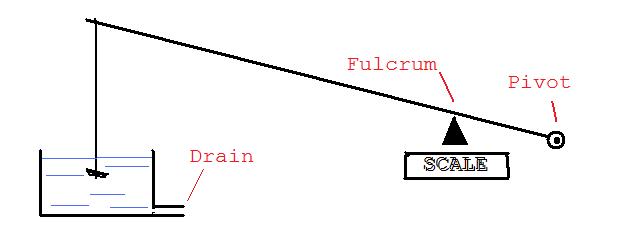 The fulcrum is just some single point where the fishing pole rests on the scale. The objective is to not have it move around (which would change the weight). The pivot is just a place where the fishing pole can pivot around; use your imagination but don't prevent the rod from free movement. A more convenient way to drain the water might be to set up a siphon. Fill the siphon before making the "in water" measurement so you won't have to disturb it. |
|
Valued Member
United States
106 Posts |
Ooooops. Now that I think of it, it would be better to start with the dry measurement and then add water. Otherwise you'd have a wet coin and you'd have to dry it.
|
|
Rest in Peace
United States
2668 Posts |
Wow.
And I think Jaobler should flesh out his response and enter it in Wheezydog's contest.
|
|
Page 2 of 2
|
Replies: 23 / Views: 8,426 |
Page 2 of 2
|








 First Page


 Posted 01/14/2009 1:40 pm


