| Author |
 Replies: 32 / Views: 4,700 Replies: 32 / Views: 4,700 |
Page 3 of 3
|
|
|
|
Pillar of the Community
United States
9810 Posts |
Interesting to see the auction result and others assessment of value, I was in line with the rest around $3200 to $3700 range in my mind. I actually wasn't aware the mint plugged blanks in the early days, I am familiar with the weight adjustment by filing and shaving blanks, I suppose it makes sense to add a plug pre-striking to the planchets as well.
"Buy the Book Before You Buy the Coin" - Aaron R. Feldman - "And read it" - Me 2013! ANA Life Member #3288 in good standing since 1981, ANS, Early American Coppers Member (EAC), Colonial Coin Collectors Club member (C4), Conder Token Collector Club member (CTCC), Civil War Token Society (CWTS) member, Liberty Seated Collectors Club (LSCC) & Numismatic Bibliomania Society member (NBS), USMex, Member in good standing, 2¢ variety collector. See my want page: http://goccf.com/t/140440 |
|
Bedrock of the Community
United States
17884 Posts |
They pretty quickly decided that it DIDN'T make sense to plug the planchets. It was too much work, especially since after the plugging they usually then had to adjust them down to the proper weight. They realized it was much simpler to reject them, remelt them them with the next melt, and just make new planchets.
Work required
Planchet is correct weight: Strike the coin.
Planchet is overweight: Use a file to adjust the weight down. Strike the coin.
Planchet is underweight: Punch a hole in the planchet. Weigh the holed planchet. Create a plug to bring the weight up. Insert the plug in the planchet and peen it a bit to keep it in place. Weigh the plugged planchet and if overweight use the file to adjust the weight down. Strike the coin.
Alternate option if planchet is underweight: Include planchet in next melting.
|
|
New Member
 United States
3 Posts |
Thanks again for everyone's input. I'm really intrigued in the quality of this presumed plug. The E is flawless, hard to wrap my head around that previously being a hole in the coin. Are there any articles or videos that discuss how that could be accomplished. True artist, whoever did that.
|
|
Bedrock of the Community
United States
10982 Posts |
Quote:
The E is flawless............. That's a clue in and of itself. The E looks better than the other letters in LIBERTY! |
|
Pillar of the Community
United States
4508 Posts |
Quote:
Regarding the whizz: Can someone point me to evidence it was whizzed? I genuinely don't know how to see that.
From your photos, I see no evidence of whizzing. You need to look at the coin under magnification, and you should see fine hairlines on both the devices and fields. My guess is that the coin was repaired, whizzed to blend metal and tool marks, and toned to hide work. |
|
Pillar of the Community
United States
3848 Posts |
Quote:
I'm really intrigued in the quality of this presumed plug. The E is flawless, hard to wrap my head around that previously being a hole in the coin. You'd be surprised at the skill of some people. These nearly perfect alterations are done by what are called Coin Doctors. There is a seller on ebay that sells a lot of higher grade 1793 large cents, but the majority are tooled professionally. If you search 1793 cent on ebay and filter by highest price first, they'll be at the top. numismatic student purchased one of these tooled cents and created a thread for discussion, but I can't post a link because I couldn't find it. Maybe you can locate his thread and the discussion of the tooling, it is very interesting. Suffering from bust half fever. Want to learn how to attribute early half dollars by die variety? Click Here: http://goccf.com/t/434955Shoot me a PM if you are looking to sell bust halves. |
|
Pillar of the Community
United States
1361 Posts |
That's one heck of a plug. It took some talent & artistry to pull that off.
|
|
Bedrock of the Community
United States
11966 Posts |
Quote:
Planchet is underweight: Punch a hole in the planchet. Weigh the holed planchet. Create a plug to bring the weight up. Insert the plug in the planchet and peen it a bit to keep it in place. Weigh the plugged planchet and if overweight use the file to adjust the weight down. Strike the coin. There was no way to punch a hole in a silver dollar blank. Doing so on such a large, thick coin would have damaged the blank. The mint actually used a hand drill and carefully cut a hole that was 8mm in diameter at the center of the blank. The amount that the blank was underweight mattered because of the size and weight of the plug that needed to be employed. The more the blank was underweight, the larger and heavier the plug needed to be to set the weight back to within specifications. Consequently, a larger and heavier plug was more likely to be more noticeable. A metal disk prior to striking can be a blank or a planchet. The difference is that the planchet is a blank that has had its edges raised prior to striking by an upset milling machine. Since blanks did not have their edges raised prior to striking in the 18th century in the U.S., the U.S. Mint produced blanks back then rather than planchets, The upset milling machine was invented in Birmingham, England by Matthew Boulton at his Soho Mint in the 1790s and he is considered a coin manufacturing giant. The process of upsetting the edges, of coins was a closely guarded secret of national mints in the 19th century. The Philadelphia Mint eventually developed an upset milling machine that was modified from a design that was sold widely by Ralph Heaton, also of Birmingham, England in the middle of the 19th century. There are many examples of mint plugged 1795 silver dollars. But the mint plugged 1794 dollar is unique as far as we know. That coin is also argued to be the first silver dollar ever produced but inconclusively. https://www.PCGS.com/coinfacts/coin/1794-1/86851IN NECESSARIIS UNITAS - IN DUBIIS LIBERTAS - IN OMNIBUS CARITAS THE MAN IN THE ARENA, Theodore Roosevelt at the Sorbonne Paris on April 23, 1910: " It is not the critic who counts; not the man who points out how the strong man stumbles or where the doer of deeds could have done better. The credit belongs to the man who is actually in the arena, whose face is marred by dust and sweat and blood, who strives valiantly, who errs and comes up short again and again, because there is no effort without error or shortcoming, but who knows the great enthusiasms, the great devotions, who spends himself in a worthy cause; who, at the best, knows, in the end, the triumph of high achievement, and who, at the worst, if he fails, at least he fails while daring greatly, so that his place shall never be with those cold and timid souls who knew neither victory nor defeat." My coin website: https://fairfaxcoins.com |
|
Valued Member
United States
202 Posts |
Quote:
numismatic student purchased one of these tooled cents and created a thread for discussion, but I can't post a link because I couldn't find it. Maybe you can locate his thread and the discussion of the tooling, it is very interesting. Agreed, this was a very eye opening thread. I don't think we ever heard the final determination, but I think it was either a genuine coin that was expertly repaired or a counterfeit made from a repaired coin. In any case it was slabbed as a problem free genuine coin by PCGS which just goes to show how good a job can be done. I can't seem to find it either, does anyone have the link? |
|
Pillar of the Community
United States
4508 Posts |
|
|
Bedrock of the Community
United States
11966 Posts |
Maybe you're referring to this discussion: http://goccf.com/t/408671It was eye-opening that there is a whole netherworld of really talented coin doctors who mill around high value issues. IN NECESSARIIS UNITAS - IN DUBIIS LIBERTAS - IN OMNIBUS CARITAS THE MAN IN THE ARENA, Theodore Roosevelt at the Sorbonne Paris on April 23, 1910: " It is not the critic who counts; not the man who points out how the strong man stumbles or where the doer of deeds could have done better. The credit belongs to the man who is actually in the arena, whose face is marred by dust and sweat and blood, who strives valiantly, who errs and comes up short again and again, because there is no effort without error or shortcoming, but who knows the great enthusiasms, the great devotions, who spends himself in a worthy cause; who, at the best, knows, in the end, the triumph of high achievement, and who, at the worst, if he fails, at least he fails while daring greatly, so that his place shall never be with those cold and timid souls who knew neither victory nor defeat." My coin website: https://fairfaxcoins.com |
|
Pillar of the Community
United States
3848 Posts |
Quote:
It was eye-opening that there is a whole netherworld of really talented coin doctors who mill around high value issues. Very much so. Unfortunate as well, the remaining original higher grade examples have been dramatically reduced. Even though they are well done, the color is unnatural and the fonts aren't exactly right. Suffering from bust half fever. Want to learn how to attribute early half dollars by die variety? Click Here: http://goccf.com/t/434955Shoot me a PM if you are looking to sell bust halves. |
|
Pillar of the Community
United States
4233 Posts |
Notice the difference in the center of E between the OP coin (top) and a Heritage example. I don't know much about these and maybe there's another obverse type, but I looked at about a dozen real ones and the crosslet (?) inside the E all looked the same. The OP's is different. 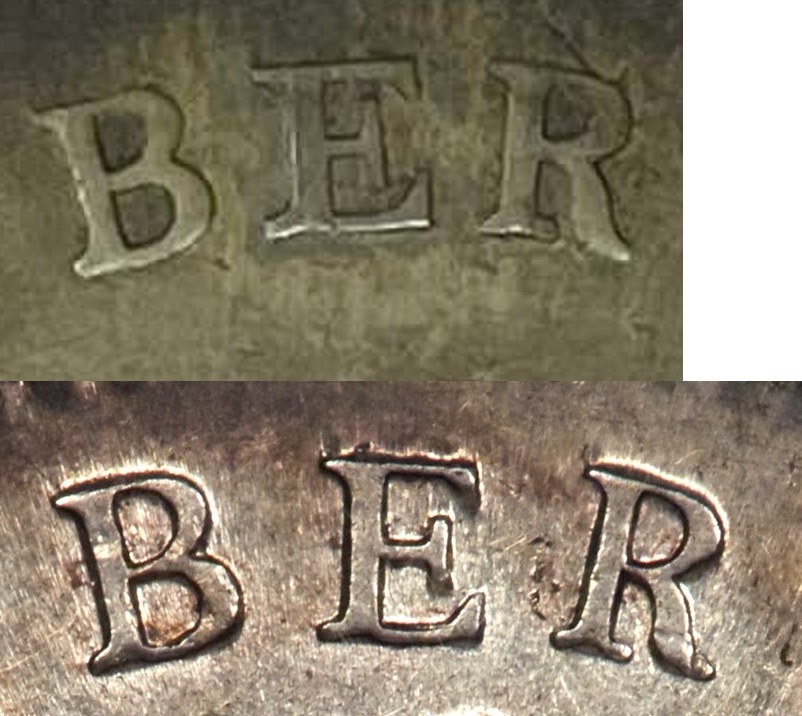 |
|
Bedrock of the Community
United States
11966 Posts |
It looks like after the coin was plugged and repaired, perhaps an E, lifted from a donor coin, was added over a plugged surface that looks different and rough behind the E. That letter looks larger than the other letters overall, maybe indicating that the repairer could not find an exactly sized letter match on top of the difference in the interior serif.
IN NECESSARIIS UNITAS - IN DUBIIS LIBERTAS - IN OMNIBUS CARITAS THE MAN IN THE ARENA, Theodore Roosevelt at the Sorbonne Paris on April 23, 1910: " It is not the critic who counts; not the man who points out how the strong man stumbles or where the doer of deeds could have done better. The credit belongs to the man who is actually in the arena, whose face is marred by dust and sweat and blood, who strives valiantly, who errs and comes up short again and again, because there is no effort without error or shortcoming, but who knows the great enthusiasms, the great devotions, who spends himself in a worthy cause; who, at the best, knows, in the end, the triumph of high achievement, and who, at the worst, if he fails, at least he fails while daring greatly, so that his place shall never be with those cold and timid souls who knew neither victory nor defeat." My coin website: https://fairfaxcoins.com |
|
Bedrock of the Community
United States
17884 Posts |
Quote:
True artist, whoever did that. There was a guy Al Stockton from Kentucky who used to do this work. He was VERY good but would always deliberately leave slight evidence to keep the coin from being sold as a problem free coin. He used to advertise in the Numismatist and Numismatic Scrapbook. He is retired now and his son took over the business. The company now goes by the name CRSSTOCKTON. Quote:
Since blanks did not have their edges raised prior to striking in the 18th century in the U.S., the U.S. Mint produced blanks back then rather than planchets, The Castaining Machine used on the lettered edge coins has roughly the same effect as the upsetting mill. Forcing the blank between the edge dies set slightly closer together empressed the lettering and as a side effect thickened the edge forming the blank into a planchet. As for the mint not being able to punch a hole in a planchet, they would be able to do so by the same method they used to punch blanks out of strip. All it would take is the properly sized punch and hole die underneath. If it did cause a slight cupping of the coin that would be flattened back out again during striking. |
|
Page 3 of 3
|
Replies: 32 / Views: 4,700 |
Page 3 of 3
|








 First Page
 Previous Page


 Posted 07/14/2022 9:48 pm


