| Author |
 Replies: 114 / Views: 9,518 Replies: 114 / Views: 9,518 |
|
|
|
|
Pillar of the Community
Canada
6244 Posts |
|
|
Valued Member
 United States
108 Posts |
Jim, I have been told 10x magnification will suffice to see the grain. In other news, here is a fascinating resource for mint documents from 1909. You will have to copy and paste the URL, for some reason. https://archive.org/details/newmannumismatic?and[]=year:%221909%22 I plowed through hundreds of pages of correspondence between the mint director and the Philadelphia mint for 1909. So far I have discovered no record of an order for a die trial with Tungsten. There is record of die trial orders for the Lincoln Cent, and explicit instructions to destroy the trials, but no mention is made of the alloy. I will assume the alloy was bronze. Release of the Lincoln Cent began on August 1st, 1909 and people loved the Lincoln Cent. One drawback is they tended to get stuck in slot machines so there was talk of remaking the cent a little thinner. The mint director (acting director, at the time) tested out the Lincoln Cent in slot machines, and found only 1 in 15 gave him trouble. There are letters pertaining to chief engraver Charles Barber (1840-1917) and Victor D. Brenner, including the removal of the VDB. Brenner was paid $1,100 for his work at the mint. Two gold medals were also ordered for the Wright brothers - I would love to have one of those! Edited by philoponus6
11/17/2022 06:35 am
|
|
Valued Member
United States
108 Posts |
Here is a record of dies which were destroyed on Jan 3rd, 1910. Standard practice was all obverse dies were destroyed, and any worn out reverse dies. There are a lot of VDB dies in there, no doubt, probably some never used. 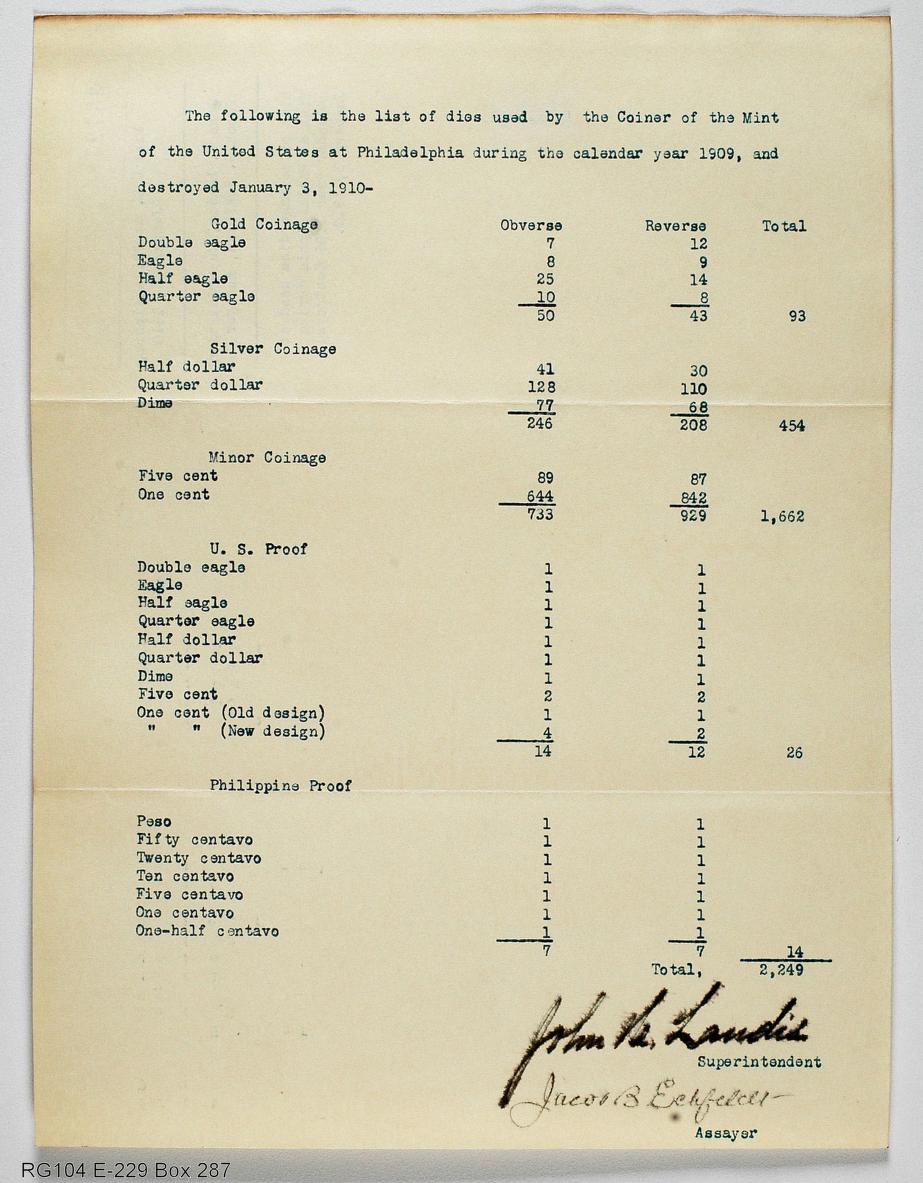 |
|
Valued Member
United States
108 Posts |
Edited by philoponus6
11/17/2022 12:15 pm
|
|
Valued Member
United States
108 Posts |
Now, before anyone gets their knickers in a twist, I am not suggesting the following is probable. I am only stating possibility.
1) Since the nickel/aluminum experiment directive came from the Secretary of the Treasury, these alloy trials may not show up in communications between the mint director and the Phiily mint.
2) Alloys are patentable, so the mint may not publicize their findings, or even the experiments themselves. Why risk having to pay someone else to use a particular alloy and related process?
3) Some of the old VDB dies may have been saved for future experiments. No doubt there were scads of unused ones. Why chew up a new, usable die in 1910 if you can do the same quality experiment with a 1909 die? If so, an experimental 1909 cent could have been produced some number of years after.
Edited by philoponus6
11/17/2022 12:22 pm
|
|
Valued Member
United States
108 Posts |
An 1893 communication, reproduced: 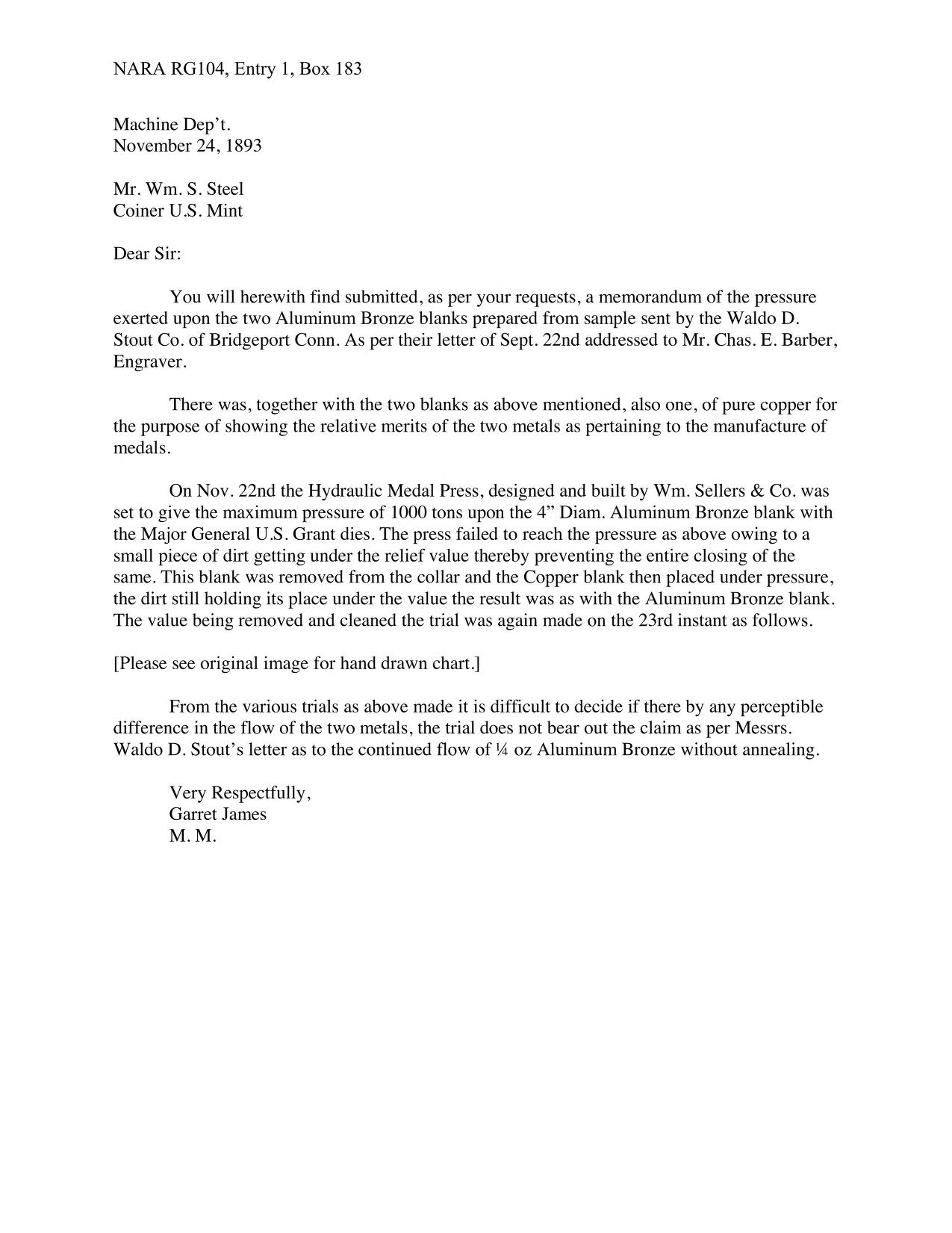 Edited by philoponus6
11/17/2022 12:21 pm
|
|
Valued Member
United States
108 Posts |
|
|
Valued Member
United States
108 Posts |
The previous NYT piece, in the Olean Democrat, 1896. It was an act of congress that ordered the Philly mint to resume experiments with aluminum bronze planchets. The article states that aluminum by itself was too soft. No doubt it still softened up bronze. Tungsten would be a likely choice for hardening things up a bit. https://nyshistoricnewspapers.org/l...range&page=1Edited by philoponus6
11/17/2022 8:00 pm
|
|
Valued Member
United States
108 Posts |
Durability of coinage was important, no doubt, and probably most important for the penny. We think of pennies as a nuisance, but in 1900 1 cent purchased what 35 cents buys now. The penny had to endure pockets, slot machines, penny pitch games, etc.
The French eventually added manganese (patent 1910, production 1920) to aluminum bronze toward that end, and successfully. .
As I mentioned earlier, tungsten-steel was showcased at the 1900 World's Fair, and was "revolutionizing engineering."
Edited by philoponus6
11/17/2022 9:04 pm
|
|
Valued Member
United States
108 Posts |
There are some hairline scratches on the surface. The appear mostly under magnification. On the obverse they appear in the fields, both left and right of honest Abe. On the reverse there are scratches down low, near the VDB.
I am not sure the coin is cleaned, although the obverse does have a slight difference in look than the reverse. There could easily have been a change to the surface, if there were some tests for corrosiveness.
Hardness would have been a consideration if this coin is indeed an experiment. It is possible that a scratch test was performed with materials of differing hardness.
Edited by philoponus6
11/17/2022 11:05 pm
|
|
Valued Member
United States
108 Posts |
So, it looks like Aluminum-Bronze was great for making medals. The alloy was cheap, looked almost as nice as gold, and large medals made of Aluminum-Bronze annealed much better than Copper or Bronze alone.
But, medals were not circulated. Medals were made to sit on a shelf or be hung on a wall. Circulation (both wear and corrosion, probably) was the problem with making Aluminum-Bronze cents.
On September 15th, when the first XRF on my VDB was done, I thought I had a really weird alloy, with no explanation of why such a combination of metals were used. When I started on this forum, I was still perplexed. Now, historically, it all makes sense. I am not sure about all the elements that are supposedly in the VDB, but at least the Copper, Zinc, Tin, Aluminum and Tungsten makes sense. The historical record fits the coin.
Edited by philoponus6
11/18/2022 10:11 am
|
|
Valued Member
United States
108 Posts |
One more small fact: T1 was a form of tungsten-steel that was the first MASS PRODUCED high speed steel, beginning in 1910. Since T1 was mass produced, I presume the price of tungsten had come down to the point where it was at least foreseeable to be economically viable as an addition to coinage.
|
|
Valued Member
United States
108 Posts |
According to one of my chemists friends, zinc is in the cent to cut down on corrosion, and aluminum would cut down on corrosion even more, but would soften up the cent quite a bit, whereby the cent would become more prone to wear. Hence, tungsten!
I wonder what else the mint tried during that era?
|
|
Forum Dad
 United States
24228 Posts |
This topic has run it's course.  |
|
Valued Member
United States
108 Posts |
On Tuesday 11/29 I took my VDB to Northeast Metal Reclaiming in WIlliamsville, NY. Their XRF did not scan well through the PCGS holder. Their more powerful one was down, and Orazio said they have been waiting for 4 months for parts.
On Thursday, 12/1, I took the VDB back, deholdered, and had him scan it raw. The results: 80% copper, 2% zinc, 2% tin and 15.5% tungsten. Orazio said definitely not gold, and the scan goes 15 microns deep - much, much deeper than ordinary plating.
Useful information: Saflips seriously confound an XRF scan.
Weight: exactly 3.11 grams.
I still haven't done a specific gravity measurement.
|
|
|
Replies: 114 / Views: 9,518 |
|







 First Page
 Previous Page

 Posted 11/17/2022 06:31 am


