| Author |
 Replies: 27 / Views: 2,420 Replies: 27 / Views: 2,420 |
Page 2 of 2
|
|
|
|
Bedrock of the Community
United States
12057 Posts |
It's entirely possible that it might be a reproduction or restrike. But then you have the issue of a date mismatch -- the originals were only struck in gold, and the most common restrike was not produced until the Civil War as @numismaticstudent noted above; the originals were not struck in New York until 1787, 10 years after the "revolutionary war", and are so rare that I question whether a contemporary Connecticut gunsmith would have even known of their existence, much less had any reason to obtain a copy of one and then deemed it to have significance enough to affix to a powder-horn stopper.
However, there were only 50 of the restrikes issued, and a quick comparison of one of the brass or copper restrikes will highlight the stark difference in quality -- the restrikes are mushy and look almost like a caricature of the original issues - they were prepared from new dies that were engraved at Jos. Merriam's workshop in Boston.. The coin on your horn is much too sharply struck and detailed, which to me suggests that it is a modern copy made with modern techniques not available in the 19th or 18th centuries.
The Medad Hills reference makes it quite a bit more interesting since Hills is the brother of John Hills and the son of Benoni Hills, also well-known gunsmiths and Connecticut Patriots.
The three Hills brothers and their father Benoni are widely considered some of the best Colonial-era gunsmiths and firearms that can be linked to them with provenance are mostly museum pieces or sell for a ton of money when they do come up for private sale. The name carries as much weight as Hawken, Ferree or the Henrys of the same era, just to name a couple, and later, Sharps, Remington, Winchester and Colt. He did sometimes sign "at Goshen" on known examples of his work. If this horn was made by or engraved by Medad Hills it is worth quite a bit of money and there are quite a few museums that would pursue it avidly. It sounds like you are qualified to make such a distinction.
However, the inclusion of the "doubloon" still throws me off. It is just too out of place and incongruent. Ultimately your best bet would be to have the coin inspected by a specialist in the Brasher coins and their restrikes.
Member ANA - EAC - TNA - SSDC - CCT #890 "Most of the things worth doing in the world had been declared impossible before they were done." -- Louis D. Brandeis Edited by paralyse
03/14/2023 1:46 pm
|
|
New Member
 United States
7 Posts |
I am an American Revolutionary War arms collector and not a coin collector.
But I can tell you that some powder horns from the French and Indian war and the Revolution have some of the finest scrimshaw engraving, often as good as banknote engraving. So plain horns were not really as much the norm in that era as may be thought. I think the horn was originally made and then, sometime after that, the coin was added. But, we'll probably never know. I just would like to know if the coin may have been added a long time ago or in the last fifty years.
Al
|
|
Bedrock of the Community
United States
12057 Posts |
I would tend to agree with that assessment. I would be more inclined to think it's an older item that's been modified with a modern fake copy of a Brasher doubloon.
I updated my original post for clarification.
I enjoy black powder and antique firearms in general, but have neither the means nor the space to buy and display them (I spend all my money on coins!) so I can only dream about owning anything related from the 18th century.
Member ANA - EAC - TNA - SSDC - CCT #890 "Most of the things worth doing in the world had been declared impossible before they were done." -- Louis D. Brandeis Edited by paralyse
03/14/2023 1:45 pm
|
|
Pillar of the Community
United States
646 Posts |
Please show us some more pictures of the horn, especially the inscription.
|
|
New Member
United States
7 Posts |
Here are some pictures of the horn. 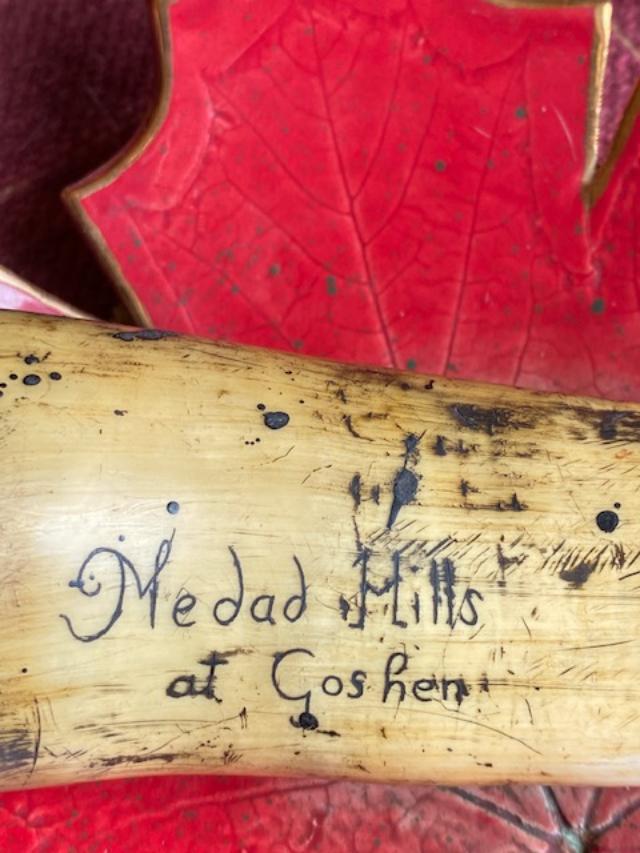 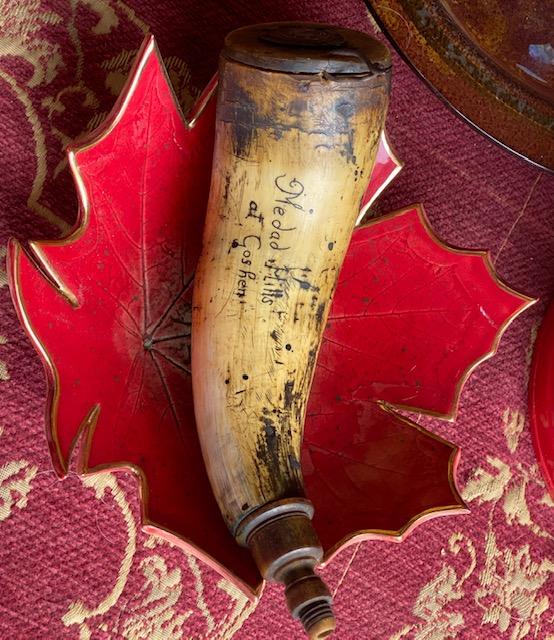 |
|
Pillar of the Community
United States
2365 Posts |
|
|
Bedrock of the Community
United States
12057 Posts |
That's quite a nice piece of history. Do you have a Hills rifle you can pair it with?  Member ANA - EAC - TNA - SSDC - CCT #890 "Most of the things worth doing in the world had been declared impossible before they were done." -- Louis D. Brandeis Edited by paralyse
03/14/2023 5:07 pm
|
|
New Member
United States
7 Posts |
I don't have a Hills gun right now but have owned several in the last few years.
The name on the horn and his name on the fowler linked to on an earlier post appear to be the same which leads me to believe he engraved the horn. Since he lived to 1808 the horn could have been made well after the Revolutionary War.
My take so far is, that the coin is old but not original to the 1787 period. It may have been added later by someone else.
Al
|
|
Bedrock of the Community
United States
12057 Posts |
I'd like to see one fired but I suspect they are much too valuable now to risk doing so.
Member ANA - EAC - TNA - SSDC - CCT #890 "Most of the things worth doing in the world had been declared impossible before they were done." -- Louis D. Brandeis |
|
Bedrock of the Community
United States
11966 Posts |
Thanks for sharing your item with us. For us numismatists, the Brasher Doubloon is an important coin because it is the first gold coin that is documented to have been made in the United States after we became a Nation. It is famous for that reason and I suppose that many copies have been made over the years. It looks like the Mills family in Goshen CT was an important part of the story of the birth of our Nation, having fought for its founding. The horn looks to be a treasure on its own and it seems to have a connection to the early coinage in our country.
I've seen a lot of intricate scrimshaw on visits to the wharf in Newport Rhode Island, carved on whales teeth, ivory tusks and whale bones. It reminds me of Moby Dick and the days before oil was first struck in Pennsylvania and homes where lit using lamps burning whale blubber. On visits to Massachusetts I remember touring the mansions in New Bedford, where whaling captains were the energy tycoons of the day and owned the bank, general store and all assets of importance as fuel was so essential to daily like. Hope you enjoy your artifact and keep our Nation's history alive through it.
IN NECESSARIIS UNITAS - IN DUBIIS LIBERTAS - IN OMNIBUS CARITAS THE MAN IN THE ARENA, Theodore Roosevelt at the Sorbonne Paris on April 23, 1910: " It is not the critic who counts; not the man who points out how the strong man stumbles or where the doer of deeds could have done better. The credit belongs to the man who is actually in the arena, whose face is marred by dust and sweat and blood, who strives valiantly, who errs and comes up short again and again, because there is no effort without error or shortcoming, but who knows the great enthusiasms, the great devotions, who spends himself in a worthy cause; who, at the best, knows, in the end, the triumph of high achievement, and who, at the worst, if he fails, at least he fails while daring greatly, so that his place shall never be with those cold and timid souls who knew neither victory nor defeat." My coin website: https://fairfaxcoins.com |
|
Bedrock of the Community
United States
11966 Posts |
I have one question. Does the "spout" of the powder horn look correct for the Revolutionary War period or before? The multiple metal fittings and threading look perfectly round, like it was turned by machine and not pounded into shape by a metal smith of those early days.
IN NECESSARIIS UNITAS - IN DUBIIS LIBERTAS - IN OMNIBUS CARITAS THE MAN IN THE ARENA, Theodore Roosevelt at the Sorbonne Paris on April 23, 1910: " It is not the critic who counts; not the man who points out how the strong man stumbles or where the doer of deeds could have done better. The credit belongs to the man who is actually in the arena, whose face is marred by dust and sweat and blood, who strives valiantly, who errs and comes up short again and again, because there is no effort without error or shortcoming, but who knows the great enthusiasms, the great devotions, who spends himself in a worthy cause; who, at the best, knows, in the end, the triumph of high achievement, and who, at the worst, if he fails, at least he fails while daring greatly, so that his place shall never be with those cold and timid souls who knew neither victory nor defeat." My coin website: https://fairfaxcoins.com |
|
New Member
United States
7 Posts |
The horn has no metal on it except for the coin and the nails. The spout and butt plug are horn. Threaded horns of that era are round. Those guys weren't as provincial as you might think.
Al
|
|
Pillar of the Community
United States
2365 Posts |
Now we seem to have a member responding that really knows what he's looking at as far as the powder horn. So glad that you came on board. You have very interesting posts. Thanks!
Maybe the coin isn't period to the horn but, it could very well have been added at a later date such as the pre Civil War time frame from the 1861 copies.
Edited by dsking
03/14/2023 7:19 pm
|
|
Bedrock of the Community
 United States
27514 Posts |
Earlier I did a search for "Brasher doubloon replica" to hopefully find a match for the one on the horn.
Did not realize how many replicas there are....
Inordinately fascinated by bits of metal with strange markings and figures
|
|
Bedrock of the Community
United States
11966 Posts |
Thanks, enlarging it shows that it is not metal but a material like horn. Looks like maybe an early turning lathe may have been used to create it. Looks like great craftsmanship. 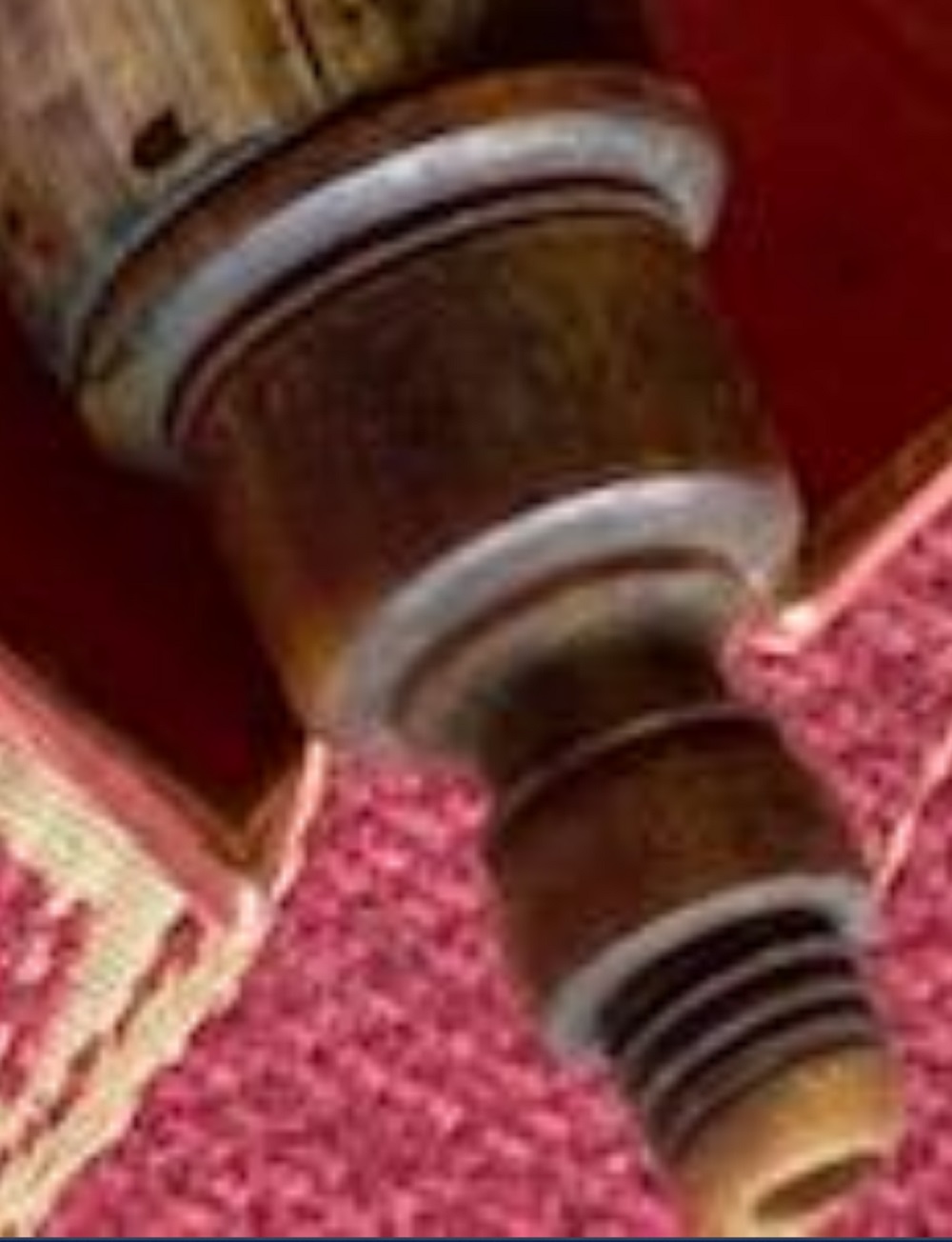 IN NECESSARIIS UNITAS - IN DUBIIS LIBERTAS - IN OMNIBUS CARITAS THE MAN IN THE ARENA, Theodore Roosevelt at the Sorbonne Paris on April 23, 1910: " It is not the critic who counts; not the man who points out how the strong man stumbles or where the doer of deeds could have done better. The credit belongs to the man who is actually in the arena, whose face is marred by dust and sweat and blood, who strives valiantly, who errs and comes up short again and again, because there is no effort without error or shortcoming, but who knows the great enthusiasms, the great devotions, who spends himself in a worthy cause; who, at the best, knows, in the end, the triumph of high achievement, and who, at the worst, if he fails, at least he fails while daring greatly, so that his place shall never be with those cold and timid souls who knew neither victory nor defeat." My coin website: https://fairfaxcoins.com |
|
Page 2 of 2
|
Replies: 27 / Views: 2,420 |
Page 2 of 2
|








 First Page

 Posted 03/14/2023 1:11 pm


