| Author |
 Replies: 22 / Views: 2,764 Replies: 22 / Views: 2,764 |
Page 2 of 2
|
|
|
|
Pillar of the Community
Canada
2630 Posts |
I was referring to Wilkins Poloz FTH & you are referring to Wilkins Poloz FTN 2 completely different prefixes (2 different change overs). Not sure what the connection is: am I missing something?
The W-P FTN prefix currently has 775 reported and with that bundle they would only go up to 777 (since you only count the first & last note of a bundle). And there's the rub with the SNDB (they only count first & last SN of consecutive runs). We can assume a reporting of 300+ notes usually means a pretty common note (500+ quite common) but 2 digits (99 & less) should be quite tough to find.
|
|
Valued Member
Canada
479 Posts |
I'm confused? Charlton shows the Wilkins-Poloz carry over as FTN (2,818,000) not FTH and it's UNC BV is up to $30. Which is why I thought you were questioning the BV on this note. The two FTH change overs are Macklem-Carney UNC $40 and Macklem-Poloz UNC $14. 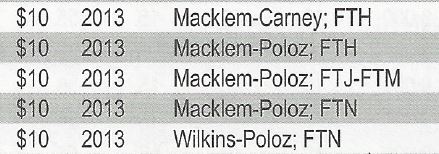 Edited by Enyaw
12/26/2023 09:42 am
|
|
Valued Member
 Canada
101 Posts |
Nice find on the FTN changeover stack!
I'm a little confused as well as the only Wilkins changeover listed for 2013 is FTN.
|
|
Pillar of the Community
Canada
2630 Posts |
Quote:
Nice find on the FTN changeover stack!
I'm a little confused as well as the only Wilkins changeover listed for 2013 is FTN. +1 I remain confused why there's such a big bump on the W-P FTN. I got many runs of these & found them ridiculously easy EXCEPT several had scratches on the holograph windows. But they weren't tough at all. Another collector updated me on the 2022 catalogue and gains for the W-P FTN were similar to the gains on the M-C FTH. This made no sense at all. That's why I was wondering why (or how) the editor of Charlton could keep posting such high BV for FTN. I am still wondering if there's a possible connection & am still puzzled by their high BV (according to Charlton). I've never seen anyone pay the premium Charlton has attributed to the FTN either. I've got lots & nobody has wanted them (for $5.00 above FV). Seems like another big oversight on their part. There's other weirdo premiums on the 2012/13 Frontiers tables but the TENS seem to be the most off & disconnected to reality. I always get a lot of good info from their guide (& it surpasses C&C by a longshot) but I typically dismiss most of their tables for the recent series/special numbers/errors. |
|
Valued Member
Canada
101 Posts |
Just received the 2024 Charlton. The only change they made was to increase the Macklem/Carney FTH by quite a bit. It's very odd as the quantity printed shows over 8.3 Million of them. 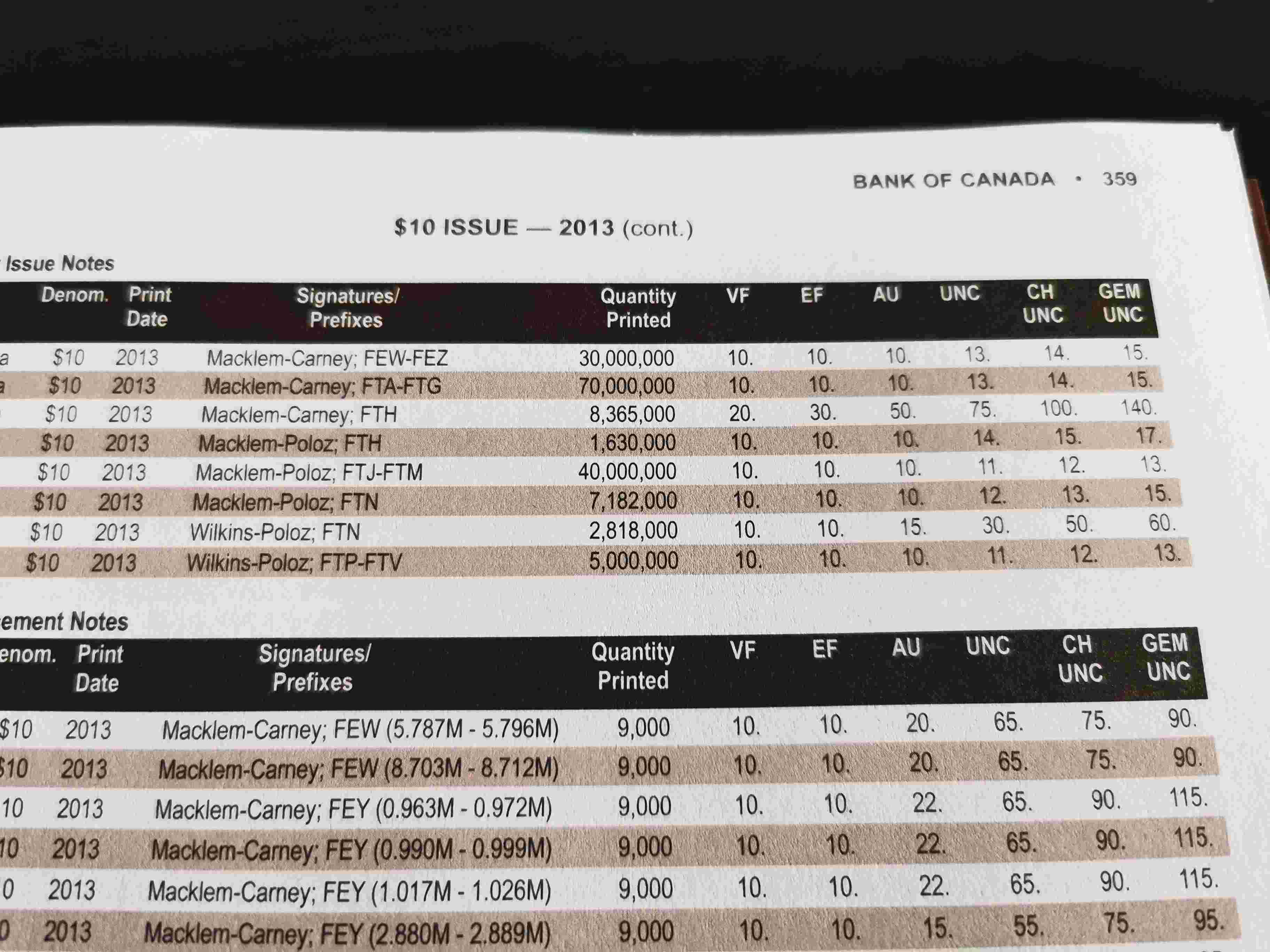 |
|
Pillar of the Community
Canada
2630 Posts |
Quote:
Just received the 2024 Charlton.  thanks for sharing snapshot of the FTH BV's @Q60driver! Quote:
It's very odd as the quantity printed shows over 8.3 Million of them. The # of notes printed is next to meaningless with some prefixes (the Macklem Carney FTH especially). You need to execute a RAW ENQUIRY on the SNDB and then look up the prefix. You will actually get the data of who entered what from where/when. My enquiry showed that: the first Macklem Carney FTH8233489 was reported by a collector from Kitchener, Ontario in September 2013. The same collector entered a 2nd FTH on December 2nd 2014 (#8320478). What is odd about this is that another collector from Sarnia, Ontario enters 2 notes on the same day (FTH8002998 & FTH8044594). He also enters another FTH6872825 the next day (12/03). It makes me wonder if he found a brick or several bundles (he reports 4). That is the lowest # FTH entered in the SNDB. There are no 7M # notes and nothing below 6872825. Of the 14 notes entered, 10 were found in Ontario, 2 in BC, 1 in Alberta & 1 in Quebec. The majority of notes are in the 8M range. You can see a similar pattern for the Macklem Carney GHD $50 (61 notes reported). Two notes were in the 0001000 -4000 range & 4 notes reported between 0034000 - 0042000 range. The rest (55) reported are 4.5M to 4.88M (end point). The majority of the GHD $50 notes were discovered in ON, with several from QC, Alberta, BC & even NFLND. Edited by walk2dwater
12/30/2023 5:03 pm
|
|
Valued Member
Canada
101 Posts |
Quote:
The # of notes printed is next to meaningless with some prefixes Interesting.. With so few notes of a specific prefix being found, I wonder what happened to all the rest of the print range? If I had to guess, production had some major issued and destroyed a large quantity maybe? |
|
Pillar of the Community
Canada
5342 Posts |
Or maybe most of the prefix was eventually issued but knowbody really cares or notice, very few people looks at their change or bank withdrawelsl. The high speed printing process and the automatic techs used today does not need a human intervention of replacing damaged notes with special desisignated notes so most collectors have lost intersts in these maybe rare inserts notes. The US BOE recently has announced that starting in new year some denomintions will be printed not in sequence, so they must be stepping up newer techs in the printing process
Edited by john100
12/31/2023 10:40 am
|
|
Pillar of the Community
Canada
2630 Posts |
Quote:
..The high speed printing process and the automatic techs used today does not need a human intervention of replacing damaged notes with special desisignated notes so most collectors have lost intersts in these maybe rare inserts notes. The US BOE recently has announced that starting in new year some denomintions will be printed not in sequence, so they must be stepping up newer techs in the printing process.. +1 Quote:
I wonder what happened to all the rest of the print range? You are assuming that the sheets(prefixes) were all serial numbered & fully issued. As John100 alludes to, we have to discard our old notions that all prefixes were issued equally & they were sequentially numbered #0000001 to 10000000. The numbering (& prefix) system could have started high & ended low (as many countries do). They could have easily started at the FTH prefix & ran out of the Macklem Carney sheets as they approached FTA (or some other prefix). We just don't know. A similar situation occurred with the 2003 (Journey) BER prefix. More 2004 BER were recorded in the SNDB & the SNDB was launched due to the discrepancies discovered in the varying prefixes. This has also happened/been observed with the 2004 HOH $5 (more 2005 HOH observed- mostly inserts) & other prefixes (especially change-overs). And this is one of the reasons I was surprised it took Charlton so long to acknowledge the M-C FTH (actually rating the M-P FTH as more scarce in earlier editions). I'm also a little surprised that they knocked the M-P FTH down to $17 in G-Unc too as these were plentiful but not as common as the W-P FTN ($60 in G-Unc). That's a real head scratcher! |
|
Valued Member
Canada
101 Posts |
Quote:
The high speed printing process and the automatic techs used today does not need a human intervention of replacing damaged notes with special desisignated notes so most collectors have lost intersts in these maybe rare inserts notes. The US BOE recently has announced that starting in new year some denomintions will be printed not in sequence, so they must be stepping up newer techs in the printing process Quote:
You are assuming that the sheets(prefixes) were all serial numbered & fully issued. As John100 alludes to, we have to discard our old notions that all prefixes were issued equally & they were sequentially numbered #0000001 to 10000000 It all seems so random now. I guess the serial numbers and prefixes don't really mater to the BOC as long as they're all different and they count how many left the building, as they would need to know how many are in circulation. |
|
Pillar of the Community
Canada
5342 Posts |
All the BOC cares is cost of production and a certain level of security
Edited by john100
12/31/2023 3:55 pm
|
|
Pillar of the Community
Canada
2630 Posts |
Quote:
I guess the serial numbers and prefixes don't really mater to the BOC Quote:
All the BOC cares is cost of production and a certain level of security  That's been my understanding. I met a former BoC official at a RCNA show years ago & he told me (in confidence) that he was astonished that collectors seek insert replacements. (I tend to agree) but I sure like the odd rare short prefix or change over. |
|
Valued Member
Canada
101 Posts |
Quote:
he was astonished that collectors seek insert replacements. (I tend to agree) I feel the same. Insert replacements are very random with no rhyme or reason. I prefer collecting the old asterisk or X replacements. As for the 2024 Charlton catalogue, I have updated all of my spreadsheets with the new catalogue numbers. My denomination collection had a minor increase of 1.4% with the few small changes coming from the older series (1935, 1937, 1954 devils face and modified) My 1973 prefix set was virtually unchanged with the exception of one note. *OL dropped in value by $25 witch decreases my set by 0.185%. I expected an increase in test notes but none were made. When comparing the 2023 and 2024 catalogue, I found the only changes were to the super rare stuff. 1937 $50 Osborne for example. Overall changes in the book are very minor. |
|
Pillar of the Community
Canada
5342 Posts |
Charlton is only good on mostly common stuff, the really rare like the serial 007 French 20 dollar young Princess sold twice in about a year for about 140 K books for like 25 k, rare serials like 01 or 10 million notes, really cool errors are all 5 to 10 times book. Recent auctions are the only way to determine true value, with inserts and maybe replacements few knows about them also they rarely trades, when collectors understand like the 5$ CB replacement they will pay up as recent auctions have proven
Edited by john100
01/05/2024 4:59 pm
|
|
Pillar of the Community
Canada
2630 Posts |
Quote:
Charlton is only good on mostly common stuff, the really rare like the serial 007 20 dollar young Princess sold twice in about a year for about 140 K books for like 25 k, rare serials like 01 or 10 million notes, really cool errors are all 5 to 10 times book. Recent auctions are the only way to determine true value, with inserts and maybe replacements few knows about them also they rarely trades, when collectors understand like the 5$ CB replacement they will pay up as recent auctions have proven +1 John100 really sums it up nicely (I believe). Back in 2014, I wanted to upgrade my 1935 set but almost everything listed on ebay was sold by US sellers in USD. And the majority of the US sellers used Charlton (or the SCWPM) as their guide. That meant that most 1935, 1937 & 1954 DF's were 30-40% higher in reality than the book. So, I waited & waited until another year passed (with few acquisitions). About 2-3 years later I realized I had to dismiss Charlton b/c it simply did not match the market place for the first 3 series. Besides special # (which are off too), Charlton is pretty close for the Modified & more recent series. A lot of US collectors snap up Canadian notes b/c they're pretty cheap for their rarity (& many US collectors know they get a good "bang for their buck" exchange on our colourful first 3 series). That's why I wrote my predictions (thinking the pricing panel & editor would finally acknowledge where they've been dragging their feet). I understand they like to be conservative with their BV/tables but I think they're "erring on the side of caution" a little too much. This is good for the dealers but terrible for the avg collector (who may be looking to sell). |
|
Page 2 of 2
|
Replies: 22 / Views: 2,764 |
Page 2 of 2
|








 First Page

 Posted 12/25/2023 5:34 pm


