| Author |
 Replies: 17 / Views: 1,823 Replies: 17 / Views: 1,823 |
Page 2 of 2
|
|
|
|
Bedrock of the Community
United States
94367 Posts |
Don't overthink it.  to the CCF! |
|
Bedrock of the Community
Australia
21789 Posts |
Look at lots of videos on how museums conserve / restore their coins.
Different coins from different previous environmental conditions require different c/r methods.
Having made these two comments, almost all coins require no treatment at all.
Buy right in the first place, and most of the c/r problems are avoided.
|
|
Bedrock of the Community
Australia
21789 Posts |
Beautiful rainbow toned coins need preservation.
Best way to do that is a quick soak in acetone, let dry and seal in an airtight positive screw seal capsule.
My only problem with rainbow toned coins from what I can best determine is that
most of them have acquired their toning by artificial means,
and as such, should not have any more value over their equivalents without any toning.
|
|
Moderator
 Australia
16983 Posts |
If you're going to be soaking a coin in water, then you'll need to dry it off before soaking it in anything else. If you've got acetone and were going to be doing multiple dips in acetone anyway (this is recommended), then the first dip in acetone could be considered "drying" - buy you'd still want to get rid of as much water as possible before putting it in the acetone. Acetone evaporates away quickly. You do not need to do anything to a coin after an final acetone rinse. As for any treatment of the coin while it is submerged, I would not recommend rubbing or scrubbing, with anything. I would recommend using an eyedropper or plastic disposable pasteur pipette to squirt jets of solvent onto stubborn areas of goo, while the coin is submerged. I use something like these, but that's just because we've got boxes of them sitting around the lab where I work. Don't say "infinitely" when you mean "very"; otherwise, you'll have no word left when you want to talk about something really infinite. - C. S. Lewis
|
|
Pillar of the Community
 United States
8047 Posts |
Lots of lotion since the acetone tends to dehydrate the skin.
|
|
Valued Member
 Italy
290 Posts |
Thanks all for the welcoming and pointers! Quote:
Don't overthink it. Ahah, as I'm a serial overthinker, it's like asking water not to be wet  Quote:
Look at lots of videos on how museums conserve / restore their coins. Any examples that come to mind? I couldn't find any video specifically from museums but probbaly I missed them. Most of the video starts with good intentions but inevitably end up bring out the old toothbrush!  Quote:
Buy right in the first place, and most of the c/r problems are avoided. My primary interest as of now is to conserve/preserve the thousands of -- very dirty -- coins passed down in my family. Probably 90% of them are common ones but hold sentimental value nonetheless. Nevertheless I still want to try doing the best job I can (plus it's always nice to learn a new skill!) Just to give an example, this is a detail of a copper coin which just had its 100th birthday -- minted in 1924 (this is an Italian 5 cents, nicknamed "wheat spikes"). Would you all consider this a coin that would benefit from a proper conservation treatment as opposed to spending the next 100 years as is? 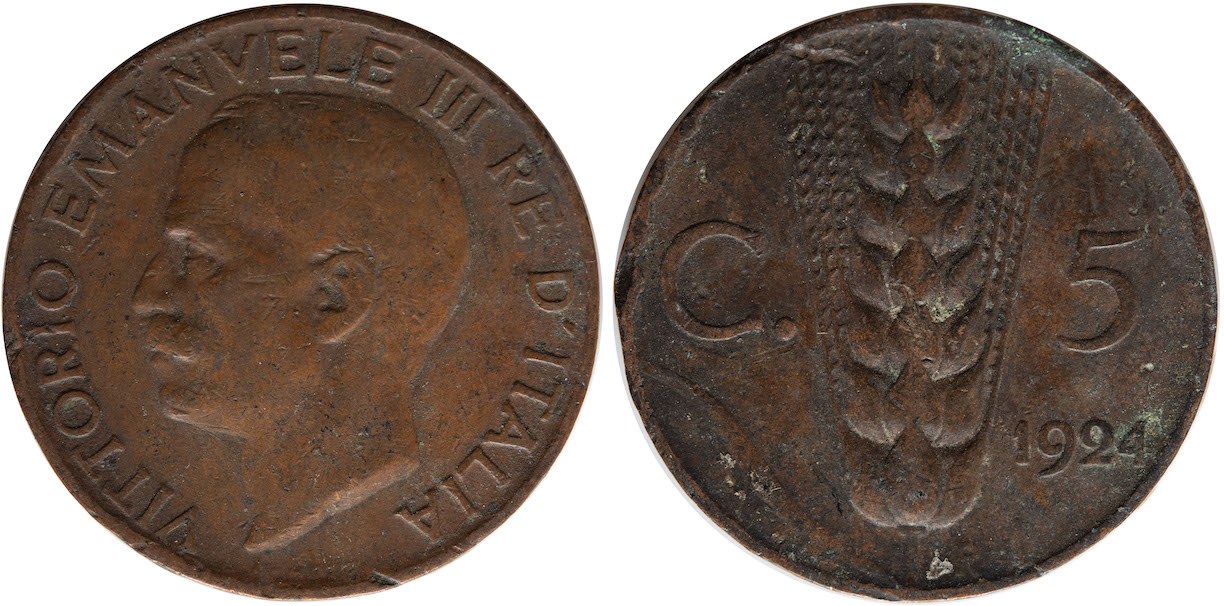 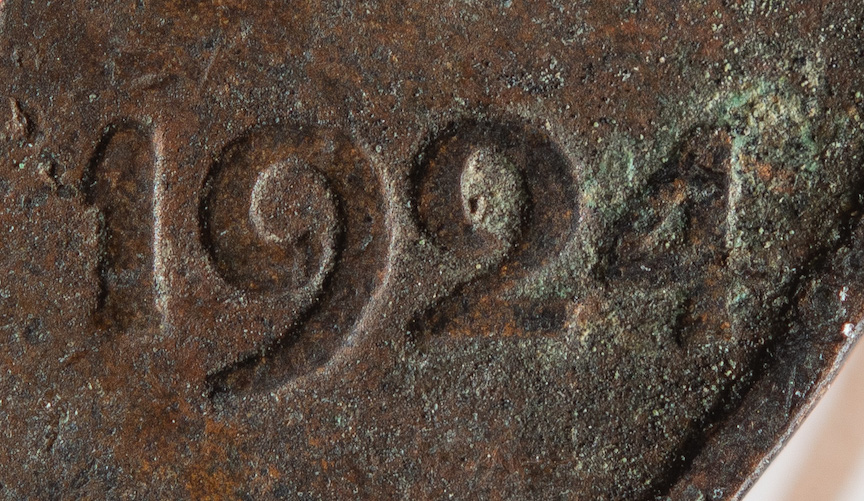 What I'm reading so far seems to indicate that water and acetone baths will require different techniques. With distilled water all is easier (can use bigger jars, more liquid), just swirling to coin held with my fingers on the rims should serve the purpose of "rinsing it". With acetone I'll probably use small containers so a squirting pipette after the bath will do the trick. Thanks a lot to all! |
|
Pillar of the Community
United States
8047 Posts |
Best wishes for your efforts.
If the green areas are copper salts, neither water nor acetone is likely to help, but they also will not hurt.
|
|
Pillar of the Community
Canada
1811 Posts |
 joe_77 |
|
Moderator
Australia
16983 Posts |
Once a copper or bronze coin starts to turn green, there's really nothing that can be done to help it; anything done to the coin to take the corrosion away will only make it look worse.
I am slightly worried about this particular coin; the pale green dusty appearance of the corrosion could be the beginning of bronze disease, an "infections" form of corrosion that can spread to cover not just this coin, but any other copper or bronze coin it touches, or on which pieces of the green dust break off and land on.
Acetone will not really help bronze disease, and water will only make it worse.It needs stronger chemicals.
Don't say "infinitely" when you mean "very"; otherwise, you'll have no word left when you want to talk about something really infinite. - C. S. Lewis
|
|
Pillar of the Community
United States
7387 Posts |
You need verdicare for that coin, acetone and water won't do anything. That coin needs a long soak and some mechanical movement (like with a toothpick) to remove that.
|
|
Valued Member
Italy
290 Posts |
Thanks to all for the additional pointers provided! A couple of questions: assuming verdigris is present on the coin, will the correct procedure be: water then acetone then something else/mechanics removal of the verdigris (and then water and/or acetone again)? Or should the verdigris be addressed first? In the above comments it was written that water will make it worse but also that it wont hurt. Verdicare, Verdigone, etc seem to be USA products. I read about EDTA (either localised or in full immersion) or Sodium Sesquicarbonate (bath), anyone has experience with these? If I seal the coin (with for example Paraloid), will verdigris reappeared if removed or will it spread if left untouched? Thanks a lot! EDIT: regarding verdigris and procedure with other baths I found an old writing by BadThad stating how a distilled water + baking soda would help before treatment to neutralise the acids on the coin. I wonder if for copper coins would be best to follow this procedure:  1. Distilled water baths + sodium bicarbonate (few) cycles. Purpose: neutralise acids and remove water soluble gunk 2. Acetone baths cycles. Purpose: remove acetone soluble gunk 3. Verdigris treatment. Purpose: stop (and removing oxides depending on treatment) the verdigris reaction 4. Distiller water baths. Purpose: remove water soluble gunk which was under acetone soluble gunk and remove salts/chemicals deposited in step 1 or 3 5. Acetone rinse. Purpose: drying the coin 6. Applying sealant What do you all think? By the way, just to make a list of them, so far the Verdigris treatment I found are: mechanical or questionable as far as conservation safe (e.g. lemon juice) verdicare or verdigone specific products EDTA bath or localised treatment Sodium Sesquicarbonate (water, sodium bicarbonate and sodium carbonate) bath Edited by joe_77
01/04/2024 3:31 pm
|
|
Pillar of the Community
United States
1314 Posts |
|
|
Moderator
United States
195203 Posts |
Quote:
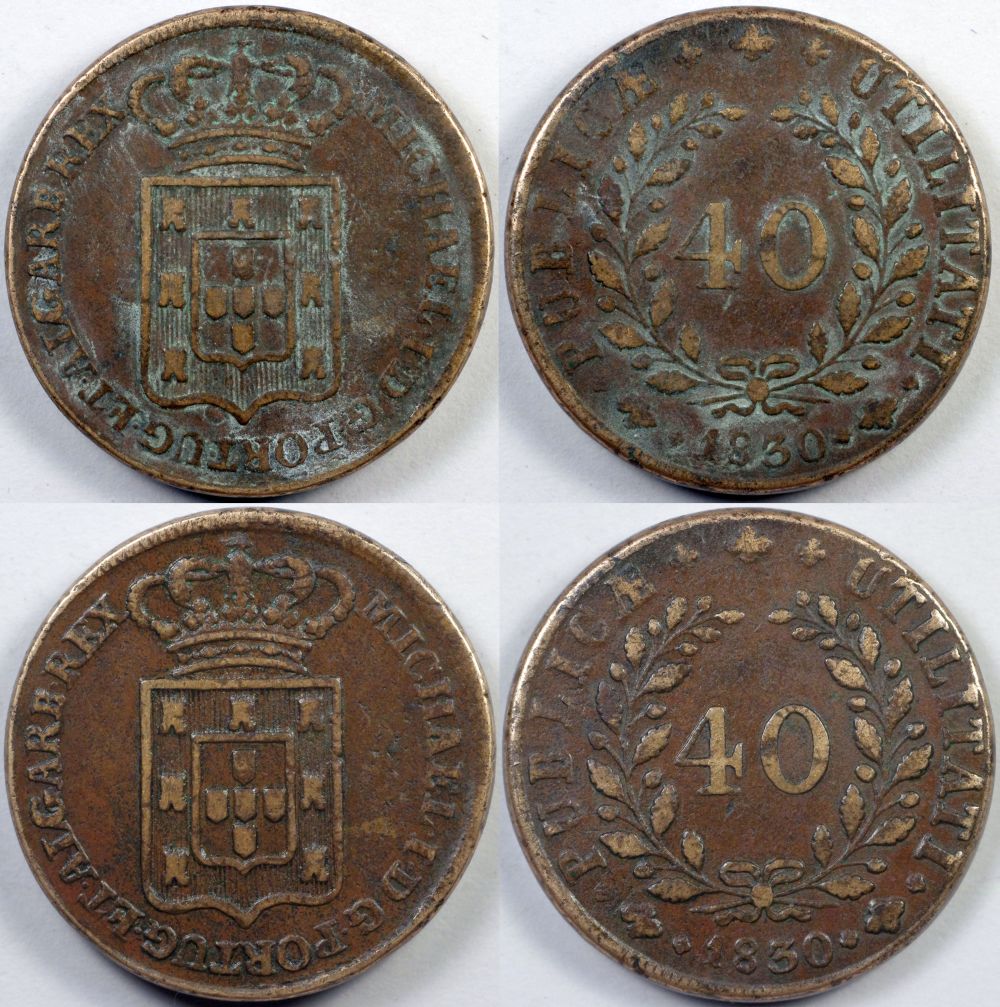
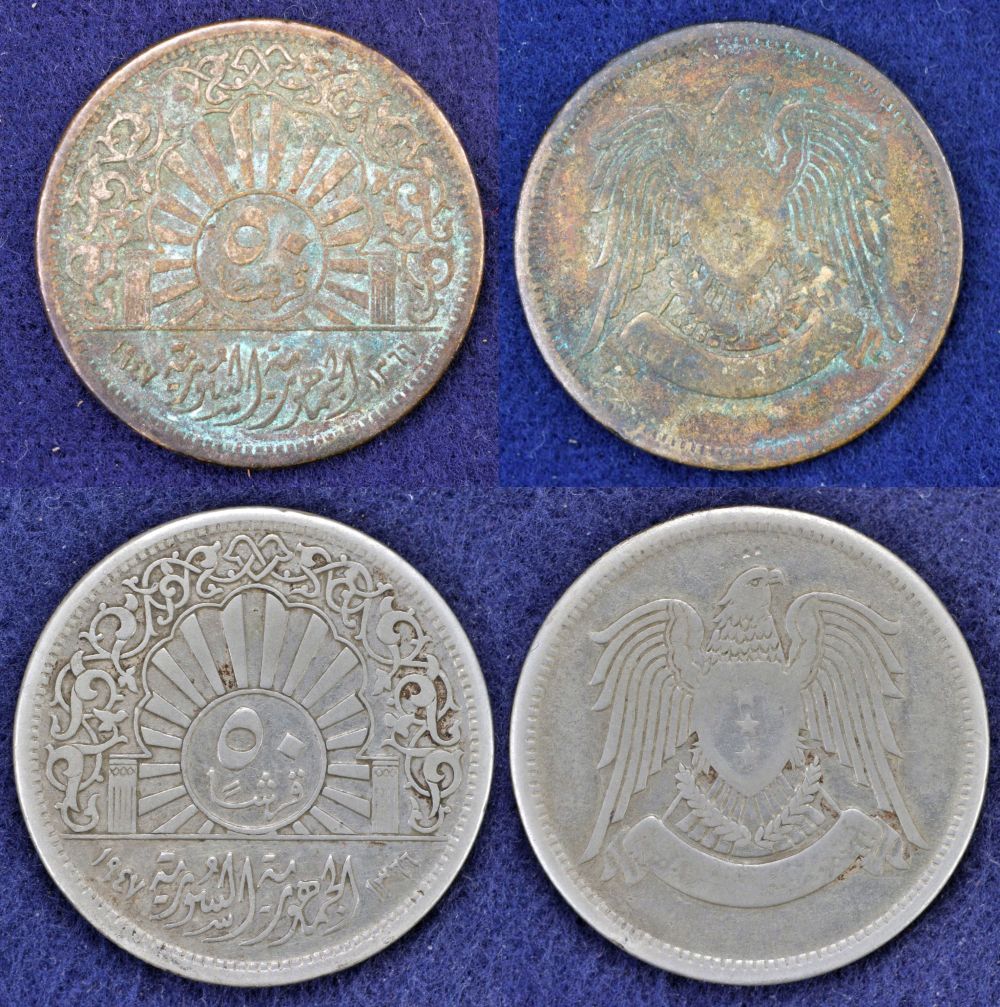
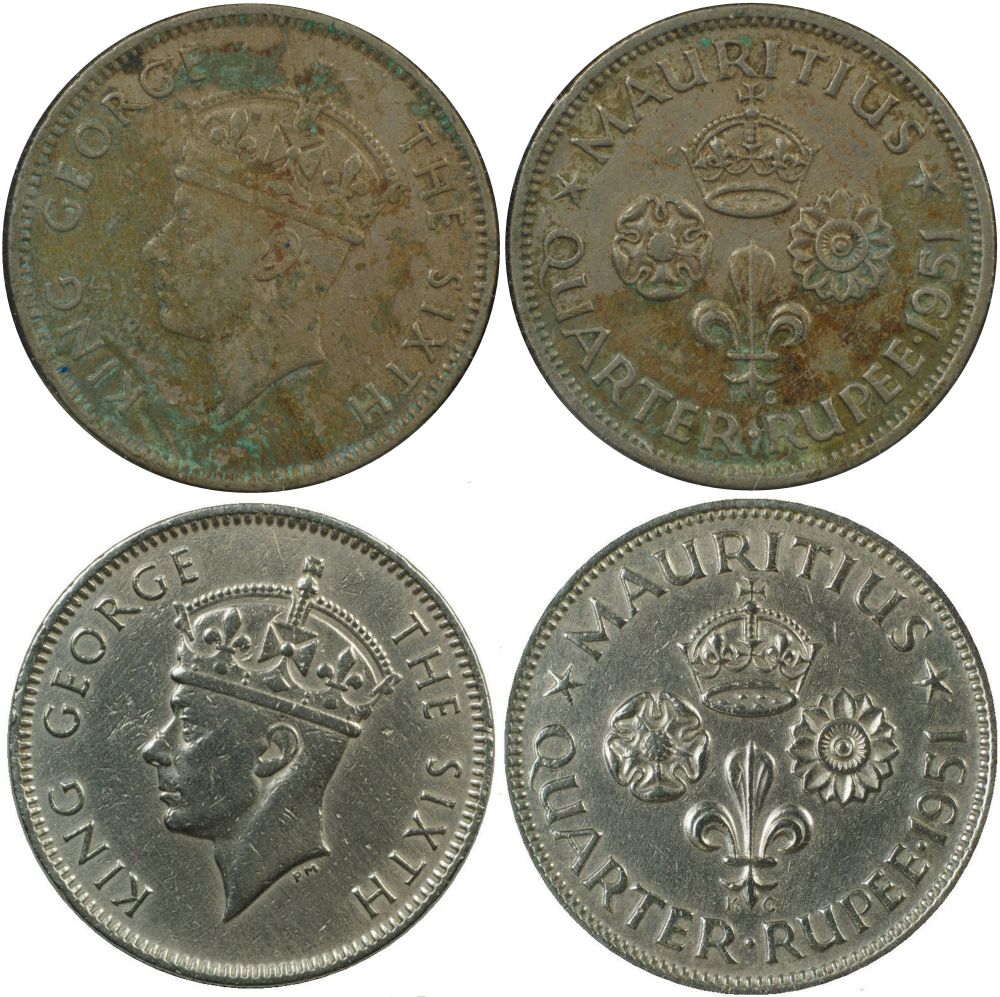
Good things are possible with patience. Looking good!  |
|
Bedrock of the Community
United States
27442 Posts |
Chute72, how did you treat your coins?
Inordinately fascinated by bits of metal with strange markings and figures
|
|
Bedrock of the Community
United States
18902 Posts |
i agree with hfjacinto. I don't think acetone is going to do much for this. Verdicare now called Verdichem will help however there appears to be some corrosion under it and this would surely bring that out and more visible. it would preserve the coin against future degradation though
|
|
Page 2 of 2
|
Replies: 17 / Views: 1,823 |
Page 2 of 2
|






 First Page


 Posted 01/02/2024 8:54 pm