| Author |
 Replies: 34 / Views: 4,571 Replies: 34 / Views: 4,571 |
Page 3 of 3
|
|
|
|
Pillar of the Community
United States
2018 Posts |
Let me see if I understand this. The coin is a genuine 1794 that has had the date altered to 1793 is that correct? So it is not a production counterfeit but rather an altered date. What sort of value would you place on a piece like this?
|
|
Pillar of the Community
United States
4510 Posts |
The obverse does not match the 1794 S-63 as the date position, hair curl and bead count is different.
|
|
Pillar of the Community
 United States
517 Posts |
Obverse was reengraved aka a "Smith Counterfeit". There obviously should not be a "bead count" on a 1794 large cent, part of the alteration. The reverse is a match.
I'll post images of the edge when I get it in-hand.
Edited by burfle23
05/20/2025 09:03 am
|
|
Moderator
 United States
196572 Posts |
Quote:
Just looking for some conversation here! A decent one it is.  |
|
Pillar of the Community
United States
4510 Posts |
I look forward to seeing your photos. I have posted a 1794 S-63 Fallen 4 in Date side by side with the OP obverse. When I look at these side by side, the make over seems over the top with too much work on the denticles, and date. Why change the hair curls? If the make over started from the 1794 S-63, all I can say is amazing work. 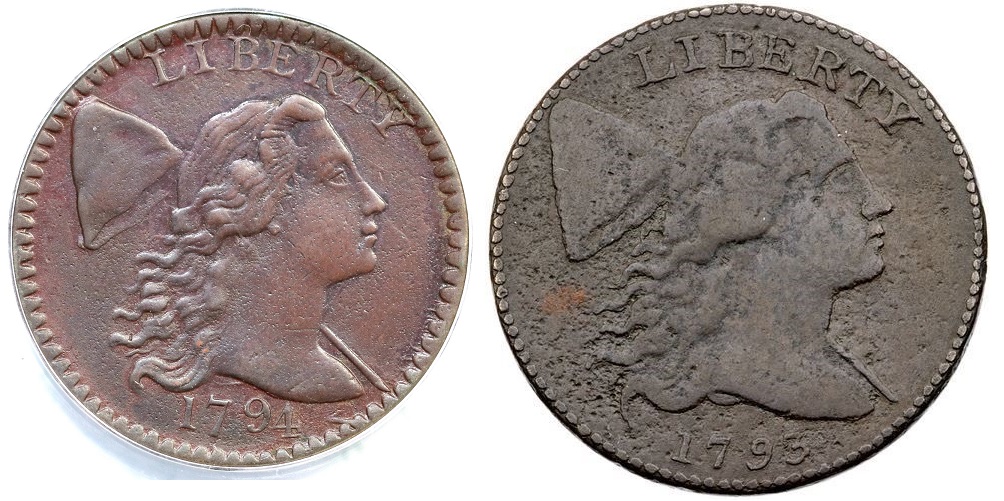 |
|
Pillar of the Community
United States
517 Posts |
Another from my collection; a Smithed" 1794 into a 1793 wreath. Yes, his work was amazing... 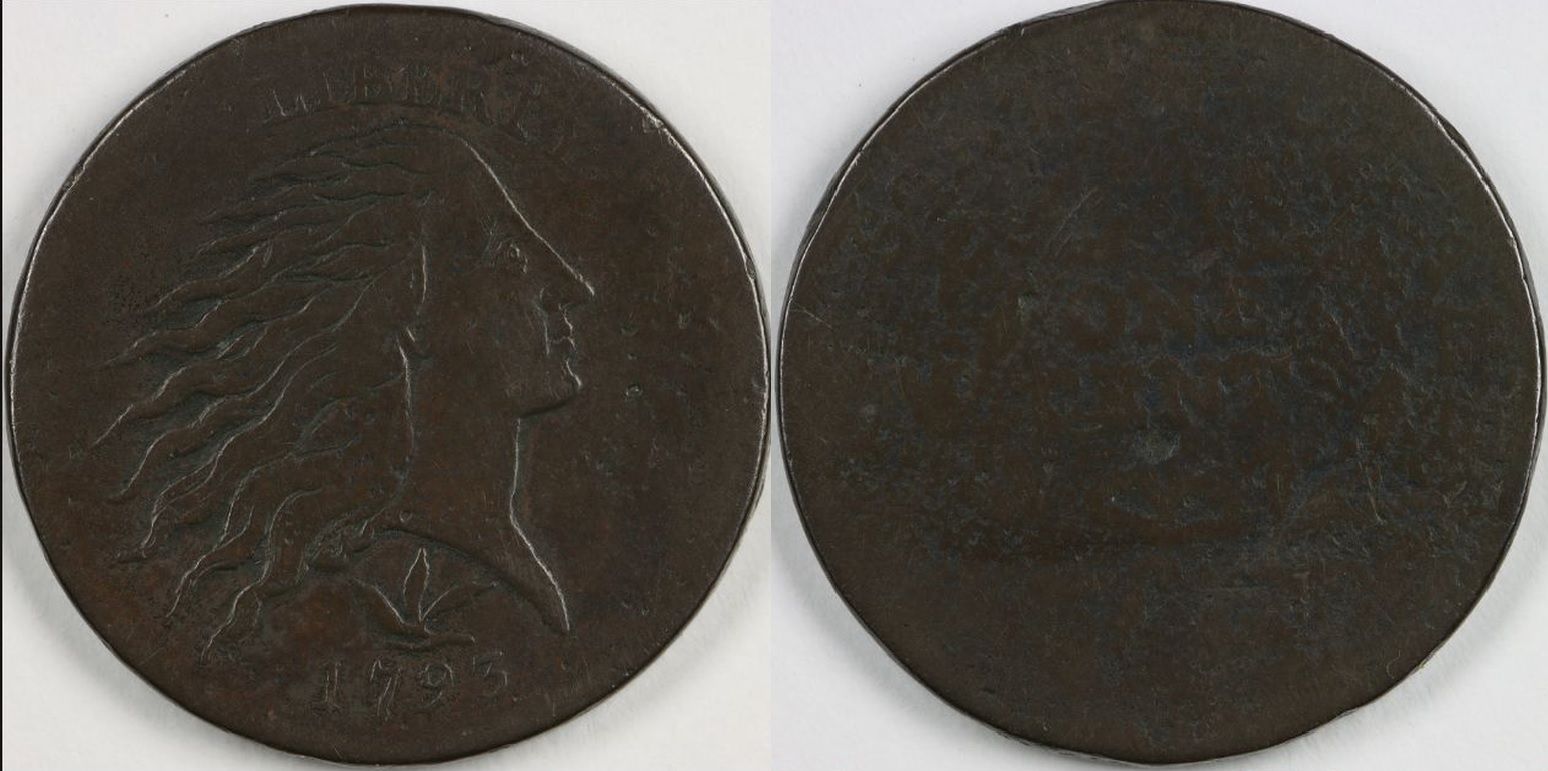 |
|
Pillar of the Community
United States
2360 Posts |
|
|
Moderator
United States
196572 Posts |
Quote:
Another from my collection; a Smithed" 1794 into a 1793 wreath. Yes, his work was amazing... Very nice! |
|
Pillar of the Community
United States
3848 Posts |
Very interesting, thanks for sharing!
Suffering from bust half fever. Want to learn how to attribute early half dollars by die variety? Click Here: http://goccf.com/t/434955Shoot me a PM if you are looking to sell bust halves. |
|
Pillar of the Community
United States
4510 Posts |
Article from Coin World About Smith Counterfeits: The "Smith Counterfeit" is a curious 19th century numismatic oddity. Coin World's Paul Gilkes wrote in his Dec. 2, 2013, feature on contemporary counterfeits, "The Smith counterfeits were heavily circulated 1793 and 1794 cents that engraver William D. Smith — known as Smith of 1 Ann Street in New York City — re-engraved in the late 1850s and early 1860s to resemble higher grade 1793 cents. Some collectors suggest the Smith counterfeits are not counterfeits at all, but simply alterations to genuine U.S. Mint cents." Smith would begin with a well-worn host coin, and he extensively reworked both sides. The description notes that the present piece has a weight of only 157.1 grains, versus the standard 208.0-grain weight of a typical 1793 Flowing Hair cent, showing just how much metal was removed during Smith's handiwork. 1793 Flowing Hair, Wreath cent, altered, "Smith Counterfeit," Fine 12 Carrying an estimate of $2,000 and up, it brought $2,585. 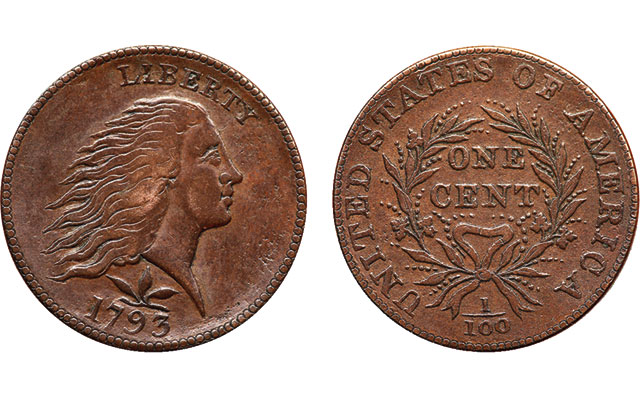 |
|
Moderator
United States
196572 Posts |
Very interesting! |
|
Pillar of the Community
United States
4510 Posts |
William D. Smith born 1800 in New York. He died after 1860. He lived and worked in both Newark, New Jersey, and New York City. He produced line engravings for printed reproductions. The 1860 city directory for New York shows his business address as 1 Ann Street. It is believed that William is the man referred to as "Smith of Ann Street" mentioned by William Woodward in several catalogs. If so, he produced engraved copies of 1793 cents. Woodward also suspected that Smith was the producer of some quality electrotypes of 1793 cents. Smith took well-worn cents and extensively engraved the remaining surface, rounding Liberty's cheeks and giving definition to her hair strands. The result — lightweight by necessity — is nowhere near original looking but has a not-unattractive, otherworldly presence that attracts collectors. His manufacture of the 1793 cents was not meant to fool anyone, but rather to make a nearly worthless cent (like a low-grade and granular Wreath cent, worth just pennies in the 1850s and 1860s) into something admirable and perhaps suitable as a hole-filler in the place of the elusive high-grade cents of 1793. William D Smith was also an artiest below is his work "Street Views no. 1--Park Row" engraving, 6 3#8260;8 x 9 inch, at the Smithsonian American Art Museum. 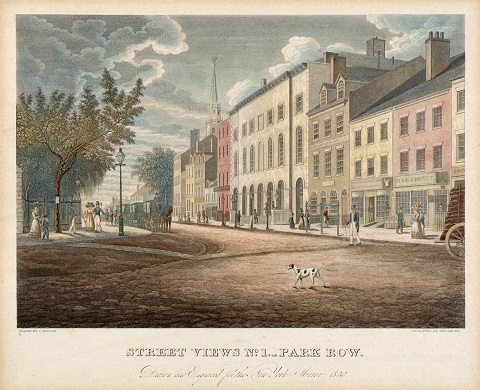 |
|
Moderator
United States
196572 Posts |
Thank you for the additional information. |
|
Pillar of the Community
United States
2253 Posts |
Looks like the obverse was faked by a counterfeiter and the reverse was faked by his brother.
|
|
Pillar of the Community
United States
517 Posts |
What an ignorant statement...
|
|
Page 3 of 3
|
Replies: 34 / Views: 4,571 |
Page 3 of 3
|






 First Page
 Previous Page


 Posted 05/20/2025 12:00 am





