| Author |
 Replies: 22 / Views: 1,930 Replies: 22 / Views: 1,930 |
Page 2 of 2
|
|
|
|
Pillar of the Community
 United States
3363 Posts |
Quote:
where did you find the information about what AISI/SAE (American Iron and Steel Institute and the Society of Automotive Engineers respectively) alloy the mint uses for their dies? I couldn't find it on the mint website. Thanks! Over the years, I have been in touch with a numismatist who is a metallurgist and works for the company that supplies the steel. I also may have seen the information in other sources. When I get back to my desktop tomorrow, I will check if I am remembering that correctly and if so, will let you know. |
|
Pillar of the Community
United States
3363 Posts |
Edited by Pete2226
10/19/2025 6:30 pm
|
|
Pillar of the Community
United States
681 Posts |
|
|
Pillar of the Community
United States
3363 Posts |
Quote:
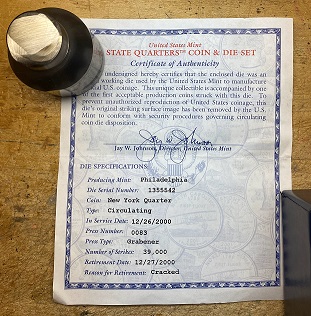
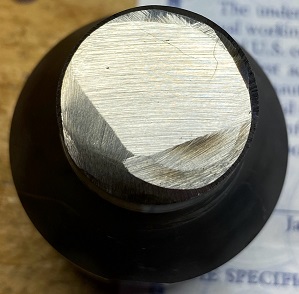
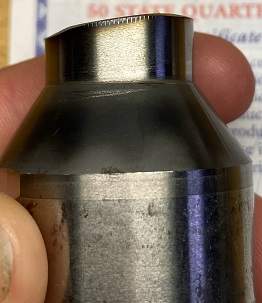
Here is my coin and die set for your records, it also appears to have suffered a collar clash in addition to those cracks. Thanks for the images. I will add to my database! In reviewing over 100 die/certificate combinations, I have not seen a die so severely defaced! I see the evidence of a collar clash on the side view of the die. This is the first example I have seen from the "Certificate of Authenticity Series" where the remnants of damage are still visible! As far as more resources for Die Steel information: Check this site: https://www.numismaticnews.net/worl...ty-discovery Appendix A in this paper I wrote in 2015 has a brief review of die steels, including their supplier. https://conecaonline.org/rockwell-h...ncoln-cents/ I have not found any mention of Die Steel types in Annual Reports or Biennial Reports of the US Mint, although alternate types are mention in the metals study report: 2012 Biennial Report to the Congress, as well as the parent company of the supplier (they merged in 2012, I believe)> For an EXCELLENT resource on general die steel understanding, check the Discussion of Die Steel Terminology and a Discussion of Die use and die failure in the first half of the 20th century by Roger Burdette in his book "from Mine to Mint." It deals with the first half of the 20th century but is important for our understanding of processes. This paper does not pertain to US coins and Dies, but is interesting for its insight into some of the analytical tools available: "Root cause analysis of coining tool failure with proposed solution to extend its service life" by Miroslava Tavodova, et.al., Engineering Failure Analysis, Volume 162, August 2024. https://www.sciencedirect.com/scien...630724004187 This paper does not pertain to coin/die use, but is interesting for its examination of die wear: "Die wear in stamping of advanced high strength steels - Investigations on the effects of substrate material and hard-coatings" by Ömer Necati Cora, et.al., Tribology International, Volume 52, August 2012, Pages 50-60. https://www.sciencedirect.com/scien...679X12000709 Edited by Pete2226
10/20/2025 09:09 am
|
|
Pillar of the Community
United States
3363 Posts |
EDITED my previous comment to add resources.
|
|
Pillar of the Community
 United States
9022 Posts |
Pete, you may want to take a look at this thread, as it may tie in with yours and you may be able to offer some input.. LINK https://goccf.com/t/484565-makecents-
|
|
Pillar of the Community
United States
3363 Posts |
makecents: Thanks for your comments! I think the Doubled Die portions of those references is not for this effort, since it is a variety and there is no evidence, that I know of, that its existence contributes to the degradation of the die.
I had not considered lathe lines. They may have no relation to my efforts either.
• They do not fit with my operative definitions.
• I have found no dies being retired because dies with lathe lines produced unacceptable coins for circulation.
• While their origin is debatable (cutting of die steel, trimming rotating bar stock, machining die stock before hubbing, inadequate polishing of the cone-shaped face of the unfinished working die, lapping after hubbing), their existence remains on the die due to inadequate die finishing/polishing.
An argument can be made that lathe rings do not contribute to the degradation of the die.
Thanks for mentioning them! It challenges my thinking!
|
|
Moderator
 United States
108341 Posts |
That is quite a write up Pete, very interesting information.
|
|
Pillar of the Community
United States
3363 Posts |
Quote:
That is quite a write up Pete, very interesting information. I appreciate your support! I love research! I have been a student all my life and I will turn 85 soon and have no intention of stopping! I appreciate comments from forum members, for they help me focus and refine my thinking. Edited by Pete2226
10/20/2025 2:47 pm
|
|
Pillar of the Community
United States
681 Posts |
Thanks Pete! I haven't looked at all the sources you provided but they are definitely interesting.  |
|
Pillar of the Community
United States
9022 Posts |
Quote:
Thanks for your comments! I think the Doubled Die portions of those references is not for this effort Thanks for looking at it Pete but really feel there is no doubled die involved here, that is why I shoved it your way with your recent post here, felt it was very relevant, especially with all the craziness with the 60 dies. It is a well known fact that these obverse dies had been modified from the start, coming from the 1959 master die and reworked. On top of that, they had NUMEROUS clashes, and we all know what happens then, polishing, and die damage.  -makecents-
|
|
Pillar of the Community
United States
3363 Posts |
Quote:
.especially with all the craziness with the 60 dies. It is a well known fact that these obverse dies had been modified from the start, coming from the 1959 master die and reworked. On top of that, they had NUMEROUS clashes, and we all know what happens then, polishing, and die damage.
Certainly effects of clashing is relevant. I think modification of hubs/master die is not so much. I have found no evidence of working dies being retired for that reason. While I suppose it could be argued that the modification contributed to die instability/degradation, but such modifications are too far removed from the scene of the crime to be considered a primary or even secondary source for degradation. Edited by Pete2226
10/21/2025 05:06 am
|
|
Pillar of the Community
United States
3363 Posts |
|
|
Pillar of the Community
United States
9022 Posts |
You do great work, Pete! Good luck on your future endeavors. Even though you have been doing this for years, I think you are just getting warmed up. -makecents-
|
|
Pillar of the Community
United States
3363 Posts |
Quote:
Even though you have been doing this for years, I think you are just getting warmed up. Thanks. I appreciate your support! I think you are correct! I am having fun too! I started collecting in 1948 and off and on since. I did not become more seriously involved until I retired, around 20 years ago! I have been a student all my life and I love research! |
|
Page 2 of 2
|
Replies: 22 / Views: 1,930 |
Page 2 of 2
|







 First Page

 Posted 10/19/2025 5:48 pm


 Thanks again!