| Author |
 Replies: 16 / Views: 15,803 Replies: 16 / Views: 15,803 |
Page 2 of 2
|
|
|
|
Pillar of the Community
 United States
5700 Posts |
Mike,
Thanks for your input, I see what appears to be what you are saying, but how would that explain the weight difference, the diameter size,the thickness being less than half the size it should be and if a corrosive liquid attacked this coin, how would the relief be so clear and not attacked, at least with coin in hand it is clearly not affected ( the relief ) by any damage that could possibly of occurred, thanks again for your input, Mike...
|
|
Pillar of the Community
United States
2752 Posts |
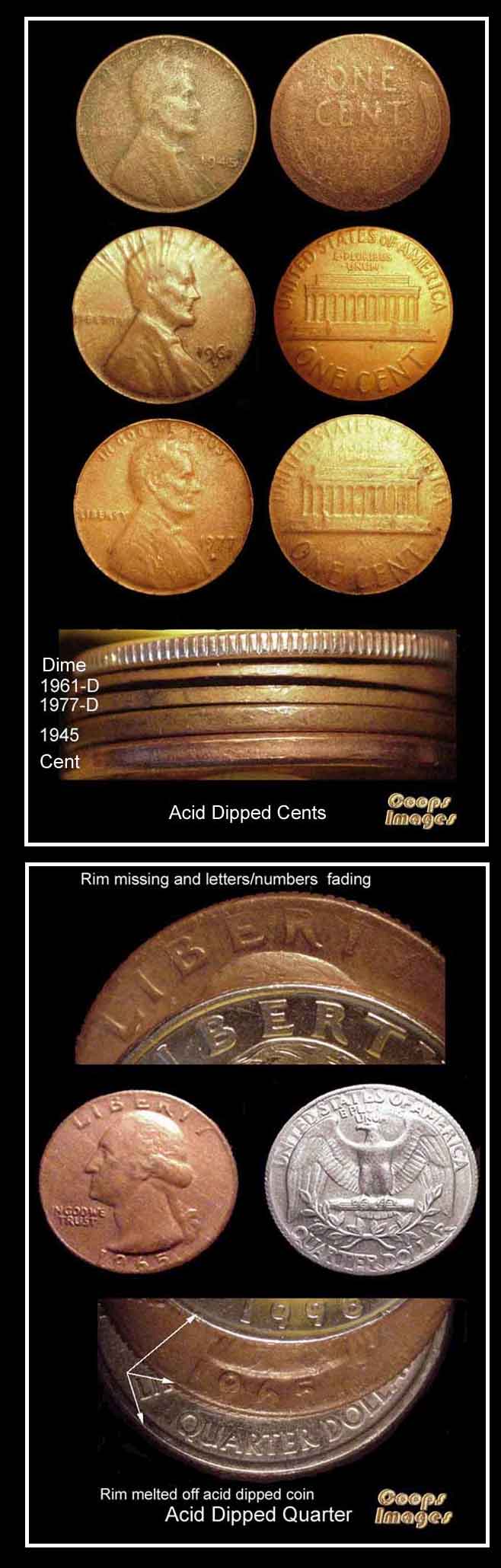
The blurred design, perfect centering, abnormally small size, and thin-to-vanishing design rim are all characteristic of this kind of damage. You'll also undoubtedly find "scalloped" reeding on the edge. The corrosive liquid attacks all areas equally, preserving the design. This is not a close call.
Error coin writer and researcher.
|
|
Pillar of the Community
United States
5700 Posts |
|
|
Bedrock of the Community
United States
17884 Posts |
Interesting. I agree it has all the characteristics of a acid soaked coin, but I'm not sure what you would use that would attack the coppernickel clad layers faster than the copper core. Typically the clad layers are more resistant and the copper core dissolves faster leaving the silver colored outer layers and a groove around the edge where the copper center is eaten away.
|
|
Bedrock of the Community
United States
62064 Posts |
They probably used sulfric acid in Chemistry class. That is usually where this occurs the most. Back in the 50 & 60's a Cent was acid soaked to make a dime out of it. They would take that thin cent and buy a soda for a cent instead of a dime. That is why you find more pre 60's cents burned that way.
|
|
Pillar of the Community
United States
5700 Posts |
Thanks guys for your input, I too believe this matter and opinions leave more questions unanswered,for instance the thickness of the dime?.Also the reeding still has the copper/nickel layer on it?. To me at least, just my opinion, be well, Mike....I would like to make it perfectly clear I have been a Numismatic student for more than 45+ years and still learning everyday!!Not an expert!
|
|
Pillar of the Community
United States
602 Posts |
Wait a minute. I'm no expert at coin errors or collecting at all. But, let me pose this question. Everyone is saying acid was used to disolve the nickel plating off the copper? I find that hard to believe. I've dug tons of clad coinage out of salt water and the first to go in that environment is the copper not the nickel. So I dont see how something would be that abrasive to the nickel but not the copper. WOLF
|
|
Pillar of the Community
United States
5700 Posts |
WnW, Welcome to the family, I think you have a very valid point, lets see who weighs in to add to the topic....Mike....  |
|
Moderator
 United States
16697 Posts |
The reduced thickness and weight plus, an etched surface appearance is a tell tale sign of acid or chemical exposure.
swcoin.ecrater.com
|
|
Pillar of the Community
United States
602 Posts |
Everyone keeps sayin that but what acid will deteriorate nickel faster than copper? WOLF
|
|
Pillar of the Community
United States
1934 Posts |
I have a rudimentary understanding of chemistry. It's hard for me to grasp that nickel dissolved faster than copper and that if that dime were attacked with acid, how the obverse is still in VF condition.
|
|
Pillar of the Community
United States
2752 Posts |
I don't know if it was acid or some other kind of corrosive solution. But there's no doubt that this coin was subjected to chemical attack that dissolved the clad layers. I've seen many (formerly) clad coins just like it.
Error coin writer and researcher.
|
|
Valued Member
United States
273 Posts |
I used to have a michigan Statehood Quarter that was missing a clad layer. The front looked normal, the back was copper colored. I took it to a coin dealer and he told me it was junk, then asked if I wanted to just leave it with him. Nice try. I held onto it for a few years and sold it on the bay for a little over $600. This dime looks like it could be a clad error, but I also see how it could be eaten by acid. Just one of those mysteries. |
|
Bedrock of the Community
United States
62064 Posts |
|
|
Pillar of the Community
United States
2254 Posts |
Quote:
It's hard for me to grasp that nickel dissolved faster than copper and that if that dime were attacked with acid, Understood. All I can say is that all acids are not the same. My thoughts are that certain acids will react differently with metals, and they will "attack" different metals more aggressively depending on the chemical properties when they meet. Sulfuric acid is a strong acid, but there are much stronger out there that people have access to. Sulfuric is just probably the most common name out there. Hydrocloric, Hydrobromic, Nitric are all strong acids, and they all have different chemicals in them that may react differently than others. It's been a long time since chem classes, but hopefully you get my point. I think as you go right and down on the periodic table the acids increase in strength. At least for the strong acids. Biochemist should be able to straighten me out if I'm wrong here.  Keep in mind there are also very corrosive acids that are not considered strong acids that can probably do some damage as well. I think hydroflouric was one that would actually dissolve glass. |
|
Page 2 of 2
|
Replies: 16 / Views: 15,803 |
Page 2 of 2
|








 First Page

 Posted 03/31/2010 12:42 am