| Author |
 Replies: 23 / Views: 3,512 Replies: 23 / Views: 3,512 |
Page 2 of 2
|
|
|
|
Valued Member
Guatemala
357 Posts |
A low run just means fewer examples are printed. For example, an emergency issue of a currency.
Normally, I'll agree, the distinction of a run is meaningless, unless there is an anomaly associated with that run. Emergency issue, an error specific to a run, or something of that magnitude.
|
|
Pillar of the Community
3660 Posts |
I see.... Thanks very much JM.... I am learning little bits here and there about what these modern FRN actually mean to the collector.
|
|
Valued Member
Guatemala
357 Posts |
Sometimes it gets rather silly. I've seen Mexican provisional banknotes sold, where the seller seeks a premium based upon a low serial number, for example 07533. Well, a knowledgeable collector could easily determine that only 8400 bills were printed, so 07533 is not, in fact, a low serial number.
Edited by JMerrick
02/20/2011 10:30 am
|
|
Pillar of the Community
3660 Posts |
Yes, I see what you mean..... or, another way that folks might look at it is that they are all low serial numbers...  I have a 1914 red seal FRN $20 Atlanta.....# F26959A.... some people might think that is somewhat of a low number, but if you realize that there were only 160,000 notes printed, the low factor dissipates quickly enough. Here is another 1914 red seal FRN from Altanta..... $5 low # ? Depends on low you look at it...... 520,000 notes printed for that district. 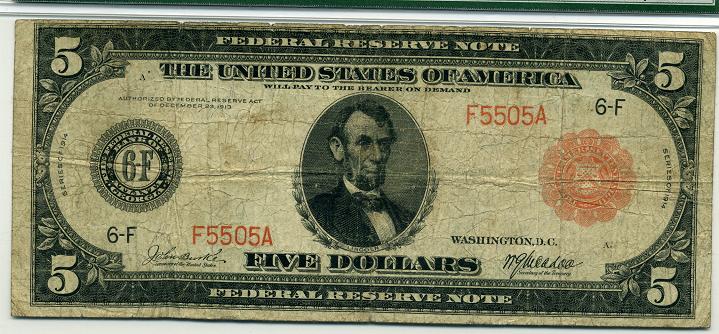 Consider the fact that prior to the new SOI press capabilities of 50 note sheets being fed, the COPE-PAK held a capacity of 40,000 half sheets, (640,000 notes) at one time..... so, to generate an entire block of serial numbers, the COPE-PAK would have to print/cut/package to its full capacity 150 times..... employing 12 presses though, this could be accomplished rather quickly at either print facility. |
|
Valued Member
Guatemala
357 Posts |
Well... I'm going to lapse into my 'opinion' here. I wouldn't consider the $5 FRN to be a low S/N, personally. If 520K bills were printed, I would want to see a leading 0, and the A suffix. So, my definition of a low S/N would be F0999A or lower. Then again, I'm a bit more of a 'snob' in that regard than the average collector.
Now, you can find yourself in a situation with modern notes, where a small segment of an FRB's allocation is dedicated to a specific 'run'. For example, the defense department could call the BEP, and say "We need 4 pallets of $100 bills" in Iraq. Since that amount is actually large enough to print a run, the BEP could assign a special block of S/N's to the job. Then BEP could look at the number of bills ordered by the different FRB's, and say a certain district was a little low in their orders, they would assign that 'run' to that district. So, if Cleveland, hypothetically, wasn't ordering as many $100 bills as the other districts average, the bills would be assigned to Cleveland, and BEP would deliver 4 skids of $100 bills from the Cleveland district to the Dept. of Defense.
|
|
Pillar of the Community
3660 Posts |
Quote:
I'm a bit more of a 'snob' in that regard than the average collector. As am I, nothing wrong with that either, as I see it.... Sorry for fading in and out JM.... I am trying to watch one of my favorite movies ("Morocco" with my favorite actress... Marlene Dietrich). Good example with the Iraq analogy.... It happens far more frequently than most folks can imagine. |
|
Valued Member
Guatemala
357 Posts |
Another thing to consider is 'terminology.
A lot of people don't understand the process fully, and use the wrong terminology.
A series is just that. All items mandated to be released at one time, bearing certain distinguishing characteristics. For example, a series number, signatures, etc.
A job is the overall mandate to produce a theoretically unique subset under that series, for example "We project we're going to need 52,000,000 $100 bills in the Boston District during the lifespan of this series"
A run is the smallest subset. It's the actual items produced without changing any variables. To use a very simple example here, If I put a sheet of paper in a photocopy machine, and press 250 copies, my maximum 'run' will be 250 copies. But, if I run out of paper, or toner at 95 copies, I actually have two 'runs' in my 'job'.
So, in theory, a 'run' begins when you fill the ink drum, load the paper and mount the plates. Anytime one of those variables is altered for any reason, your 'run' is over.
|
|
Pillar of the Community
3660 Posts |
A most excellent process explanation JM... it parallels my thoughts very closely, and answers my original question.
|
|
Valued Member
Guatemala
357 Posts |
I'm glad you're around Zee... It's refreshing to be able to be technical with someone at that level... I usually just translate very specific concepts into something general enough for the layman to understand.
It's those subtle distinctions, though, that can turn a fairly common 19th century bible that retails for $20 into a $40,000 rarity. :)
|
|
Pillar of the Community
3660 Posts |
The sentiment is mutual JM.... I assure you. I don't know much about Bibles, but here is a synographic example.... these 1862 $1 notes are quite common..... but not this one... note the placement of the lower serial number, note the series number..... $20K+ in VG. 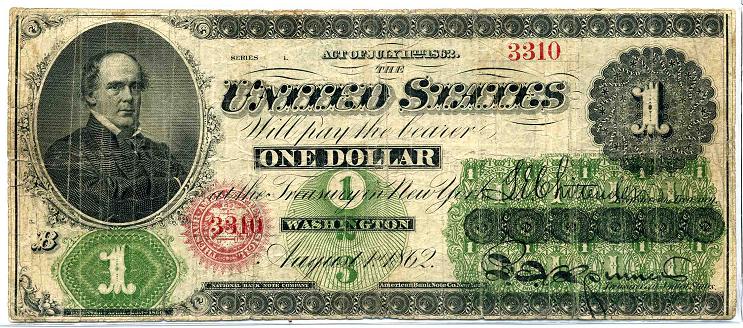 |
|
Valued Member
Guatemala
357 Posts |
Now, that was an excellent *RUN*....  To illustrate the kind of stuff I buy/sell, here's an example from the 'Wicked Bible'. It's the 10 Commandments. Read closely... 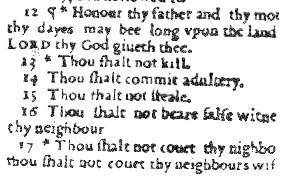 I'd pay $80K for that edition in a heartbeat, if one hit the market, and I could double my money in 6 months or less. Edited by JMerrick
02/20/2011 1:55 pm
|
|
Pillar of the Community
3660 Posts |
Would that be because of #14 ?
|
|
Valued Member
Guatemala
357 Posts |
You betcha! |
|
Pillar of the Community
3660 Posts |
Quote:
I'd pay $80K for that edition in a heartbeat For $80K, I will either find, or create several specimens for you. |
|
Valued Member
Guatemala
357 Posts |
A handful have appeared in the last 20 years, but they are all flawed and/or restored. Perfection carries it's price. I might have a couple of restored pieces in my private collection, but I would never sell one.
|
|
Page 2 of 2
|
Replies: 23 / Views: 3,512 |
Page 2 of 2
|







 First Page
 Posted 02/20/2011 10:14 am





