| Author |
 Replies: 22 / Views: 6,163 Replies: 22 / Views: 6,163 |
Page 2 of 2
|
|
|
|
Valued Member
 United States
115 Posts |
|
|
Pillar of the Community
United States
5362 Posts |
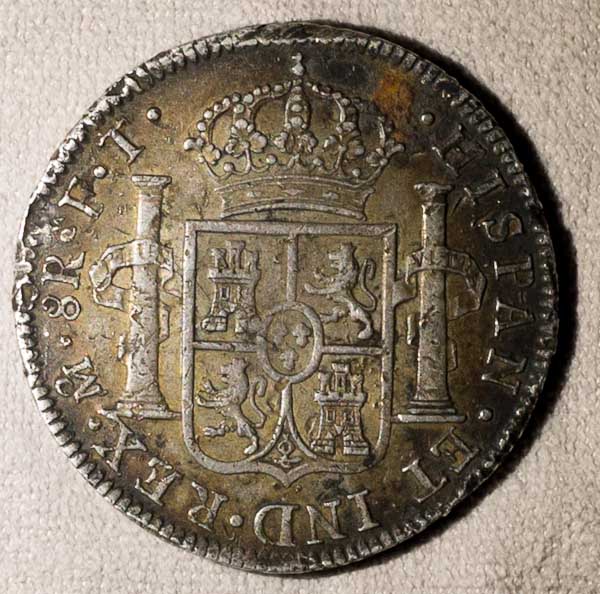
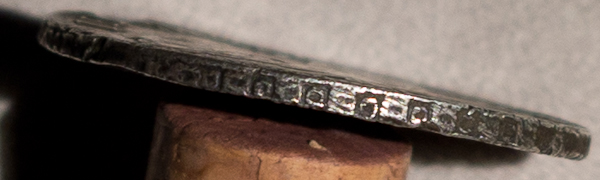
The coin is very likely silver of the correct alloy. But I seriously doubt it was created in 1802. Based on the edge irregularities ONLY - I think the coin may be a "Boston" style bullion forgery produced in the US for the China trade between 1870 and 1930.
The edge is wavy - the distance between the edges of the circle and square design moves far too quickly from well centered to not centered. To me that indicates the coin was edged on a flat bar mill WITHOUT retaining lips on the bar. A second more critical point is the NON ROUND circles. This was usually the result of a crude method of die cutting on the edge die. Some of the circles have SQUARE corners particularly on the outside of the circles.
The fact that the "Boston style" forgeries are silver and about 100 years old makes MOST dealers and collectors refer to these coins as REAL. But like the Micro-O US silver Dollar are really circulating replicas or restrikes (forgeries) made to take advantage of the low silver value versus face value.
At the point in time when these "dollar" coins were produced - they contained less silver than $1.00. At times this intrinsic value was as low as 35 cents per dollar. That was one reason silver dollars circulated so poorly. They contained too little metal. But as we all know that
changed dramatically in the 1950's.
|
|
Valued Member
United States
115 Posts |
Thank you, Swamperbob! I plan to return the coin, which is a difficult call for me since I really like its appearance. But as my first purchase of any 8 reales, I'd prefer to find a genuine coin.
Are there any dealers who are fastidious and extremely knowledgeable about 8 reales, from dos mundos through cap and ray?
|
|
Pillar of the Community
United States
5362 Posts |
There are quite a few I would trust - Ponterio being the biggest. But there are numerous ebay dealers who are excellent - too many to name for fear of offending anyone by omitting them from a list. |
|
Valued Member
United States
115 Posts |
Hi Swamperbob, I just tried sending you an email through the forum to ask on that venue for the names of some of the reliable ebay sellers but was unable to do so as a new member. I purchased this coin from an ebay seller who I believed to be reliable (who claim over $10 million in coin sales) with a 99.8% feedback rating. I don't expect any problems returning the coin, but I am disappointed that I placed too much confidence in their opinion of authenticity. If there's any way to let me know of who some of the good guys are there, I would be very thankful. Again, many thanks for your help. |
|
Pillar of the Community
United States
5362 Posts |
As I have said a few times, the "Boston type" forgeries are extremely difficult to identify and most dealers - even the good ones - treat them as real since they are full weight and did circulate. Your dealer could be top tier and still may not be able to identify one of these Class 2 counterfeits. They are too much work for the average level of expertise and I argue with many long time collectors about their very existence. That is why I spent years proving (documenting in period sources) the origins of these coins before I ever went public with the story. My case was supported very recently by a pair of articles in Coin World which in general acknowledged the existence of this class of full weight counterfeit / replica / restrikes. So I feel far more certain that my long held theories will ultimately win when they are fully published. Until then, most dealers and collectors will treat these coins as real. |
|
Pillar of the Community
France
1591 Posts |
On ebay, I never had issues with those sellers for pillars : lucernae and coinworldtv, as well as sussi01negro, sedemo (although those don't often have pillars |
|
Valued Member
United States
115 Posts |
Thanks, Mathieu, for suggesting some good sellers. Before sending the coin back, I did some comparison overlays with an NGC slabbed 1802 Mo FT. Please draw your own conclusions--I would say master counterfeiter/engraver, if not escaped dies: 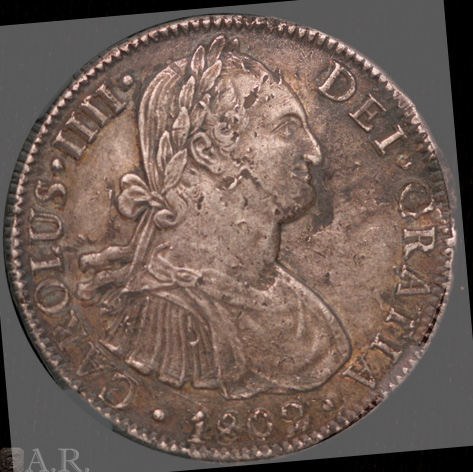 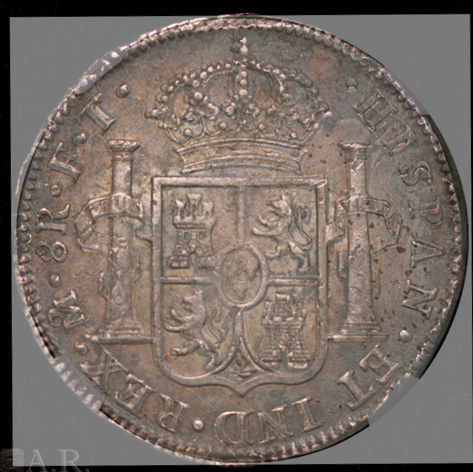 |
|
Pillar of the Community
United States
1801 Posts |
Or the NGC coin was also a Boston Style counterfeit. Remember, not everyone in the "Spanish Colonial" Coin World agrees with Swamperbobs carefully researched conclusions. I believe many of these coins that were high grade may have been encapsulated as real and accepted by the TGP services. |
|
Valued Member
United States
115 Posts |
I must admit that I when I purchased the coin, I did not feel 100% confident about its authenticity as its patination and strike would be highly unusual for an example "typically" identified as genuine.
I continue to have admiration for the remarkable technical quality of many Spanish colonial coins and the degree to which they represented highly advanced technology of the 18th century. These coins must have had a very high degree of security against contemporary fraud. In the 19th century as technology trickled down and silver bullion declined in value, the balances turned toward the counterfeiters. I eagerly await the opportunity to see a collected (and augmented) presentation of the information Swamperbob has presented here. Hope it may happen soon!
Edited by rexvictor
09/26/2011 7:10 pm
|
|
Valued Member
United States
426 Posts |
Good luck with whatever you decide to do.
I purchased a 1797 8 Reales earlier this year which might also be a "Boston Style Counterfeit".
I personally decided to keep mine because it is not a counterfeit in the traditional sense of the word. These were struck for trade just as the originals were and they have the proper weight and finesse not to mention the correct design.
The only difference being "when" they were struck.
I consider them similar to the Maria Therese dollars.
|
|
Pillar of the Community
United States
5362 Posts |
A master forger is of course a possibility but so is an encapsulated forgery.
I know that when I personally spoke with the head grader at ANACS, I was told they "do not routinely look at the edges of the coins they are grading".
Therefore, since the graders do not actually look at the edges of coins they are grading, how would they be able to detect a forgery that is ONLY detected because of an edge application error?
I suspect that a GREAT NUMBER of "Boston Type" 8 Reales have already been encapsulated and that one of the biggest roadblocks I will face is an unwillingness on the part of the "experts" to admit that they can be fooled.
|
|
Pillar of the Community
United States
5362 Posts |
I Just did my own side by side comparison.
Did anyone notice that the Damage on both coins includes some IDENTICAL DAMAGE?
For instance place both portraits together and look at the odd shaped dent (J) in the field in front of the Kings face. Also the scrape along the jaw line is the same, as is the damage behind the head of the King and the ding on his armour.
NGC has clearly encapsulated a forgery. Great discovery.
Do you know who owns the encapsulated version. It would make a simply fantastic pair coupled with your coin.
|
|
Valued Member
United States
115 Posts |
Hi Swamperbob, I'm glad you liked the overlays. They were done at 50% opacity, however the dark toning on the "Boston" coin and the bright surfaces on the NGC may have led to a misleading final image. I'm posting the original pics of the NGC coin. Unfortunately I was unable to locate the URL. 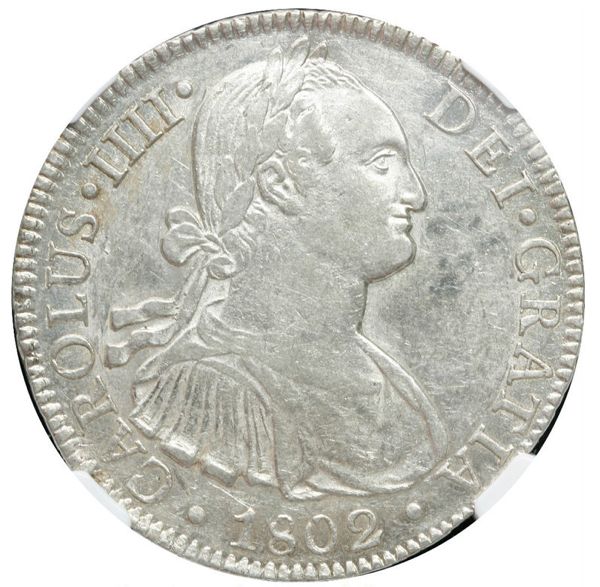 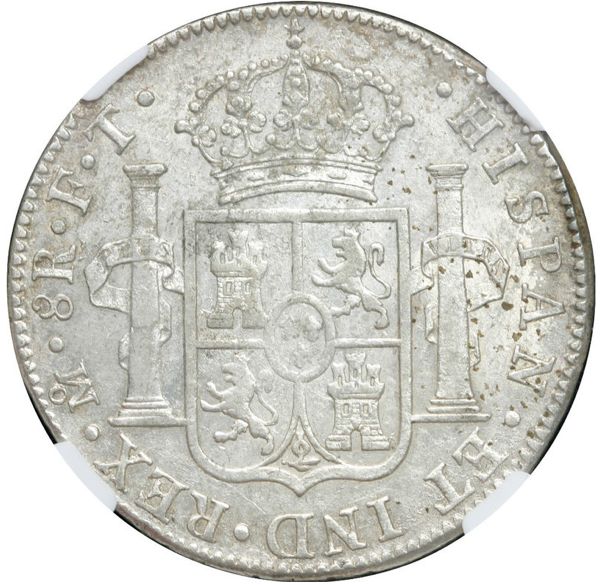 |
|
Pillar of the Community
United States
5362 Posts |
I was not aware you could do such an overlay - shows how OLD I am. I was not raised with computers. I graduated from college about the time the first hand held calculators from Texas Instruments came out. We had one kid in 4th semester Structural design that had one (the rich kid in class) and the professor went nuts when he brought it to the finals. Now I understand they are mandatory in the same situation because no one does the calculations by hand anymore.
Looking again at the overlay picture - I now see that the punch elements are the same - but the spacing varies just a bit proving that two dies are involved. So I now see what you mean. You can ignore my earlier comments.
But one caution, you need to know more about the story behind die production that I was told about years ago. The Boston dies were at one time produced EXACTLY like the originals with a King punch and die arrangement. They made multiple dies with the same punches so there would be die variation as expected and also because they were operating like a mint and dies wore out. The dies were shipped in from somewhere (that is one element I have not been able to discover is the die maker). Period (1890's) letters that have recently come to my attention lead me to believe the US Government was involved (or at least viewed the undertaking with a blind eye) - so it is not a long stretch to postulate that the US mint iteslf could have been involved. That is speculation based on a statement in one letter from a US Senator to a lawyer - but it fits the pattern that this was a quasi official but "secret" production facility.
It has been proved beyond any doubt that the US mint did attempt to open an "official" mint in California to make restrike Portrait Dollars using US silver in the early 1870 era. This was only abandoned when the Mexican government demanded a 15% royalty. But the need to trade with China and the preference on the part of the Chinese for "Bustman" dollars did not go away.
In any event - I have also been told in correspondence with another researcher that the dies were produced from punches copied from real coins. This technique is documented elsewhere and is a well documented procedure used by forgers for a century or longer. It involves copying each element (letter, portrait etc.) on the coin separately and making a punch set. The process used is virtually identical to using a punch block similar to what the real mints used. It makes complete sense to do so before newer technologies came into being.
The other story which I heard from the old forger that started all of this research back in 1960 - was that they also used a 1 to 1 pantographic lathe to duplicate dies. This story conflicts with his other statements about punched the dies. But they could have had two die sources - over time. This theory makes more sense to me since it uses technology that is known to have existed at the time he was involved (1920's and 1930's). The apparatus (lathe) used would be similar to the machine that Francis Henning built ON HIS OWN in the late 1940's or early 1950's to make his famous nickel counterfeits. To me it makes complete sense to think that in the 1880's dies would have been punched but that by the 1920's a die could be lathed quicker and less expensively. The Boston type forgery did occur over a period of about 50 years so advances in technology would have been employed.
My real wish is that someone at the time had documented exactly what was being done and that I could find that document. But that is very wishful thinking since the enterprise was not 100% on the "up and up". But I keep searching archives for clues. It is a very interesting detective story.
|
|
Page 2 of 2
|
Replies: 22 / Views: 6,163 |
Page 2 of 2
|






 First Page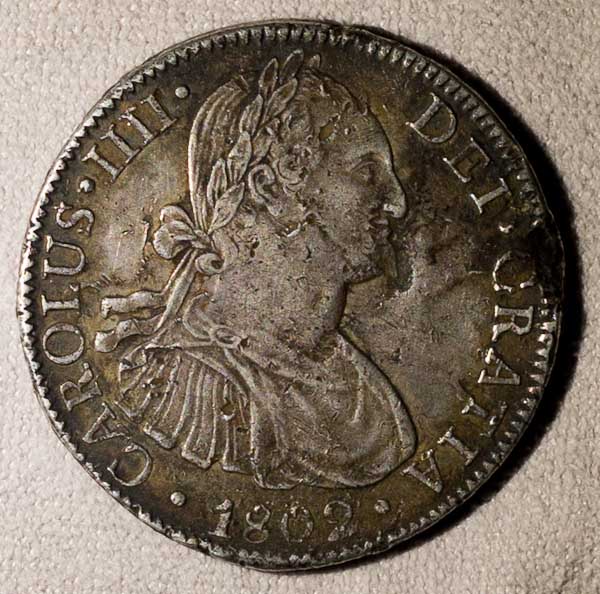


 Posted 09/24/2011 8:58 pm


