Today we take a look at one of the more infamous coins of the classic commemorative series, the 1936 half-dollar commemorating the golden anniversary of Cincinnati as a "center of music." The coin is presented via an example in PCGS MS-65.
While it is not alone in the category of "Questionable" US commemorative coins, the Cincinnati might possibly be #1 in terms of being the biggest stretch to establish a link to an event to commemorate. The issues start with the use of songwriter Stephen Foster as the primary obverse design element. Mr. Foster came to be known as the "Father of American music" due to the large number of popular songs he wrote between the mid-1840s and his death in 1864. A number of his songs are still known today; they include "Oh! Susanna", "Old Folks at Home" (aka "Swanee River") and "Beautiful Dreamer". His being featured on a commemorative coin could certainly be justified under the proper circumstances. The problem is, Stephen Foster has somewhat of a tenuous tie to Cincinnati. He was born in Pittsburgh, Pennsylvania and lived most of his life either there or in New York City and spent only about three years in Cincinnati. While his time there did produce a number of songs, including "Oh! Susanna", Stephen spent his days working as a bookkeeper in his brother's office and was not a significant part of whatever "music scene" there was in Cincinnati in the mid-1840s.
Read More: Commems CollectionAs far as 1936 being the 50th anniversary of Cincinnati becoming a "center of music," the facts don't back it up. It's not that Cincinnati doesn't have a place in US musical history, it does. For example, its annual May Festival (a choral music festival) is known around the world and has played host to acclaimed US and international musicians and conductors. The Festival was launched in 1873 to "transform the musical tastes of America and, at the same time, enhance Cincinnati's image and national reputation." (www.mayfestival.com) Cincinnati also has one of the oldest symphony orchestras in the US -- the Cincinnati Symphony Orchestra is fifth oldest -- which shares some common history with the May Festival. And so while Cincinnati has a long history of musical excellence, none of it actually started or became noteworthy in 1886 -- it all began a decade or more earlier.
So, how did a coin get issued with such dubious historical dates/facts behind it? And with a primary portrait of someone only tenuously linked to Cincinnati? Chalk it up to the political lobbying of the Cincinnati Musical Center Commemorative Coin Association and its Treasurer the prominent businessman and coin collector Thomas G. Melish. Melish was also involved in the sponsorship and distribution of the 1936 Cleveland Centennial half-dollar. Though the Coin Association was ultimately a sham organization that acted only as a coin distributor and not as anything that supported music in Cincinnati, at least the coins were distributed in a reasonable manner.
As with almost all of the commemoratives, I could go on and on with the story behind the coin, but this post has gotten fairly long already. I'll bring it to a close by noting that 5,000 of the coins were struck at each of the three mints (P, D, S) for a total net type mintage of 15,000. The coin was designed by Constance Ortmayer.
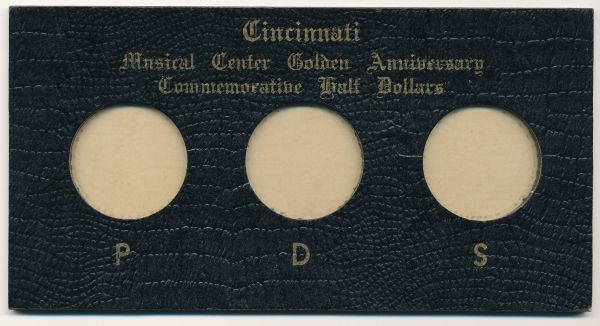
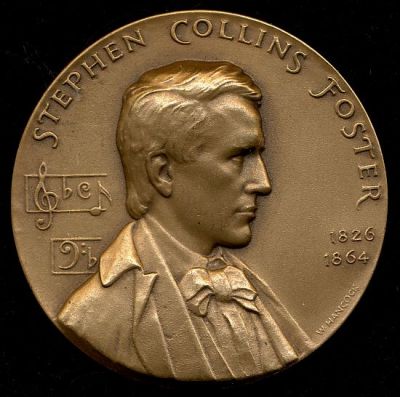
In addition to the brilliant, flashy coin, I've also included an image of one of the holders used to mail the coins to collectors at the time of issue. I also added obverse and reverse images of the Stephen Foster medal from the Hall of Fame for Great Americans series.
Enjoy!
1936 Cincinnati Music Center - Obverse 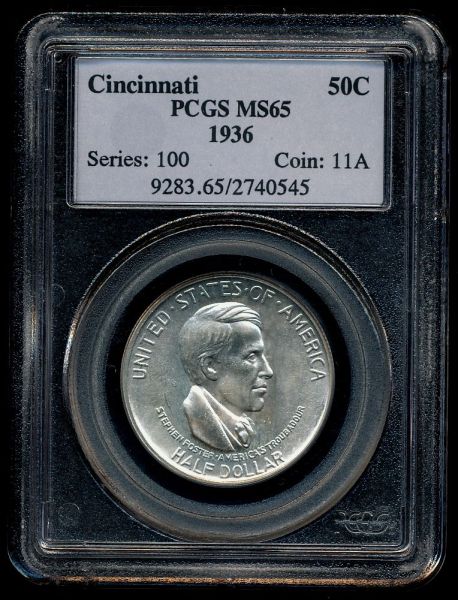 1936 Cincinnati Music Center - Reverse
 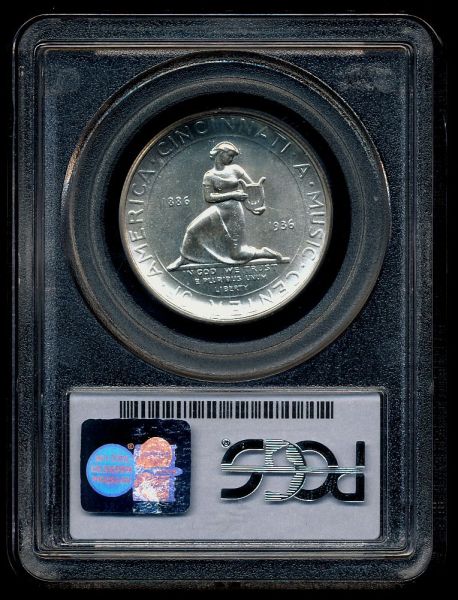 1936 Cincinnati Music Center -- Original Holder/Mailer
  Hall of Fame Medal - Obverse
 Hall of Fame Medal - Reverse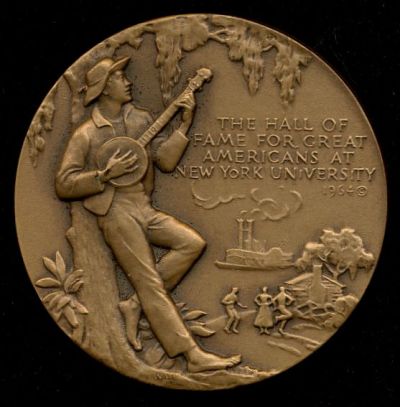





 Posted 04/17/2012 10:58 pm





