Today we look at the Oregon Trail Memorial half-dollar, a coin struck to honor the early pioneers who explored and settled the US western frontier. The coin is represented here by an example in PCGS MS-65.
The Oregon Trail half-dollar is a perennial favorite among US commemorative coin collectors, with frequent billing as the "most beautiful" coin of the classic series. It is little wonder that the coin's design was so well received, as it was entrusted to two of the most prominent artists of the day -- the husband and wife team of
James Earle Fraser (obverse) and
Laura Gardin Fraser (reverse). Historical footnote: Noted artist/sculptor Chester Beach was actually the first artist chosen to design the coin, but was not able to execute his initial design thoughts due to other commitments.
Read More: Commems CollectionThe obverse of the coin depicts a family in a Conestoga wagon making its way west for a new life. The reverse depicts a symbolic Native American looking east with an outstretched arm and upward extended hand seeming to indicate "Stop!" to approaching settlers. It is interesting to note that while the wagon side is officially considered the obverse, it is the standing Native American side that is typically viewed as the obverse by today's collectors (and third-party grading companies!).
The Oregon was issued in multiple (but not all) years between 1926 and 1939. It was struck at all three US mints over its course, though not necessarily in all three mints in a given year. One note: the 1933 coins struck at Denver were the first commemorative coins struck there. I'll leave it to the reader to review a "
Red Book" or other commemorative coin reference to see all of the various date/mint combinations. Its multi-year run ultimately positioned it as one of the primary examples for Congress of how commemorative coins were abusing the
US coinage system and was thus a primary driver behind Congress passing a bill in 1939 that imposed limitations on US commemorative coins and put a stop to such long-running commemorative series as the Arkansas, Boone, Oregon and Texas.
The Oregon Trail Memorial Association initially attempted to differentiate each of it annual issues by assigning a historical name tag to each year. The 1926 issue came to be referred to as the "Ezra Meeker" coin, the 1928 issue was referred to as the "Jedediah Smith" coin, the 1933 as the "Century of Progress" coin, the 1934 release as the "Fort Hall, Fort Laramie, Jason Lee Centennial" coin and the 1936 issue as the "Whitman Mission" coin. The practice stopped after 1936, with neither the 1937 nor 1938 coins being tagged with a historical reference. From looking at contemporary advertisements for the Oregon Trail coins, it does not appear that the historical name tags ever achieved any sort of traction among coin dealers -- the coins were typically just listed by date in their advertisements.
The example presented is a brilliant first-year-of-issue coin that has wonderful luster and a very attractive overall aesthetic (IMHO!). I know that it would be about the easiest coin in my collection to upgrade, but I like this coin and never think to look for an upgrade to it while at coin shows -- maybe it's the nearly 45 degree rotation of the reverse (obverse?) that keeps it interesting for me! (Hope the wagon has a good braking system!)
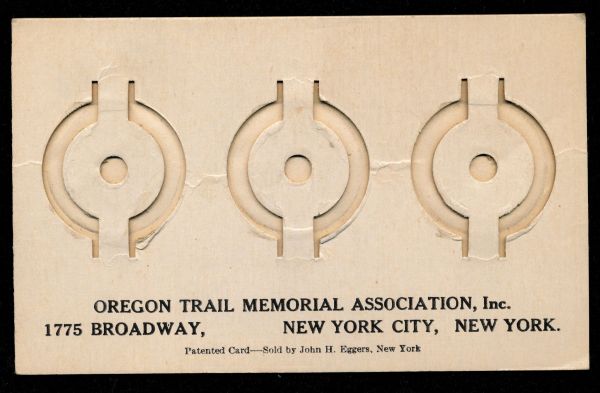
I've also included an example of the original holder for the coin along with its mailing envelope; both are in very nice shape.
Enjoy!
1926 Oregon Trail Memorial -- Obverse (?)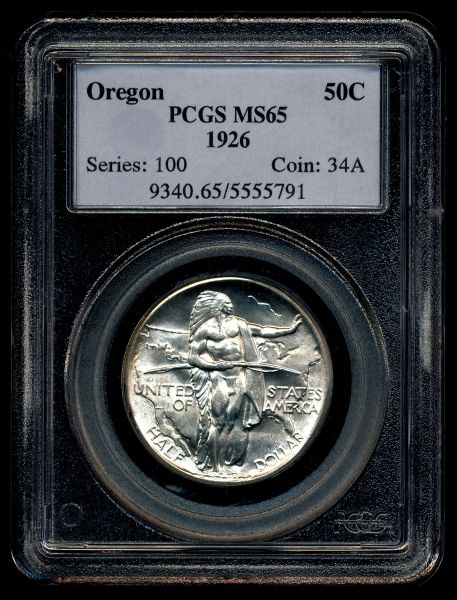 1926 Oregon Trail Memorial -- Reverse (?)
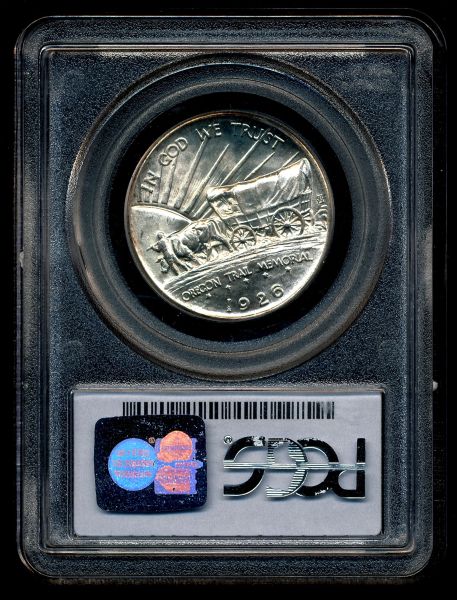 Oregon Trail Memorial Coin -- Original Holder
 Oregon Trail Memorial Coin -- Mailing Envelope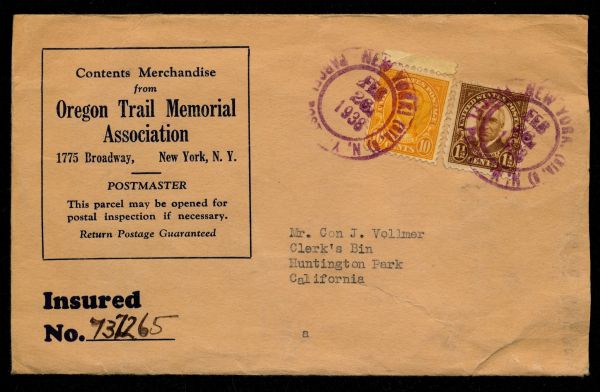
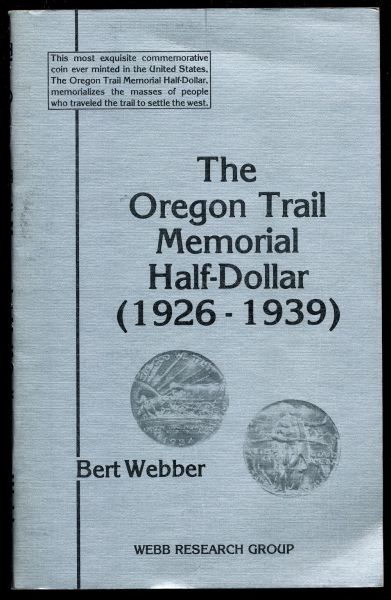
For those with a strong interest in the Oregon Trail Memorial half-dollar, the following booklet written by Bert Webber (1986) might be of interest.










 Posted 04/29/2012 5:17 pm


 . I own eight examples but still want to acquire the full sub set, yours is a beautiful example.


