During the first term of his presidency, Franklin D. Roosevelt signed into law no fewer than 25 different commemorative coin bills -- more than any other US President before or since. Early in his second term, however, he echoed the concerns of his predecessor (Herbert Hoover) regarding the number of proposed commemorative coins being introduced in Congress and took the formal action of vetoing a commemorative coin bill that came before him in June 1938.
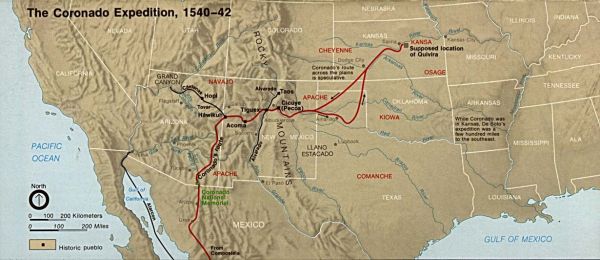
Roosevelt chose to "put his foot down" in 1938 and withheld his approval on a bill that would have issued a half-dollar to mark the 400th anniversary of the expeditions of the Spanish conquistador Francisco Vasquez de Coronado in the American Southwest; Coronado was based in New Spain (now Mexico) at the time. (See below for a public domain map image of Coronado's possible routes.) The bill, HR 2734, would have authorized a maximum of 100,000 1940-dated half-dollars to be struck at one US mint; the Coronado Cuarto Centennial Corporation was to be the sponsor/beneficiary of the new coins. In his veto letter to Congress, Roosevelt proposed that commemorative medals be struck for the anniversary event instead of half-dollar coins. Roosevelt's 1938 veto was only the second veto of a commemorative coin approved by Congress.
Noted numismatist Michael Turrini, has put forth the possibility that Roosevelt's approval of so many commemorative coin bills during his first term may have been politically driven -- he may have exchanged coin passage for support of his many New Deal initiatives. While such quid pro quo activities have never been proven, his conjecture makes for an interesting possibility and one that certainly seems plausible considering the backroom political deals for which Washington is famous.
While Coronado's expedition failed at its ultimate goal -- conquering, in the name of Spain, Native American cities that were rumored (erroneously) to contain vast wealth -- his written accounts of what he encountered while traveling through parts of what are now Arizona, New Mexico, Texas, Oklahoma and Kansas did provide the first descriptions of this rich and diverse region as seen through the eyes of a European.
Was Coronado's expedition worthy of a commemorative half-dollar? Not sure, but I can certainly argue that it was more of a historical milestone for our country than the founding of several small- to medium-sized cities in the eastern US!







 Posted 06/12/2012 6:09 pm





