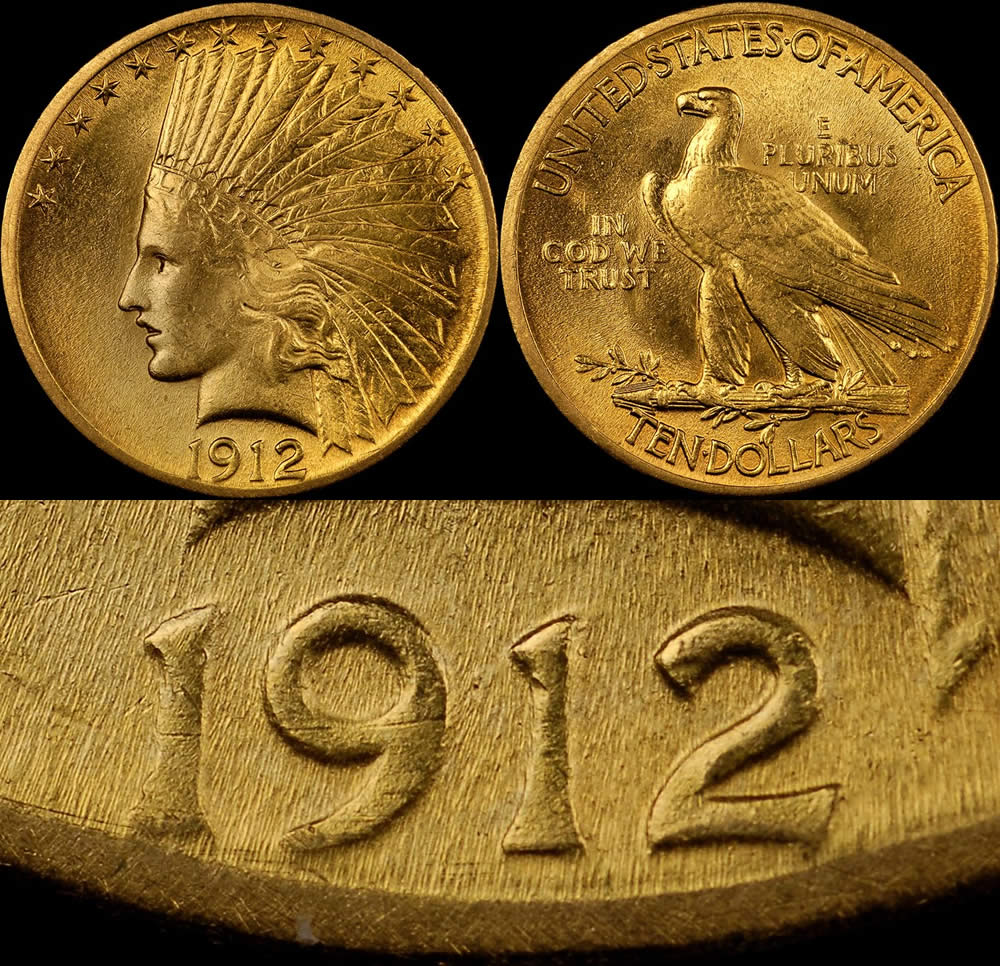
NGC - The raised spikes at the rim of this 1912 $10 Indian Head Eagle are one indication that it is a counterfeit.
Read More: Counterfeit Detection SeriesIt is no surprise that United States gold coins have long been the target of counterfeiters. A wave of deceptive forgeries appeared in the marketplace in the 1960s and 70s, and many of these continue to be encountered by dealers, collectors and NGC. These spurious pieces were often well struck and made from the correct gold alloy, which can make them particularly deceptive.
Although China is believed to be the source of most of the fakes from the last decade or two, in the 1960s and 70s the Middle East was the primary manufacturer—at least of gold coins. Middle Eastern merchants preferred gold coins as a store of value and as long as the weight and composition were correct, they were not particularly concerned whether the coin was authentic or not.
Many of these counterfeit gold coins ended up in the United States, where they found their way into collections of the era. There is a theory that some people knowingly purchased these fakes because at the time Americans were prohibited to own gold except for certain collectible coins. (The ban on private gold ownership lasted from 1933 until 1974.) Those people who wanted to own gold had limited options and, much like the Middle Eastern merchants of the era, were less concerned about authenticity than they were about gold content.
This 1912 Indian Head Eagle is a prime example of one of these 35-50 year old forgeries. It has the correct composition and the correct weight. It is well struck with sharp details and mostly smooth fields. There are, however, raised lumps between stars 12 and 13, which are usually telltale signs of a fake. Raised spikes, another diagnostic, are seen at the rim in several places and, most prominently, to the left of the L in LIBERTY. Finally, there are tiny patches of tool marks, such as above the IB in PLURIBUS, where the counterfeiter tried to touch up the dies.
Gold coin forgeries like this one are seen regularly when older collections come to market and can be quite challenging. Thankfully they still have some intrinsic gold value, which usually tempers the loss, but there is no numismatic premium. Of course, any coin worth as much as a gold eagle should be carefully evaluated and only purchased if its authenticity is an absolute certainty.











 Posted 02/18/2015 2:18 pm


