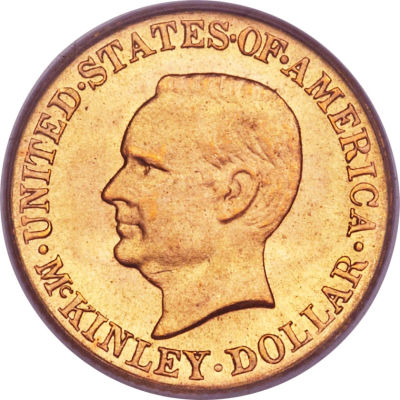
On February 20, 1915, during the third session of the 63rd Congress, Representative William Albert Ashbrook (D-OH) introduced a bill calling for "a McKinley souvenir silver dollar, in commemoration of the erection of a memorial to William McKinley, late President of the United States."
McKinley, the 25th US President, was shot in Buffalo, New York on September 6, 1901 while attending the 1901 Pan-American Exposition; the Exposition was staged to promote trade between the US and the countries of South and Central America. McKinley was standing in the receiving line shaking hands during a reception in the Exposition's "Temple of Music" when he was approached by self-proclaimed anarchist Leon Czolgosz. McKinley was shot twice - one bullet struck his sternum and caused only a superficial wound, the other entered his abdomen.
McKinley was rushed into surgery in an operating room on the Exposition grounds. Even though the bullet in his abdomen was not located, the President appeared to be recovering in the days that followed. On September 13th, however, McKinley's condition began to worsen and he died in the early hours on the 14th. He died as a result of his blood being poisoned by the gangrene that was growing in his stomach. Vice President Theodore Roosevelt succeeded him.
Czolgosz's trial was brief. It opened on September 23rd and was concluded the following day with a "Guilty" verdict; he was sentenced to death. His sentence was carried out, via the electric chair on October 29th, less than two months after he fired his deadly shots.
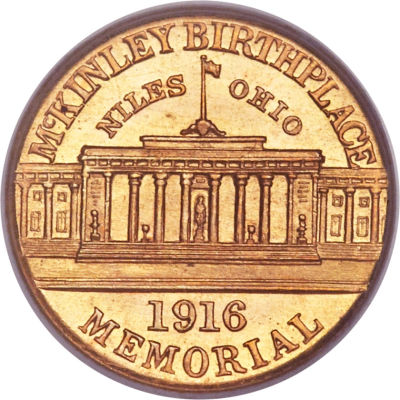
Ashbrook's bill called for the minting of up to 100,000 silver dollars of standard specification for the National McKinley Birthplace Memorial Association. Several years before, in 1911, President William Howard Taft signed into law the Act that incorporated the Birthplace Association in the District of Columbia. It was formed to "perpetuate the name and achievements" of McKinley and to erect a memorial to him in his hometown of Niles, Ohio. It soon began a successful, multi-faceted campaign to raise the necessary funds.
The coin bill stated that the net proceeds from sales of the souvenir dollar were to go to "aiding in defraying the cost of completing in a suitable manner the work of erecting a memorial in the city of Niles, Ohio, to William McKinley."
The bill was referred to the Committee on Coinage, Weights, and Measures but did not get reported out. A mitigating factor in the lack of action on the bill was the fact that Congress was about to adjourn.
The bill was re-introduced during the following Congress, in December 1915. It was also referred to Committee but enjoyed a much different outcome vs. the previous bill. During its consideration of the coinage proposal, the Committee decided to change the bill's wording by replacing "silver" with "gold." It reported the bill out to the full House where it was passed after minimal discussion. The Senate also passed the bill without objection and President Woodrow Wilson signed the bill into law on February 23, 1916.
And that's how you turn silver into gold!
 Read More: Commems Collection






 Posted 02/28/2016 12:31 am





