I've previously shared a few thoughts about the 1928 Hawaiian here
Hawaiian Revisted and here
Original Hawaiian Post.
Today, I thought I'd share a story about an auction that is a unique piece of US commemorative history.
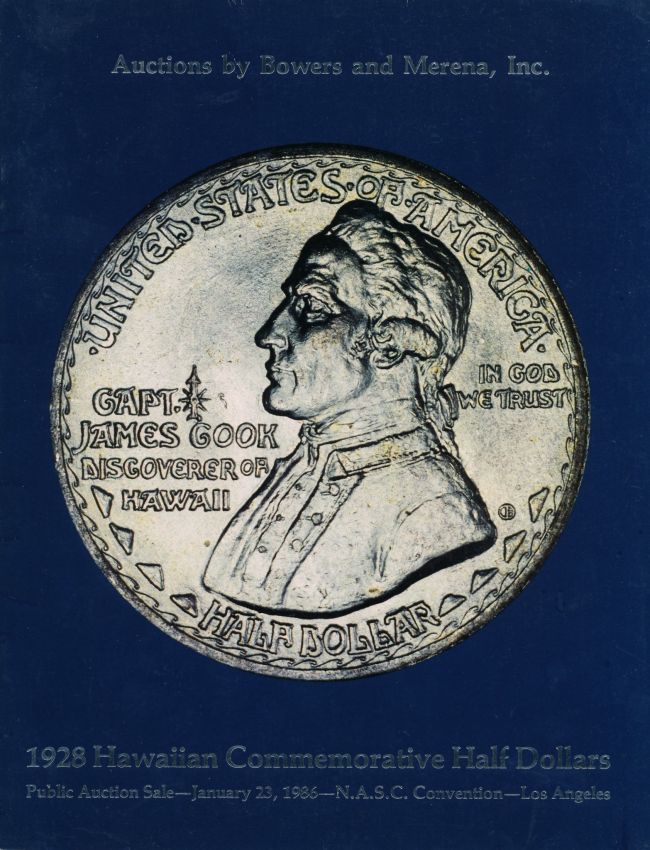
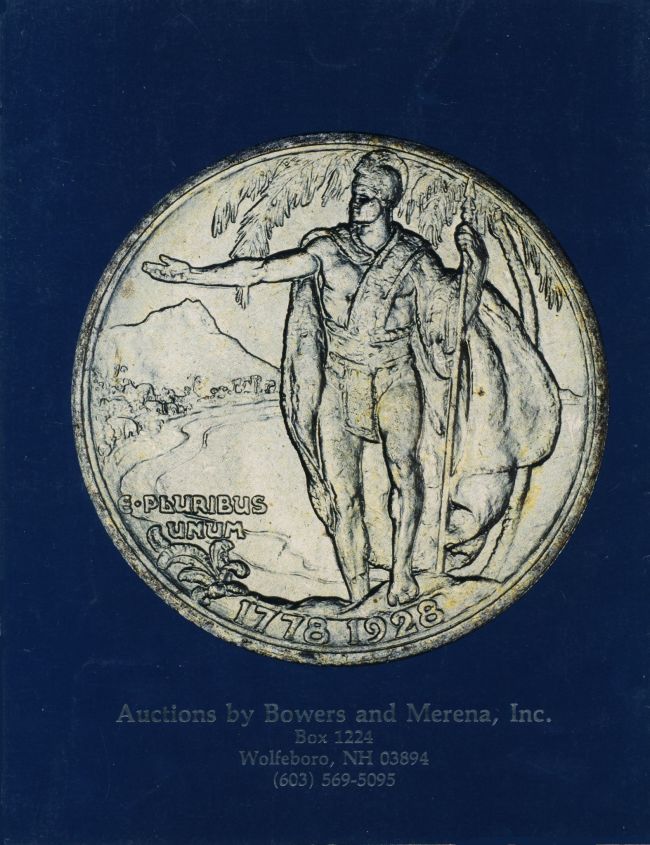
On January 23, 1986, as part of the Numismatic Association of Southern California (NASC) Convention in Los Angeles, Bowers and Merena, Inc. held a special auction comprised of 137 lots of the 1928 Hawaiian commemorative half dollar. All of the coins were consigned by the Bank of Hawaii, Ltd. which had been storing them in their vault since 1928! The Bank of Hawaii was the official agent for the coins in 1928; it handled their distribution on behalf of the Cook Sesquicentennial Commission of Hawaii.
Read More: Commems CollectionA few words about the Hawaiian commemorative.
The coins were authorized on March 7, 1928 via Public Law 77-98. They were issued to commemorate "the 150th anniversary of the
discovery [emphasis added] of the Hawaiian Islands by Captain James Cook and to help fund the creation of a Captain James Cook memorial collection in the archives of the Territory of Hawaii."
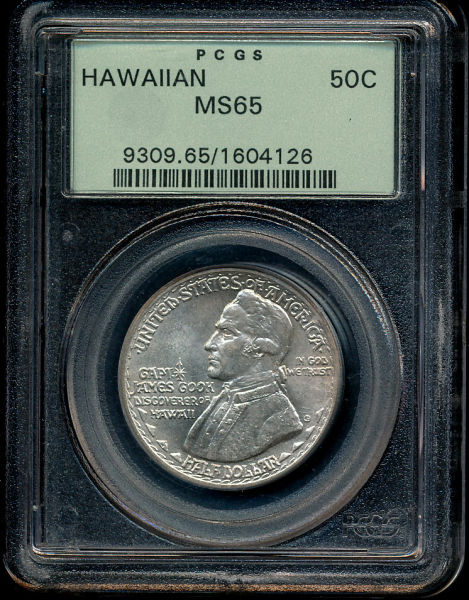
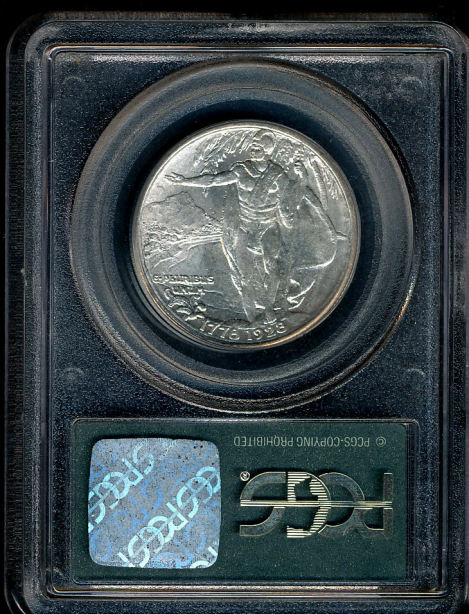
Chester Beach sculpted the models for the coin from drawings created by Juliette May Fraser, a Honolulu artist. The obverse of the coin is dominated by a left-facing (westward-facing) portrait of Captain Cook. A Hawaiian warrior chief adorns the reverse. He is shown looking out over a part of the Hawaiian shoreline with an outstretched right hand indicating "Welcome!" In his left hand he is holding a spear -- maybe the "Welcome!" is conditional?
Net mintage for the coin was 10,000 (including 50 sand-blasted proofs). It is considered one of the keys to the classic US commemorative set and its market price across all grade levels generally reflects this.
The coins originally sold for $2.00 each with a limit of five (5) per person/company. Coin orders were to be sent to the Bank of Hawaii for processing.
And now back to the auction.
The sale was eagerly anticipated by the collecting community, as the large number of high-grade pieces to be offered in one auction was never before seen and the link of the coins back to the original agent for the coins made the event unprecedented. The auction also excited collectors because of the incredible number of gem condition examples that were to be offered.
Gem examples of the coin definitely led the way in the auction, as lots 1 through 74 (54% of the total coins to be sold!) were listed with a grade of MS-65. The grades for lots 75 through 82 were listed as MS-63/65; the split grade indicating coins exhibiting "gem" reverses with "choice" obverses. The next 42 coins, lots 83 to 124, were graded "MS-63 to MS-65" (today's MS-64?). The remaining 13 coins ranged from MS-63 to AU-50. Lots 134 and 135 were listed as "MS63 to MS-65" but with a planchet defect noted on each.
The overall average selling price of the coins was $2,107 including the 10% "buyer's charge." For the MS-65 coins, the average selling price was $2,354. The first five coins had an average selling price of $3,498 while coins numbered 6 through 74 saw an average of $2,271. With only the auction catalog and prices realized list (PRL) to review, it's difficult for me to state definitively why the first five coins went for so much more. It's certainly possible that they were the superior coins of the auction and thus commanded appropriate attention from the bidders. The catalog descriptions of these initial lots does provide some indication of their quality. The phrase "Surfaces close to perfection" was used to describe three of the first five coins.
Unfortunately, the coins are all pictured in black-and-white in the auction catalog and, with one exception, are all presented in actual size. So, the coin images do not offer any clear-cut answers on the relative "gem-i-ness" of the individual coins.
In general, the prices realized were below the "Bid" prices published in the Coin Dealer Newsletter ("Greysheet") at the time. For example, in early 1986, MS-65 coins were listed at prices in excess of $4,000. So, it appears while collectors were excited by the sale, the sheer volume of coins available at one time resulted in some true "bargains" for many successful bidders.
I've always wondered if my Hawaiian might have come from this sale. None of the coins in the sale were third-party graded at the time of the sale, so it's always possible that one of its gem coins later found its way into a green PCGS holder and then into my collection. Not likely, of course, but you never know!
If you enjoy the 1928 Hawaiian half dollar and are looking for a comprehensive history of the coin (or if you just enjoy reading US commemorative coin history), I would suggest looking for a copy of the auction catalog at your favorite numismatic literature dealer or even on
ebay. They are not very expensive and offer great coverage of the history of the coin and the Bank of Hawaii.










 Posted 10/03/2016 1:58 pm


