|
This page may contain links that result in small commissions to keep this free site up and running.

Welcome Guest! Registering and/or logging in will remove the anchor (bottom) ads. It's Free!
To participate in the forum you must log in or register. | Author |
 Replies: 6 / Views: 2,243 Replies: 6 / Views: 2,243 |
|
|
Pillar of the Community
United States
772 Posts |
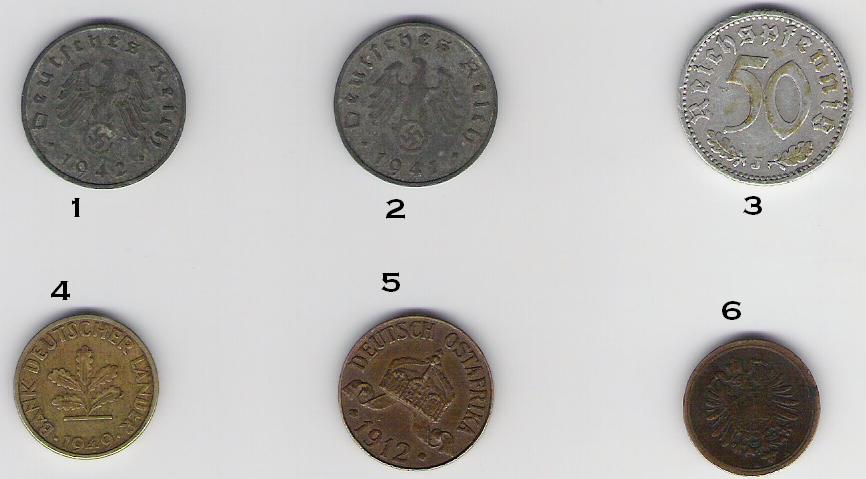
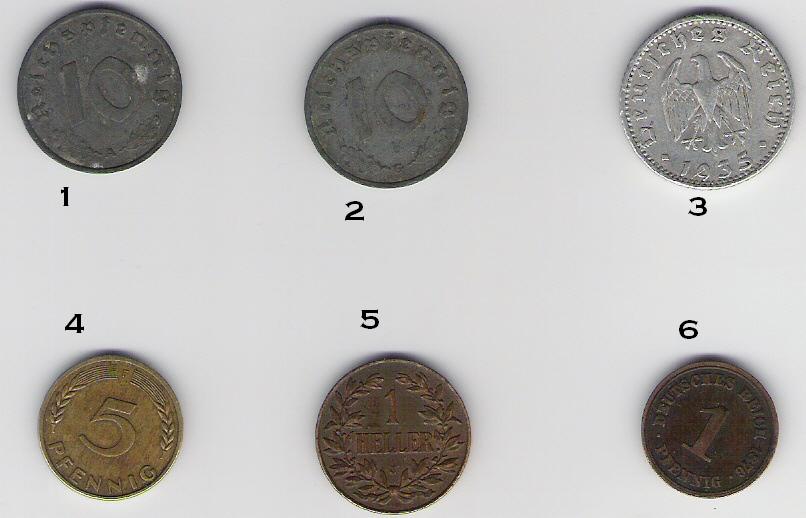
Image:  for-cns.jpg for-cns.jpg44.01 KB Image: for-cns2.jpg44.12 KB Hello. I just picked up this handful of coins and wondering if anyone could help me out with them. I do not really know anything about foreign coins, so any info would be great. #1 is a 1942 10 Pfennig, assumed to be German. It has an eagle over a swastika on the back. #2 is the same, except 1941 #3 is a 1935 50 Pfennig. This is a very light coin. I had to do a drop test to make sure it was metal. This coin has the same eagle, but no swastika. I believe that the Nazis did not adopt the swastika until that year, so it was not on their coin. #4 is pretty visible, so use the pics. #5 1912 1 Heller? #6 1876 1 Pfennig, with an eagle behind a shield. It looks like the shield has the same eagle on it. So if anyone could tell me if these are worth anything... What was their approximate value to USD? Thanks for your help! Jordan
|
|
|
|
Pillar of the Community
Australia
3841 Posts |
1. German 1942 10 pfennig (zinc)
2. Same as number 1 (different year)
3. Also german, 50 pfennig (probably silver)
4. German 10 pfennig, Mintmark F
5. Austria 1912 1 heller
6. Also German, First Reich 1876, 1 pfennig.
(hopefully I haven't got this wrong)
I believe you might be able to pick those out from your dealer's 10 cent-a-piece box. So they aren't worth too much unfortunately.
The 3th, 5th and 6th might be worth more than 1 dollar but I will let others say.
|
|
Pillar of the Community
 United States
772 Posts |
gxseries, Thank you for your reply.
The 50 Pfennig, could it be aluminum? Did they ever make coins out of aluminum?
It is extremely light. The 1876 (smallest) coin probably weighs more than this one does.
|
|
Valued Member
United States
230 Posts |
First off, yes, the 50 pfennig is aluminum. Germany used aluminum in several coins during the early 1900's, including the 1 pfennig from 1917-1918 (end of the Empire issues), also some 3-mark coins of the Weimar Republic and the Third Reich.
Secondly, #5 is not from Austria, but from German East Africa (Tanganyika), after WWII, it became a British mandate, using the coinage of East Africa (along with Kenya and Uganda), later united with the island of Zanzibar, taking the name TANZANIA (TAN from Tanganyika, ZAN from Zanzibar) . There should be a "J" mintmark on the reverse (from the Hamburg mint). It is listed as KM#7, with a mintage of just over 7 million. F=$0.75, VF=$1.50, XF=$4.00, UNC=$20.00.
|
|
Pillar of the Community
United States
772 Posts |
Thanks kuhli, that was some great info.
|
|
Pillar of the Community
Australia
1079 Posts |
jdheyne does that mean you like to collect german coins?
Interesting point is that the coins you have may not be worth a hell of a lot but they do span through both world wars.
|
|
Pillar of the Community
United States
772 Posts |
KLD,
These were the first non-canadian foreign coins I have had.
I am not a big foreign collector... mainly American.
But I do really enjoy the history of coins and may eventually shift my focus.
Jordan
|
| |
Replies: 6 / Views: 2,243 |
|
To participate in the forum you must log in or register.
 
- Liberty Head 10/11 Stars Obverse With A Sick Looking Eagle On The Reverse Holed 0.59g 13.06mm
- The Tyrant Collector - PCGS Youtube Interview
- Counterfeit Detection: ANA Video - Introduction, With Brian Silliman And Jim Robinson Ep. 1
- Counterfeit Detection: ANA Video - Mistakes, Risk Factors, And Counterfeits & Alterations, Ep. 2
- Counterfeit Detection: ANA Video - Pimples And Pits, Looking At Cast Counterfeits, Ep. 4
- Counterfeit Detection: ANA Video - What Year Is That Cent? Key Date Coins, Ep. 5
- Counterfeit Detection: ANA Video - Diagnostics Of The 3, 5, And 10 Cent Coins, Ep. 6
- Counterfeit Detection: ANA Video, Counterfeit Quarter Dollar Diagnostics, Ep. 7
- Counterfeit Detection: ANA Video, Counterfeit Classic Commemorative Coins Diagnostics, Ep. 8
- Counterfeit Detection: ANA Video, Counterfeit Silver Dollar Diagnostics, Ep. 9
- Counterfeit Detectection: ANA Video, Classic US Gold Coin Diagnostics, Ep. 10
- Counterfeit Detection: ANA Video, Diagnostics Of Chinese Made Counterfeits Of US Coins, Ep. 11
- Counterfeit Detection: ANA Video - Wrap Up Recap With Brian Silliman And Jim Robinson Ep. 12
- 2026-P Jefferson Nickel Possible Die Chips, Die Cracks And Other Anomalies
- Commems Collection Modern: What If? 1993 Bill Of Rights Circulating Coinage - A 1990 Attempt
- Split Grading - An Idea That Would Drive Collectors Mad
- 1960 D Lincoln Memorial Cent (Small Date) BIE
- Is This 1888-S A VAM-10, 10A Or Something Else?
- 1994 Brazil 10 Centavo - With Die Clash
- US 1 Cent 1856 Altered From 1858?
Disclaimer: While a tremendous amount of effort goes into ensuring the accuracy of the information contained in this site, Coin Community assumes no liability for errors. Copyright 2005 - 2026 Coin Community Family- all rights reserved worldwide. Use of any images or content on this website without prior written permission of Coin Community or the original lender is strictly prohibited.
Contact Us | Advertise Here | Privacy Policy / Terms of Use
|
| Coin Community Forum |
© 2005 - 2026 Coin Community Forums |
| It took 0.36 seconds to rattle this change. |
 |
|
| |
| |





 for-cns.jpg
 for-cns2.jpg
 Posted 12/23/2005 09:02 am


