During the 1920s and 1930s, more than three dozen commemorative coin programs were approved by the US Congress and signed into law by various presidents. In addition, more than 100 unsuccessful coin proposals were introduced. Included among the various proposals were a number that featured a religious theme or a connection to a religious group.
In general, such proposals did not find favor within Congress; it did its best to keep Church and State separated on commemorative coinage. In this regard, it was most often but not totally successful. For example, the 1924 Huguenot-Walloon Tercentenary commemorative half dollar, struck to mark the 300th anniversary of the settling of New Netherland (i.e., portions of present-day New York, New Jersey, Pennsylvania, Connecticut and Delaware) by the Walloons and Huguenots in 1624 was driven by the Federal Council of the Churches of Christ in America. Upon its release there was a minor backlash over its religious underpinnings, but it did not develop into a major or long-lasting issue.
Read More: Commems CollectionAn example of an unsuccessful proposal is the one sponsored by the Wichita Mountain Easter Sunrise Service Association of Lawton, Oklahoma. The group sought a half dollar to help mark the founding of the Wichita Mountain Easter Sunrise Service (a passion play depicting the life of Jesus from birth through crucifixion and resurrection). The bill was introduced and referred to committee where it died for lack of action.
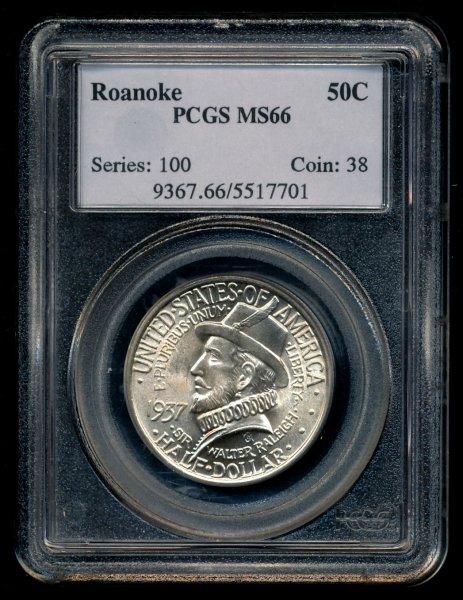
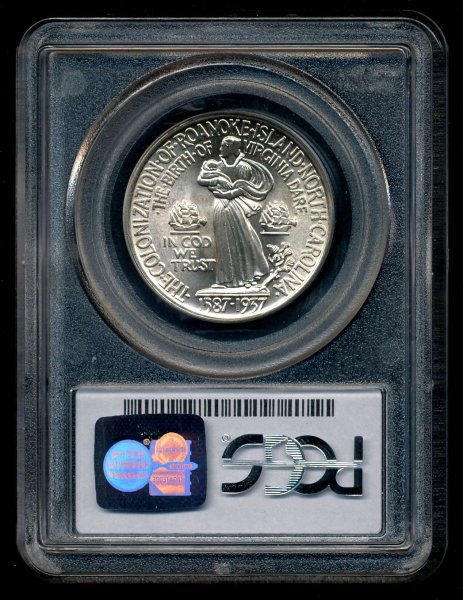
In May 1936, a bill calling for a commemorative coin to recognize the 350th anniversary of Sir Walter Raleigh's colony on Roanoke Island, NC was introduced by Representative Thomas Granville Burch (D-VA). The proposed coin was also meant to celebrate "the birth of Virginia Dare, the first child of English parentage to be born on the American continent, and her baptism."
Virginia Dare was born on August 18, 1587 and was baptized into the Church of England roughly a week later on August 24. She was the first child of English parents to be born and baptized in the New World; she was the second person overall to be baptized in the New World. Manteo, the Native American of the Croatan tribe who had befriended the English explorers and helped them survive, was the first person to be baptized in what would become America; he was baptized at the Roanoke colony on August 13, 1587, 11 days before Virginia.
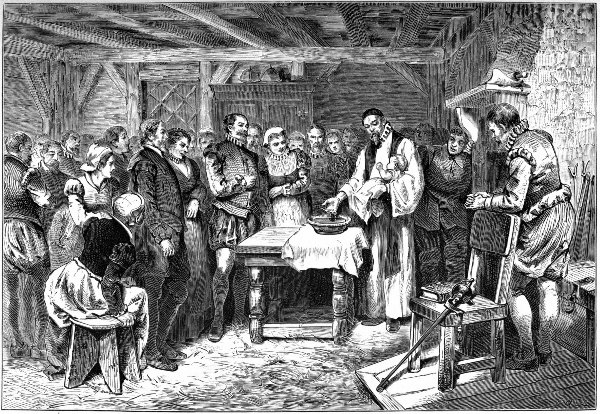 "Baptism of Virginia Dare"- 1876 Lithograph
Burch's bill, as written, was passed by the House via unanimous consent. It was then referred to the Senate Committee on Banking and Currency where discussion led to a proposed amendment that removed the phrase "and her baptism" from the bill. It was decided by Committee members that the phrase unnecessarily brought religion into the coinage proposal and that its removal would not change the core reasons for striking the coins - the establishment of Raleigh's colony and the birth of Virginia Dare.
The amended bill was reported out of committee, passed by the full Senate and sent back to the House. The revised bill met no strong challenges in the House and was soon passed. President Franklin Delano Roosevelt signed the bill into law on June 24, 1936, thus bringing to life the Roanoke Colony-Virginia Dare commemorative half dollar!
The removal of the reference to Virginia's baptism was never an issue with collectors of the day. In fact, I would suggest that the vast majority were completely unaware such phrasing was ever part of the coin's proposed legislation. The coin's sponsor, The Roanoke Colony Memorial Association, did not make an issue of it either, as they were more focused on getting the overall bill approved so they would get their desired coin and have another vehicle to help them raise funds for the anniversary celebrations. (I would estimate that 99.5% of today's collectors are also unaware of the wording of the original bill.)
Had the phrase regarding Virginia's baptism remained in the law authorizing the coin, it seems likely that some amount of public discourse over it would have taken place. In my opinion, however, it would have been relatively minor. The US was a different nation in the 1930s, with those identifying themselves as a follower of a Christian faith making up a much larger percentage of Americans than today. In my opinion, many reading the bill in 1937 would likely not have taken particular notice of the reference to Virginia's baptism.
And that's the story of how a Congressional committee intervened regarding the Roanoke half dollar in order to avoid having it be the subject of a potential religious controversy.







 Posted 08/18/2020 5:50 pm





