The bill authorizing the 1937 Battle of Antietam commemorative half dollar was signed into law by US President Franklin Delano Roosevelt on June 24, 1937; it was introduced in the Senate during the
First Session of the 75th Congress.
It's interesting to note, however, that a different (but same) bill was set to be authorized late in the
Second Session of the 74th Congress, but was essentially forgotten about by the House (due to an apparent clerical error) during the closing days of the session and was not acted upon before Congress adjourned. As a result, the bill died and needed to be re-introduced in order for the Antietam coin to become a reality.
Beginning at the beginning...
The first proposal for the Battle of Antietam half dollar occurred during the 74th Congress via a bill introduced in the Senate in late March 1936; a companion bill was introduced in the House a week later. The bills called for up to 5,000 coins to be struck.
Each of the bills proceeded to consideration in their respective chambers. The House bill was amended to set the maximum mintage at 25,000 and was subsequently passed. The Senate bill was set aside in favor of the companion House bill due to its prior passage. Before passing the House version of the bill, however, the Senate amended it to raise the mintage to 50,000 coins. The amended bill was then sent to the House for consideration, concurrence and final passage.
Unfortunately, though no objections to the Senate's increased mintage authorization were expected from the House, the amended bill was never considered by the House as it closed out its session. Congress adjourned on June 20, 1936 without passing the amended Antietam coinage bill.
So, a new bill needed to be introduced when the 75th Congress opened its session. Such a bill was introduced in March, 1937 (it was a duplicate of the one previously passed in the Senate with a 50,000 coin mintage specification). The new bill was briefly debated in each chamber but was ultimately passed in both. The House did amend the bill to change its language such that the coins could only be struck at one Mint facility vs. multiple. The Senate concurred in the House changes and sent the bill on to the President for his approval and signature; it was approved on on June 24, 1937.
The coins were all struck at Philadelphia in August 1937 and delivered to the Washington County Historical Society of Hagerstown, Maryland. The coins were offered by the Society for $1.65 each, but only 18,000 were ultimately sold; the balance of the mintage was returned to the Mint to be melted.
So, while the 5,000 coins requested in the original Antietam bills would have proven to be far too few to meet collector demand, the House's plan of 25,000 coins would have been more than enough - the lower maximum mintage (vs. the Senate's 50,000 amendment) might have even driven a sales increase that exceeded the realized 18,000 sales figure due to a perceived greater scarcity.
Here's the Antietam I have in my collection:
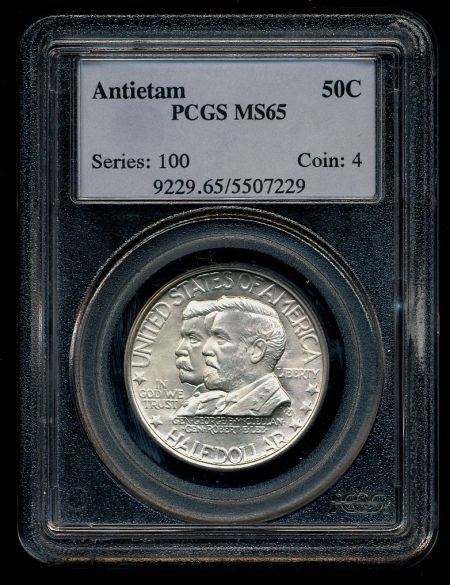
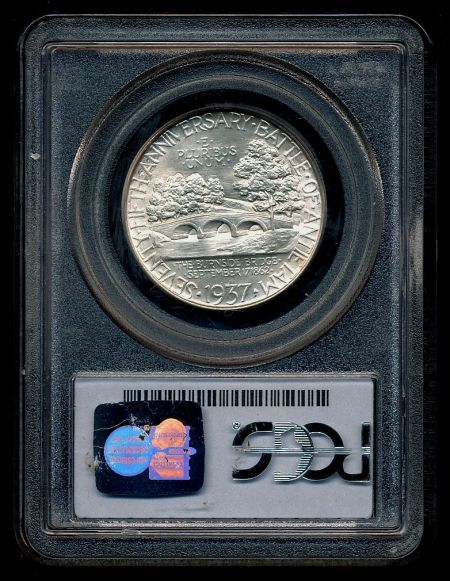
For more on the 1937 Battle of Antietam commemorative, check out my previous post about it here:
1937 Battle of Antietam Half DollarAlso,
Read More: Commems Collection 





 Posted 12/20/2020 9:33 pm





