NGC - A counterfeiter relied on artificial toning and new production techniques to create a colorful fake.Virtually any 1893-dated
Morgan silver dollar has undeniable allure. The low-mintage San Francisco issue of that year often is called the "King of
Morgan dollars." The main reason for its limited production there and at other U.S. Mint facilities was the repeal of the silver-purchasing clause contained in the Act of July 14, 1890. Without the ability to buy silver, the mint ceased production of dollars in San Francisco and New Orleans in January 1893; in Philadelphia in April; and in Carson City in May. These dates relate closely to the coins' mintages at those facilities: 100,000 (San Francisco), 300,000 (New Orleans), 378,000 (Philadelphia) and 677,000 (Carson City).
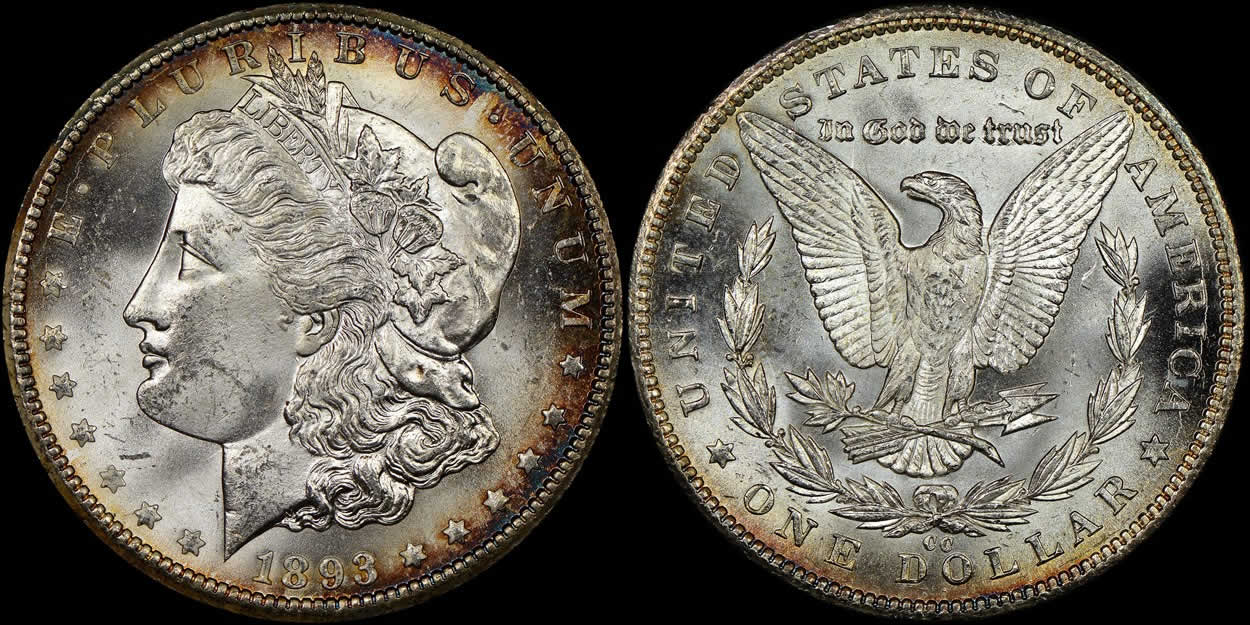
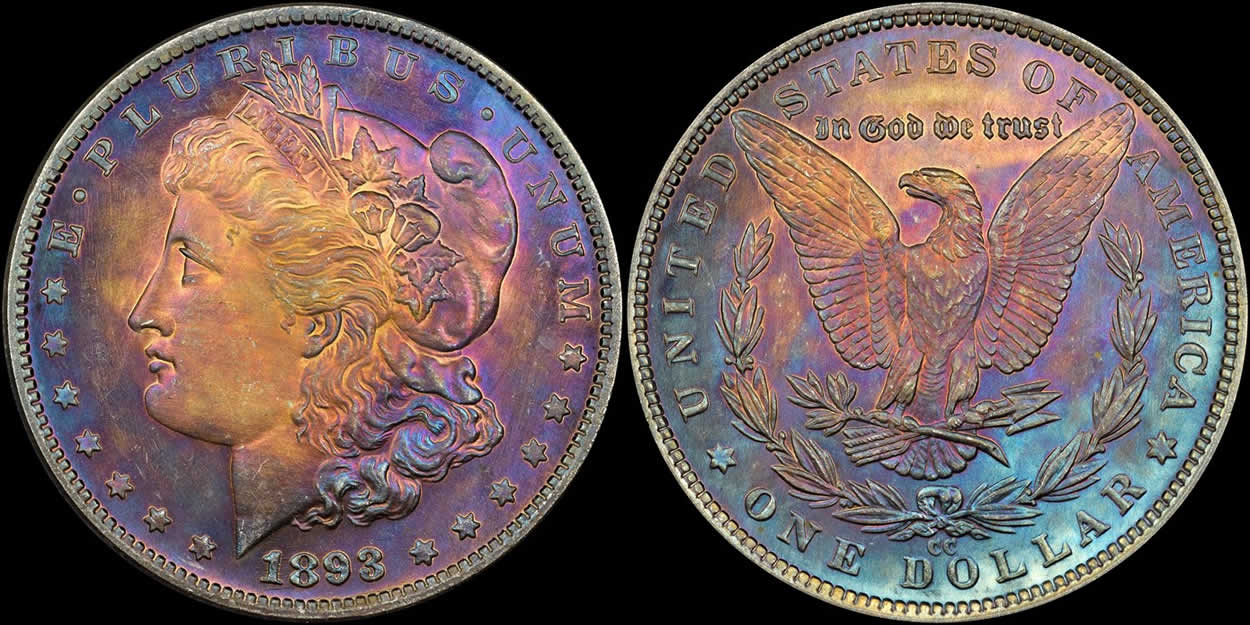 The artificially toned fake lacks the detail and natural appearance of the genuine specimen.
Even though the Carson City issue is the most common 1893
Morgan dollar, Mint State examples still are worth thousands. Recently, Numismatic Guaranty Corporation (NGC) graders noticed an 1893-CC Morgan with very interesting toning. The deep purple, orange and blue hues are not consistent with a naturally oxidized coin. As it turns out, the coin was artificially toned, likely in an attempt to mask its more obvious problems. A comparison with an authentic 1893-CC dollar (above) makes the ruse even more apparent. The genuine example has a much more natural look, with light toning emanating from the edges.
Aside from its colorful presentation, the fake lacks much of the detail of a real coin. Pay particular attention to the highest and lowest parts of the design: the hair above Liberty's face is particularly flat, while the shallow areas around the nostril and the hair above the date have been polished away.
Under magnification, the counterfeit is easily identified as such. The numerals of the date are uneven and blobby, with numerous large striations above and below. Additionally, toolmarks appear as spikes emerging from the bottom of Liberty's neck, directly above the "1."
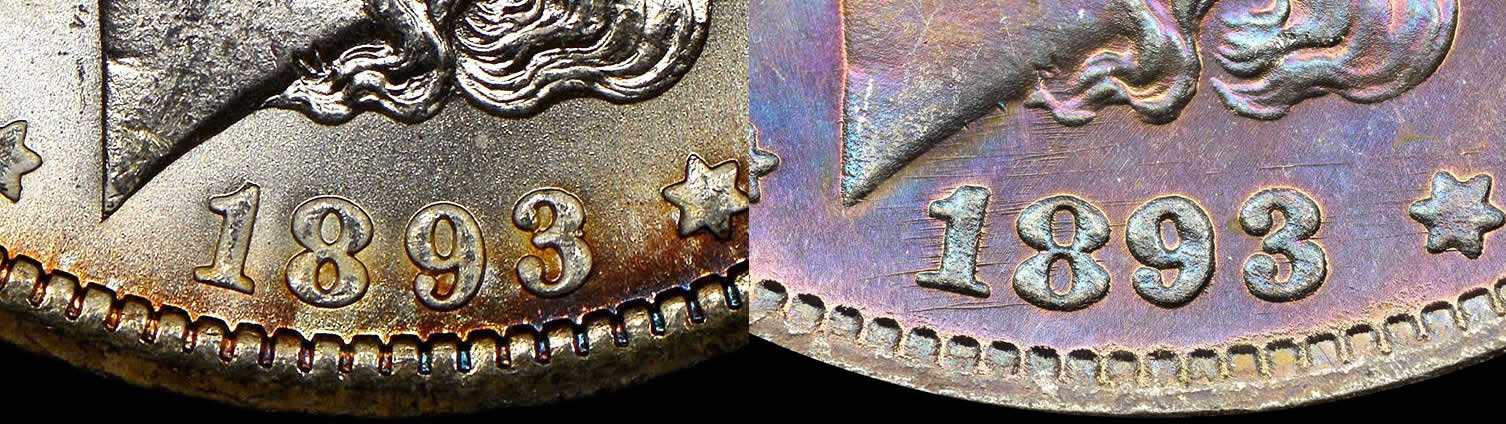 The numerals in the date on the counterfeit dollar are uneven and blobby, with unusual striations above and below. Also note the spikes emerging from the truncation of Liberty's neck.
The reverse displays very odd doubling on the word DOLLAR, which resulted from the laser apparently used to create the counterfeit die. The process created tiny overlapping circles on the letters' surfaces and imparted odd striations that are rotated about 45 degrees. Clearly, counterfeiters are employing new technologies to dupe unsuspecting collectors.
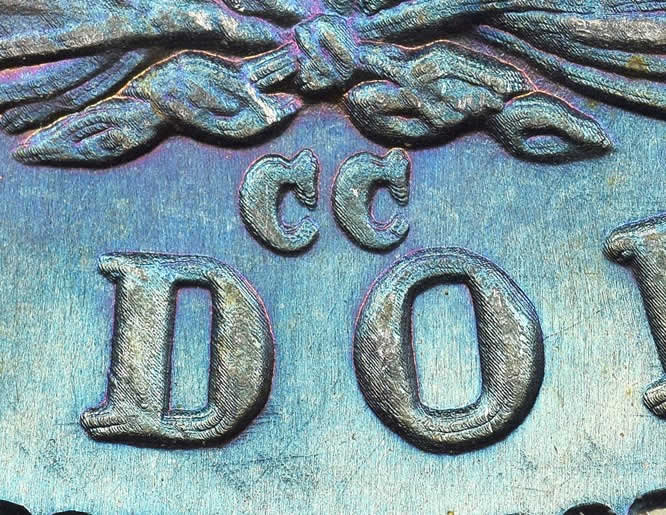 The doubling on the reverse of the counterfeit was caused by the laser used to produce the dies. Striations appear on the surfaces of the letters.Read More: Counterfeit Detection Series









 Posted 02/09/2021 05:28 am





