Coin Community Family of Web Sites
Shop CCF Members on eBay! Coin, Banknote and Medal Collectors's Online Mall Royal Canadian Mint products, Canadian, Polish, American, and world coins and banknotes. Specializing in Modern Numismatics Shop for APMEX Bullion on eBay!Vancouvers #1 Coin and Paper Money Dealer 300,000 items to help build your collection!


Username:
Password:
Save Password
Forgot your Password?


This page may contain links that result in small commissions to keep this free site up and running.

Welcome Guest! Registering and/or logging in will remove the anchor (bottom) ads. It's Free!

Commems Collection Classic: 1936 Bridgeport Centennial - Revisited

To participate in the forum you must log in or register.
Author Previous TopicReplies: 11 / Views: 1,980Next Topic  
CCF Master Historian of USA Commemoratives
Learn More...
commems's Avatar
United States
12252 Posts
 Posted 02/10/2021  4:48 pm Show Profile   Bookmark this topic Add commems to your friends list Get a Link to this Message Number of Subscribers
I previously discussed the 1936 half dollar that commemorates the 100th anniversary of the incorporation of Bridgeport, CT back in 2012; you can access it here: 1936 Bridgeport Centennial. I thought I would take another look at the coin by exploring its authorizing legislation a bit more deeply.

The bill calling for the Bridgeport commemorative half dollar was introduced in the Senate on March 10, 1936; it proposed that a maximum of 10,000 coins be struck. The bill was referred to the Senate's Committee on Banking and Currency, where a recommendation for an amendment in the form of a substitution was made. The amendment restricted the coin to one design to be struck at one mint, mandated that all coins struck bear the date "1936" and limited the coin's minting to one year from the date of enactment. (I've previously discussed similar substitution amendments for the Battle of Gettysburg, Delaware Tercentenary and Long Island Tercentenary half dollars. You can find them at Read More: Commems Collection.)

The amended bill was brought to the full Senate for consideration and was passed without issue; it was then sent to the House for consideration. The House referred the bill to its Committee on Coinage, Weights, and Measures which reported it out with two recommended changes: one to the coin's mintage and another to the ordering rules for the coin's sponsor, Bridgeport Centennial Incorporated.

Based on its Committee's recommendations, the House revised the bill's mintage figure from "not more than ten thousand" to "not less than 25,000." The House also removed the bill's language that enabled the coin's sponsor to request the coin in groups of as low as 5,000 over just a one-year period. By removing the language, the House's revision ensured that the minimum mintage of 25,000 would be struck and delivered in one batch, but it also opened up a potential loop hole regarding when the coin could be struck. Essentially, the bill's revised language would have allowed for a multi-year program to have been created if the sponsor believed sales so justified (as long as they ordered 25,000 each time/year).

The bill was signed into law on May 15, 1936 by President Roosevelt, but the Mint was not able to strike the coins until September; as would be expected, it struck all 25,000 coins that were authorized plus 15 additional reserved for assay. By the time it delivered them to the sponsor, the centennial celebrations were mostly over as the primary events took place in the June through September time frame. Despite this, coin sales proceeded at a good pace. In fact, W. B. Aurandt, the Managing Director of Bridgeport Centennial. Inc. reported in the November 1936 issue of The Numismatist, that sales had reached 18,000 coins and that "demand is continuing to be evident both from local and out-of-town reservations."

Fortunately, the Bridgeport Centennial group was not interested in a multi-year coin program and announced publicly that they would limit the coin's mintage to 25,000 and would not place additional orders.

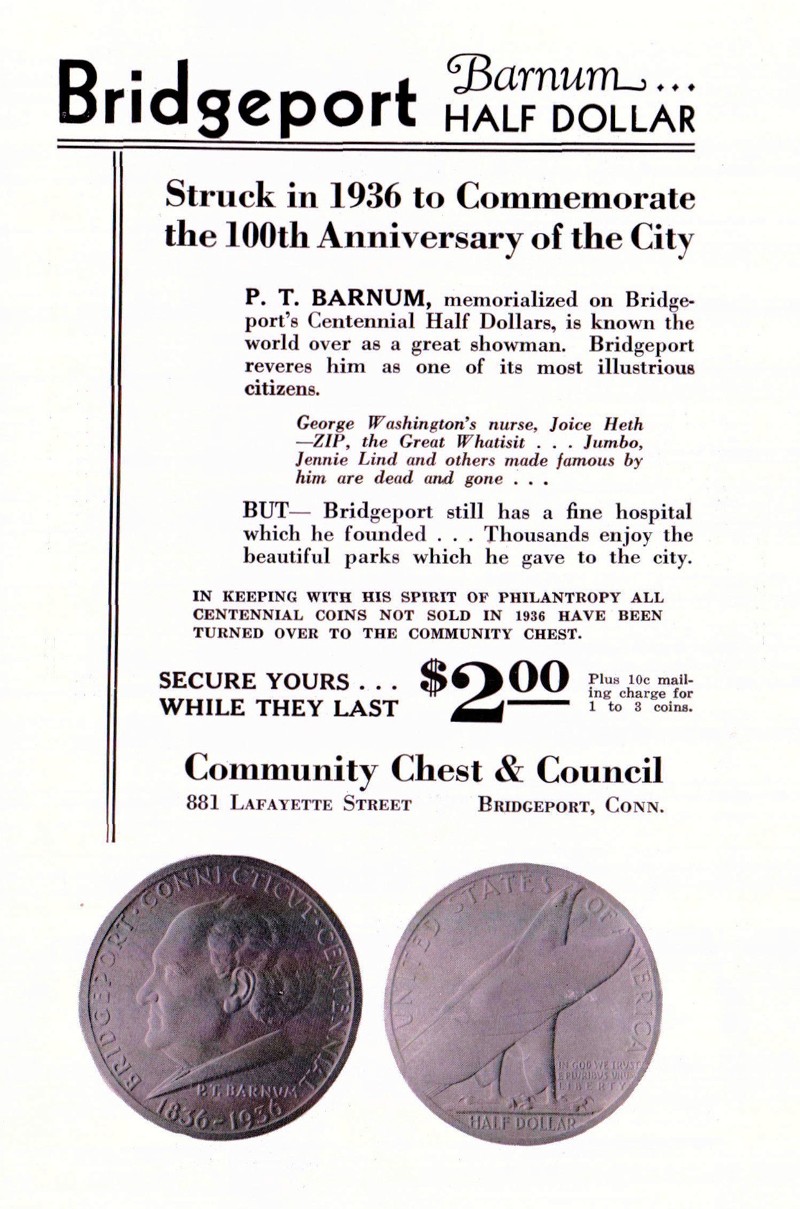
In the end, all of the 25,000 coins provided to Bridgeport Centennial, Inc. were sold/distributed by it - none were returned to the Mint to be melted. The vast majority of the coins were sold to collectors for $2.00 each, though a few thousand were later sold to the Community Chest and Council of Bridgeport. The Community Chest (the forerunner of today's United Way) announced in 1938 that it had purchased surplus coins from the Centennial group and that it planned to offer them for sale, presumably as a fundraiser for its charity efforts. It later sold many of the coins in bulk lots to dealers for a small advance over face value.

I'm sure the Bridgeport team was thankful they caught the commemorative wave before it crashed! Otherwise, sales of their coin would likely have gone much more slowly and proven to be much more difficult.

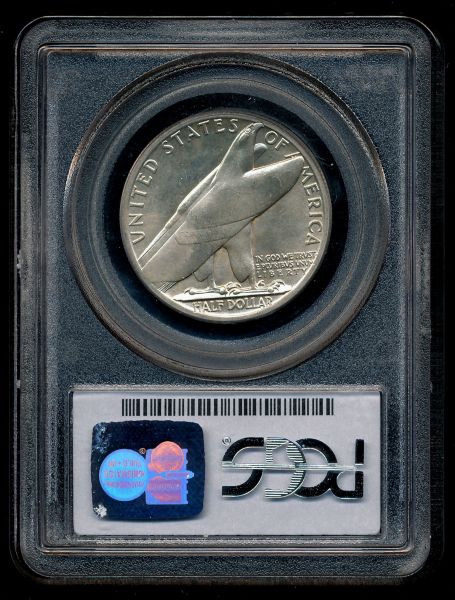
Here's my example:
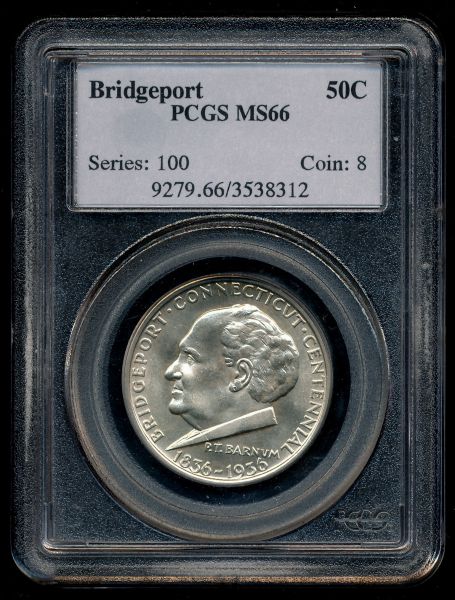
Commems-Collection-Classic:-1936-Bridgeport-Centennial---Revisited Commems-Collection-Classic:-1936-Bridgeport-Centennial---Revisited

I will say one thing for Henry Kreiss, the coin's designer, he did not let the coin's mandated inscriptions intrude into his overall design. The mottoes "In God We Trust," "E Pluribus Unum" and "Liberty" were all positioned in small letters in the lower right of the reverse - out of the way and nicely opening up the rest of the coin's surface areas for the design.


Collecting history one coin or medal at a time! (c) commems. All rights reserved.
Bedrock of the Community
Coinfrog's Avatar
United States
94367 Posts
 Posted 02/10/2021  5:10 pm  Show Profile   Bookmark this reply Add Coinfrog to your friends list Get a Link to this Reply
Great read as always, thanks. That Deco eagle is a triumph.
Moderator
Learn More...
jbuck's Avatar
United States
187582 Posts
CCF Master Historian of USA Commemoratives
Learn More...
commems's Avatar
United States
12252 Posts
 Posted 06/24/2023  07:02 am  Show Profile   Bookmark this reply Add commems to your friends list Get a Link to this Reply
As a further follow-up...

Here's a Community Chest advertisement from 1938 announcing its acquisition and sales offering of the 1936 Bridgeport, CT Centennial half dollars:

Commems-Collection-Classic:-1936-Bridgeport-Centennial---Revisited
(Image Credit: American Numismatic Association, The Numismatist, March, 1938. Fair use, education,)

For other of my posts about commemorative coins and medals, including other Bridgeport stories, see: Commems Collection.


Collecting history one coin or medal at a time! (c) commems. All rights reserved.
Edited by commems
06/24/2023 07:03 am
Moderator
Learn More...
nickelsearcher's Avatar
United States
15386 Posts
 Posted 06/24/2023  09:58 am  Show Profile   Bookmark this reply Add nickelsearcher to your friends list Get a Link to this Reply
I appreciate the follow-up on the legislative actions and the Community Chest sales efforts.

IMO Henry Kreis has provided two of the most icon Eagle images in the classic commemorative series - this coin and of course the reverse of the 1935 Connecticut half.
Take a look at my other hobby ... http://www.jk-dk.art
Pillar of the Community
Morgans Dad's Avatar
United States
5602 Posts
 Posted 06/24/2023  11:46 am  Show Profile   Bookmark this reply Add Morgans Dad to your friends list Get a Link to this Reply
"There's a sucker born every minute" — .......... Thanks....
Moderator
Learn More...
Dearborn's Avatar
United States
94728 Posts
 Posted 06/24/2023  12:26 pm  Show Profile   Bookmark this reply Add Dearborn to your friends list Get a Link to this Reply
Thanks for the great article commems.
That Eagle on the reverse is reminiscence of the militaristic eagles Germany used during WWII
Bedrock of the Community
Learn More...
HondoB's Avatar
United States
24905 Posts
 Posted 06/24/2023  1:37 pm  Show Profile   Bookmark this reply Add HondoB to your friends list Get a Link to this Reply
But really.... P.T. Barnum is Bridgeport's claim to fame? And this design was approved?

On another note, commems, your mintage figures always include a number of coins "reserved for assay". How were they assayed, and was it a destructive testing or were they simply melted afterwards?
Inordinately fascinated by bits of metal with strange markings and figures
Pillar of the Community
Morgans Dad's Avatar
United States
5602 Posts
 Posted 06/24/2023  3:17 pm  Show Profile   Bookmark this reply Add Morgans Dad to your friends list Get a Link to this Reply
Hondo,

I agree, This COMMEMORATIVE was Granted to the Legacy of a Marketing Genius..... Really !!!


I mean in My Opinion the Commemoratives I Love and Cherish like Most, Have been granted their " Day in the Commemorative History Books ", for a National, or State Wide Recognition , of Historic Value For America's Days Gone Bye, NO....
CCF Master Historian of USA Commemoratives
Learn More...
commems's Avatar
United States
12252 Posts
 Posted 06/24/2023  4:07 pm  Show Profile   Bookmark this reply Add commems to your friends list Get a Link to this Reply

Quote:
"There's a sucker born every minute"

While this may be true, there's a good chance that it wasn't PT Barnum that first uttered the phrase. Check out:

- Government Officials - Part III

and read past the images of the Bridgeport coin.


Quote:
But really... P.T. Barnum is Bridgeport's claim to fame?

The above post also addresses some of this this point, more can be found here:

- Coins And Medals With A Public Service Career Theme


Collecting history one coin or medal at a time! (c) commems. All rights reserved.
CCF Master Historian of USA Commemoratives
Learn More...
commems's Avatar
United States
12252 Posts
 Posted 06/24/2023  4:12 pm  Show Profile   Bookmark this reply Add commems to your friends list Get a Link to this Reply

Quote:
...your mintage figures always include a number of coins "reserved for assay". How were they assayed, and was it a destructive testing or were they simply melted afterwards?

The coins reserved for assay were divided, with individual groups subject to different tests to ensure they met purity and weight standards.

Selected coins were weighed on a special, high-precision, tightly-calibrated scale in the Philadelphia Mint that was accurate to 0.00 grains (not grams).

Purity/fineness tests, by their nature, were destructive and damaged the tested coins as metal samples were either taken from them (e.g., via drilling, cutting or shaving) or the entire coin was destroyed/melted for assay, including separation of molten metals via specific gravity.

In the end, after being handled by multiple Assay Commission members, the subject coins were destroyed/melted vs. released.


Collecting history one coin or medal at a time! (c) commems. All rights reserved.
Moderator
Learn More...
jbuck's Avatar
United States
187582 Posts
 Posted 06/26/2023  11:29 am  Show Profile   Bookmark this reply Add jbuck to your friends list Get a Link to this Reply

Quote:
As a further follow-up... Here's a Community Chest advertisement from 1938 announcing its acquisition and sales offering of the 1936 Bridgeport, CT Centennial half dollars:
Very nice!
  Previous TopicReplies: 11 / Views: 1,980Next Topic  

To participate in the forum you must log in or register.


Disclaimer: While a tremendous amount of effort goes into ensuring the accuracy of the information contained in this site, Coin Community assumes no liability for errors. Copyright 2005 - 2026 Coin Community Family- all rights reserved worldwide. Use of any images or content on this website without prior written permission of Coin Community or the original lender is strictly prohibited.
Contact Us  |  Advertise Here  |  Privacy Policy / Terms of Use

Coin Community Forum © 2005 - 2026 Coin Community Forums
It took 0.44 seconds to rattle this change. Forums